. 2017 Jan;222(1):61-70.
doi: 10.1007/s00429-016-1200-6. Epub 2016 Feb 20.

The anterior midcingulate cortex as a neural node underlying hostility in young adults

Affiliations

The anterior midcingulate cortex as a neural node underlying hostility in young adults

Seishu Nakagawa et al. Brain Struct Funct. 2017 Jan.

Abstract

Anger typically manifests for only a short period of time, whereas hostility is present for a longer duration. However, both of these emotions are associated with an increased likelihood of psychological problems. The nodes within the neural networks that underlie hostility remain unclear. We presumed that specific nodes might include the anterior midcingulate cortex (aMCC), which seems to be essential for the cognitive aspects of hostility. Thus, the present study first evaluated the associations between regional gray matter density (rGMD) and hostility in 777 healthy young students (433 men and 344 women; 20.7 ± 1.8 years of age) using magnetic resonance imaging and the hostile behaviors subscale (HBS) of the Coronary-prone Type Scale (CTS) for Japanese populations. The HBS scores were positively correlated with rGMD in the aMCC and in widespread frontal regions from the dorsomedial/dorsolateral prefrontal cortices to the lateral premotor cortex at the whole-brain level. No significant correlation was observed between rGMD and the conjunction of HBS and Trait Anger/Anger-Out scores. Furthermore, no significant interaction effects of sex and HBS scores on rGMD were revealed, although the HBS scores of males were significantly higher than those of females. The present findings indicate that the neural correlates of hostility appear to be more distinct in rGMD than those of anger due to differences and duration.

Keywords: Anger-Out; Anger-Trait; Hostile behaviors subscale (HBS); Regional gray matter density (rGMD).


Conflict of interest statement

There are no conflicts of interest to declare.

Figures
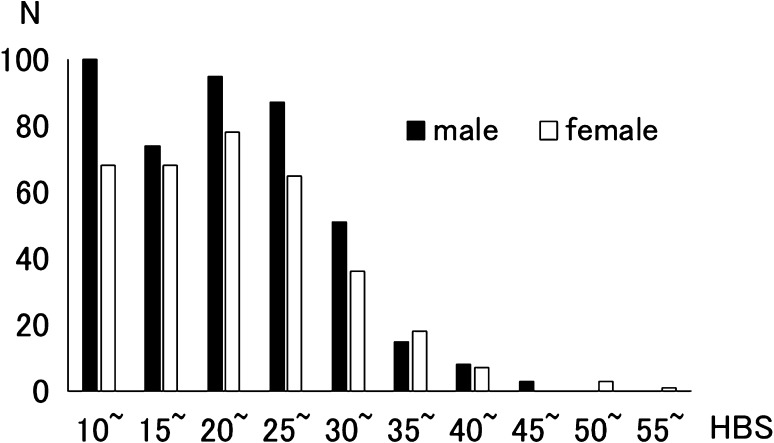
Fig. 1
Fig. 1
Distributions of HBS scores according to sex. Histogram separately displaying the distributions of scores of the hostile behaviors subscale (HBS) of the Coronary-prone Type Scale (CTS). Males: filled square, females empty square. N number of subjects
Fig. 2
Fig. 2
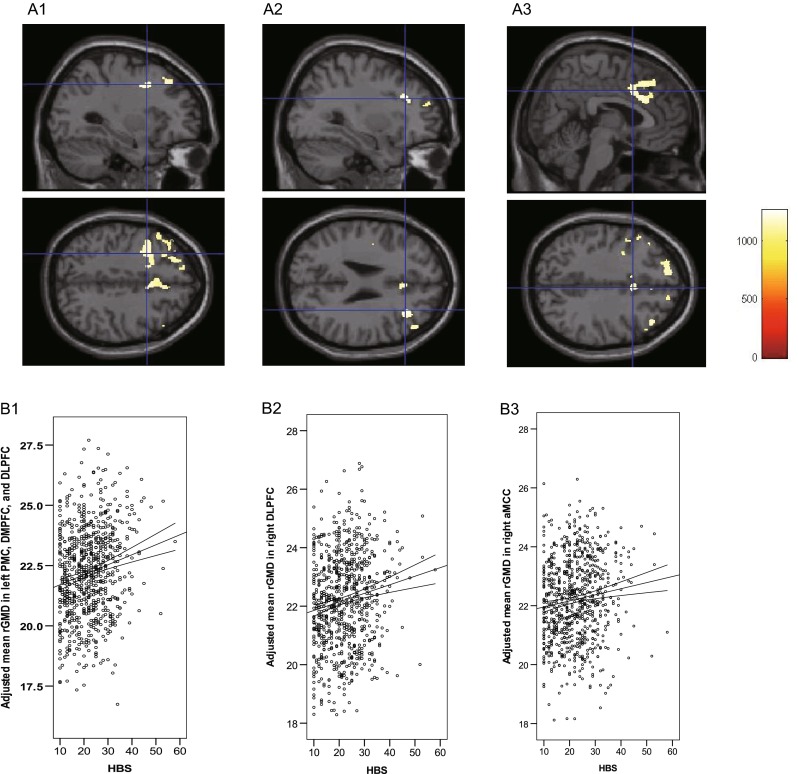
Brain regions exhibiting a correlation between mean rGMD and HBS scores. Multiple regression analyses were performed on the hostile behavior subscale (HBS) scores using sex, age, RAPM score, total intracranial volume [TIV; total gray matter (GM) volume + total white matter (WM) volume + total cerebrospinal fluid (CSF) volume], and Trait Anger (T-Anger) and Anger-Out scores as additional covariates. The red-to-yellow color scale indicates the t score of the positive correlation between the mean regional gray matter density (rGMD) values and the scores on the HBS [P < 0.05, two-tailed threshold-free cluster enhancement (TFCE) corrected with a family-wise error (FWE)]. Regions showing correlations were overlaid on a single T1-weighted image using the SPM8 toolbox. Areas with significant correlations included widespread regions mainly in the (A1) left frontal cortex from the left dorsomedial and dorsolateral prefrontal cortices (DMPFC/DLPFC), including the left premotor cortex (PMC), (A2) the right DLPFC, and (A3) anterior midcingulate cortex (aMCC). Residual plots with trend lines depicting the correlations between residuals in the multiple regression analyses with HBS scores as the dependent variable and other confounding factors as the independent variables; 95 % confidence intervals for the trend line are shown. The mean rGMD values for the significant clusters (B1) in the left PMC, DMPFC, and DLPFC; (B2) the right DLPFC; and (B3) the right aMCC

References

    1. Angerer P, Siebert U, Kothny W, Muhlbauer D, Mudra H, von Schacky C. Impact of social support, cynical hostility and anger expression on progression of coronary atherosclerosis. J Am Coll Cardiol. 2000;36(6):1781–1788. doi: 10.1016/S0735-1097(00)00944-X. - DOI - PubMed
    1. Bishop GD, Quah S-H. Reliability and validity of measures of anger/hostility in singapore: Cook & Medley Ho Scale, STAXI and Buss-Durkee hostility inventory. Personal Individ Differ. 1998;24(6):867–878. doi: 10.1016/S0191-8869(98)00024-5. - DOI
    1. Bissonette GB, Powell EM, Roesch MR. Neural structures underlying set-shifting: roles of medial prefrontal cortex and anterior cingulate cortex. Behav Brain Res. 2013;250:91–101. doi: 10.1016/j.bbr.2013.04.037. - DOI - PMC - PubMed
    1. Botvinick MM. Conflict monitoring and decision making: reconciling two perspectives on anterior cingulate function. Cognit Affect Behav Neurosci. 2007;7(4):356–366. doi: 10.3758/CABN.7.4.356. - DOI - PubMed
    1. Boylan JM, Ryff CD. Varieties of anger and the inverse link between education and inflammation: toward an integrative framework. Psychosom Med. 2013;75(6):566–574. doi: 10.1097/PSY.0b013e31829683bd. - DOI - PMC - PubMed

Publication types

LinkOut - more resources