


Editorial
doi: 10.1186/s12931-016-0337-4.
Endothelial to mesenchymal transition (EndMT): an active process in Chronic Obstructive Pulmonary Disease (COPD)?
Affiliations
- PMID: 26898357
- PMCID: PMC4762171
- DOI: 10.1186/s12931-016-0337-4
Item in Clipboard
Editorial
Endothelial to mesenchymal transition (EndMT): an active process in Chronic Obstructive Pulmonary Disease (COPD)?
Respir Res.
.
Abstract
Small airway fibrosis is the main contributor to physiological airway dysfunction in COPD. One potential mechanism contributing to small airway fibrosis is epithelial mesenchymal transition (EMT). When associated with angiogenesis (so called EMT-Type-3) it may well also be the link with the development of airway epithelial cancer, which is closely associated with COPD and predominantly in large airways. In a recent study published in Respiratory Research, Reimann and colleagues, showed increased expression of S100A4 in vasculature of human COPD and murine lungs. It is quite possible that the process of endothelial to mesenchymal transition (EndMT) is active in COPD lungs which we wish to comment on.
Figures
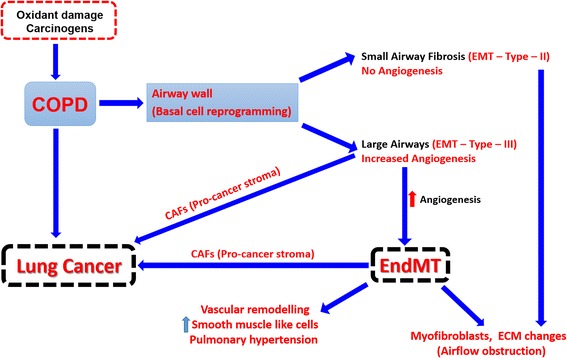
Potential contribution of epithelial mesenchymal transition (EMT) and endothelial mesenchymal transition (EndMT) to pathogenies of COPD and its linkage to lung cancer through formation of pro-cancer stroma
References
-
- Mitchell RS, Filley GF. Chronic obstructive bronchopulmonary disease. I Clinical Features. Am Rev Respir Dis. 1964;89:360–71. - PubMed
-
- Nowrin K, Sohal SS, Peterson G, Patel R, Walters EH. Epithelial-mesenchymal transition as a fundamental underlying pathogenic process in COPD airways: fibrosis, remodeling and cancer. Expert Rev Respir Med. 2014;8(5):547–59. - PubMed
-
- Mahmood MQ, Sohal SS, Shukla SD, Ward C, Hardikar A, Noor WD, Muller HK, Knight DA, Walters EH. Epithelial mesenchymal transition in smokers: large versus small airways and relation to airflow obstruction. Int J Chron Obstruct Pulmon Dis. 2015;10:1515–24. doi: 10.2147/COPD.S81032. - DOI - PMC - PubMed
Publication types
MeSH terms
LinkOut - more resources
Full Text Sources
Other Literature Sources
Medical
Research Materials
