


Prevalence of antibodies to Rickettsia conorii in human beings and dogs from Catalonia: a 20-year perspective
- PMID: 26899636
- PMCID: PMC9150624
- DOI: 10.1017/S0950268816000261
Prevalence of antibodies to Rickettsia conorii in human beings and dogs from Catalonia: a 20-year perspective
Abstract
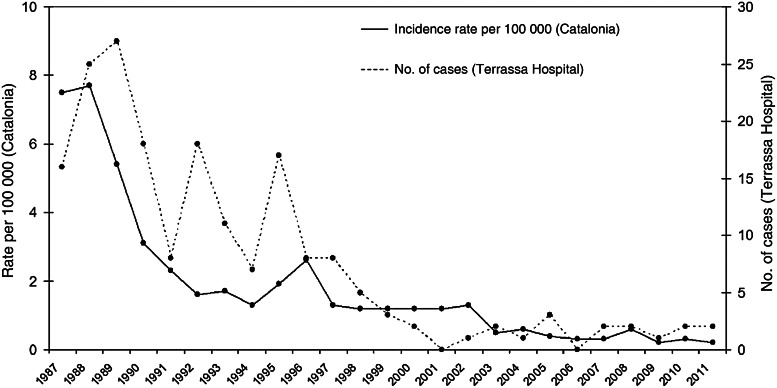
The incidence of Mediterranean spotted fever (MSF) in Catalonia (Spain) has decreased in the last two decades. The prevalence of antibodies to Rickettsia conorii in human beings and dogs in the region of Vallès Occidental (Catalonia) was assessed by indirect immunofluorescence, and the results compared with those obtained in a similar study from 1987. Nineteen (5·0%) out of 383 human serum samples had antibodies to R. conorii. This seroprevalence was significantly lower (11·5%) (P = 0·003) than that recorded in the 1987 survey. Forty-two out (42·0%) of 100 canine serum samples had antibodies to R. conorii. A high proportion of the studied dogs (91·0%) were receiving anti-tick treatment, mainly with permethrin-imidacloprid spot-on (Advantix, Bayer, Germany). The current canine seroprevalence was not significantly different from that recorded in the 1987 survey (36.9%). In conclusion, this study shows a significant decrease in the prevalence of antibodies to R. conorii in the human population of Catalonia in the last 20 years, which corresponds with a decrease in the number of cases of MSF. We suggest that the widespread use of anti-tick treatment in dogs could limit the introduction of ticks to humans due to a reduction of infestation duration in dogs, thus contributing to the decrease in MSF incidence.
Keywords: Dogs; Mediterranean spotted fever; Rickettsia conorii; seroprevalence; tick-borne disease.
Figures
References
-
- Font-Creus B, et al. Mediterranean spotted fever: a cooperative study of 227 cases. Reviews of Infectious Diseases 1985; 7: 635–642. - PubMed
-
- Rovery C, Raoult D. Mediterranean spotted fever. Infectious Disease Clinics of North America 2008; 22: 515–530. - PubMed
-
- Gilot B, et al. Relationships between the Rhipicephalus sanguineus complex ecology and Mediterranean spotted fever epidemiology in France. European Journal of Epidemiology 1990; 6: 357–362. - PubMed
-
- Font Creus B, et al. Mediterranean boutonneuse fever. Study of 246 cases. Medicina Clínica 1991; 96: 121–125. - PubMed
Publication types
MeSH terms
Substances
LinkOut - more resources
Full Text Sources
Other Literature Sources
Miscellaneous
