


A randomized, placebo-controlled pilot trial of armodafinil for fatigue in patients with gliomas undergoing radiotherapy
- PMID: 26902850
- PMCID: PMC4864265
- DOI: 10.1093/neuonc/now007
A randomized, placebo-controlled pilot trial of armodafinil for fatigue in patients with gliomas undergoing radiotherapy
Abstract
Background: Fatigue is common among glioma patients undergoing radiotherapy (RT) and impacts quality of life (QOL). We evaluated whether armodafinil, a wakefulness-promoting medication, improves fatigue in glioma patients undergoing RT.
Methods: Eligibility criteria included age ≥18 years, Karnofsky performance status ≥60, and grade 2-4 glioma undergoing RT to a total dose of 50-60 Gy. Patients were randomized 1:1 to armodafinil or placebo for 8 weeks beginning within 10 days of starting RT. Fatigue and QOL were assessed at baseline, day 22, day 43, and day 56 with the Functional Assessment of Chronic Illness Therapy - Fatigue (FACIT-F), the Functional Assessment of Cancer Therapy - General (FACT-G), the Brief Fatigue Inventory (BFI), and the Cancer Fatigue Scale (CFS). The primary aim was to detect a difference in the 42-day change in FACIT-F fatigue subscale between the 2 groups using a 2-sample Wilcoxon statistic.
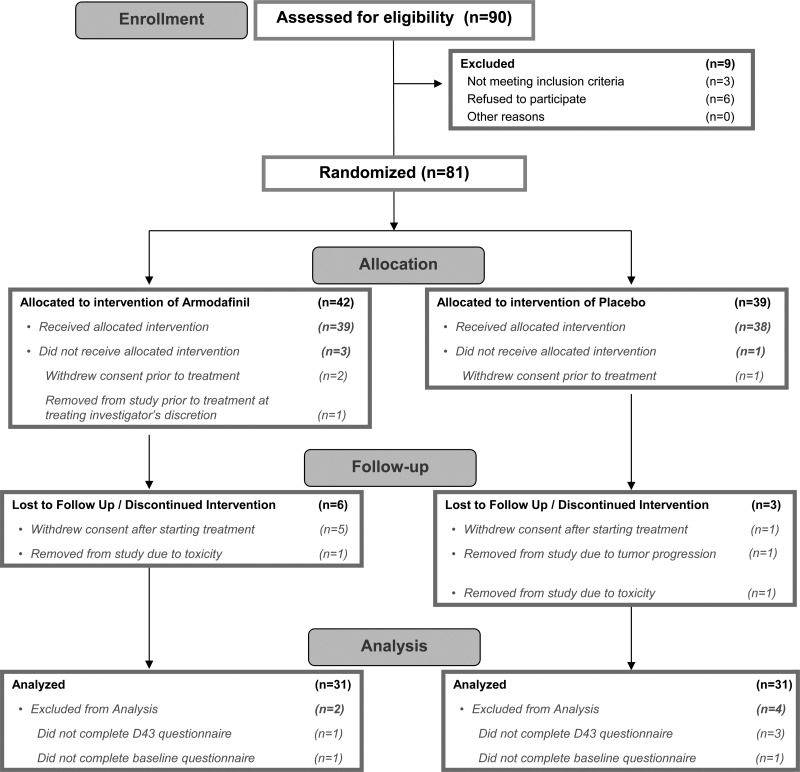
Results: We enrolled 81 patients total (42 armodafinil and 39 placebo). Armodafinil did not significantly improve fatigue or QOL based on the 42-day change in FACIT-F fatigue subscale, FACT-G, CFS, or BFI. Further analysis suggests no difference between the arms even after accounting for the potential bias of missing data. Treatment was well tolerated with few grade 3 or 4 toxicities.
Conclusions: While treatment was well-tolerated, an 8-week course of armodafinil did not improve fatigue or QOL in glioma patients undergoing RT in this pilot study. Further studies are needed to determine whether pharmacologic treatment improves fatigue in glioma patients undergoing RT.
Keywords: armodafinil; clinical trial; fatigue; glioblastoma; glioma.
© The Author(s) 2016. Published by Oxford University Press on behalf of the Society for Neuro-Oncology. All rights reserved. For permissions, please e-mail: journals.permissions@oup.com.
Comment in
-
Fatigue randomized controlled trials-how tired is "too tired" in patients undergoing glioma treatment?Neuro Oncol. 2016 Jun;18(6):759-60. doi: 10.1093/neuonc/now052. Epub 2016 Apr 3. Neuro Oncol. 2016. PMID: 27044296 Free PMC article. No abstract available.
References
-
- Lovely M, Miaskowski C, Dodd M. Relationship between fatigue and quality of life in patients with glioblastoma multiformae . Oncol Nurs Forum. 1999;26(5):921–925. - PubMed
-
- Cella DF, Tulsky DS, Gray G et al. The Functional Assessment of Cancer Therapy scale: development and validation of the general measure. J Clin Oncol. 1993;11(3):570–579. - PubMed
Publication types
MeSH terms
Substances
LinkOut - more resources
Full Text Sources
Other Literature Sources
Medical
