. 2016 Feb 8:7:99.
doi: 10.3389/fmicb.2016.00099. eCollection 2016.

Hydrogenase Gene Distribution and H2 Consumption Ability within the Thiomicrospira Lineage

Affiliations

Hydrogenase Gene Distribution and H2 Consumption Ability within the Thiomicrospira Lineage

Moritz Hansen et al. Front Microbiol. .

Abstract

Thiomicrospira were originally characterized as sulfur-oxidizing chemolithoautotrophs. Attempts to grow them on hydrogen failed for many years. Only recently we demonstrated hydrogen consumption among two of three tested Thiomicrospira and posited that hydrogen consumption may be more widespread among Thiomicrospira than previously assumed. Here, we investigate and compare the hydrogen consumption ability and the presence of group 1 [NiFe]-hydrogenase genes (enzyme catalyzes H2↔2H(+) + 2e(-)) for sixteen different Thiomicrospira species. Seven of these Thiomicrospira species encoded group 1 [NiFe]-hydrogenase genes and five of these species could also consume hydrogen. All Thiomicrospira species exhibiting hydrogen consumption were from hydrothermal vents along the Mid-Atlantic ridge or Eastern Pacific ridges. The tested Thiomicrospira from Mediterranean and Western Pacific vents could not consume hydrogen. The [NiFe]-hydrogenase genes were categorized into two clusters: those resembling the hydrogenase from Hydrogenovibrio are in cluster I and are related to those from Alpha- and other Gammaproteobacteria. In cluster II, hydrogenases found exclusively in Thiomicrospira crunogena strains are combined and form a monophyletic group with those from Epsilonproteobacteria suggesting they were acquired through horizontal gene transfer. Hydrogen consumption appears to be common among some Thiomicrospira, given that five of the tested sixteen strains carried this trait. The hydrogen consumption ability expands their competitiveness within an environment.

Keywords: Thiomicrospira; [NiFe]-hydrogenases; biogeography; horizontal gene transfer; hydrogen consumption.


Figures
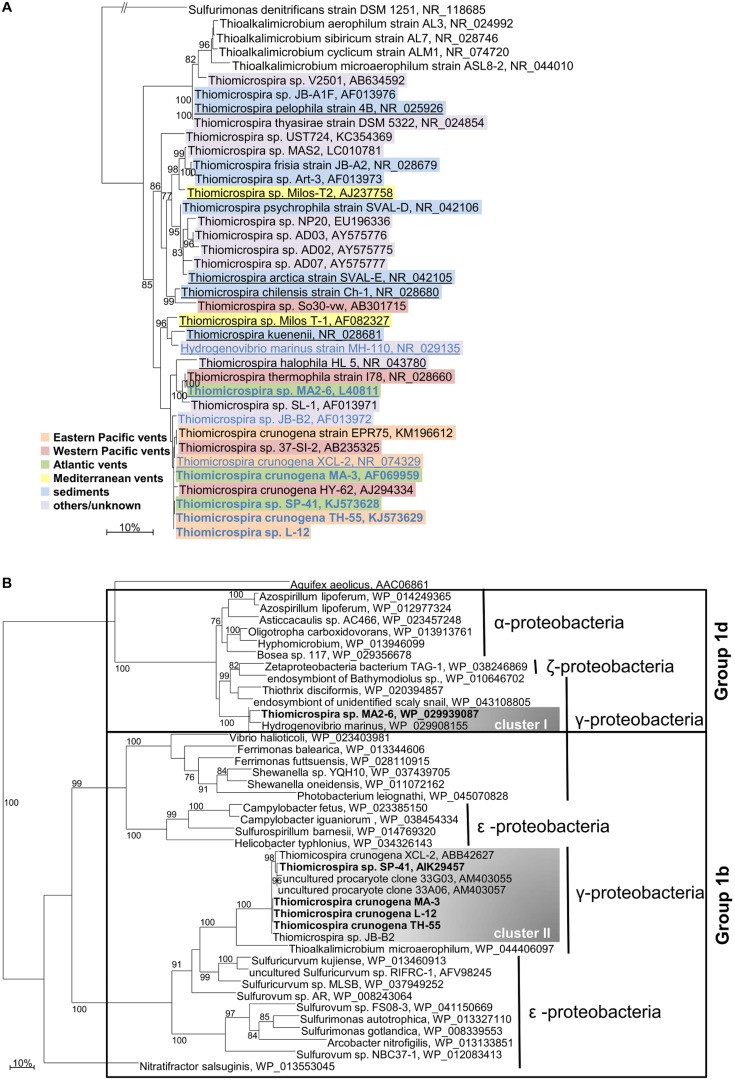
FIGURE 1
FIGURE 1
Phylogenetic relationship of Thiomicrospira species. (A) 16S rRNA genes. Thiomicrospira species are color-coded according to their isolation source. Species that are underlined indicate that genomic sequence data is available. Species for which a hynL gene is known are written in blue, those which consumed hydrogen in our experiments are written in bold. (B) [NiFe]-hydrogenase large subunit genes (hynL). Species which consumed hydrogen in our experiments are written in bold. Only bootstrap values ≥ 75 are given. The scale bar represents the expected number of changes per (A) nucleotide and (B) amino acid. Classification in (B) is according to Greening et al. (2015). Aquifex aeolicus’ [NiFe]-hydrogenase belongs to group 1e.
FIGURE 2
FIGURE 2
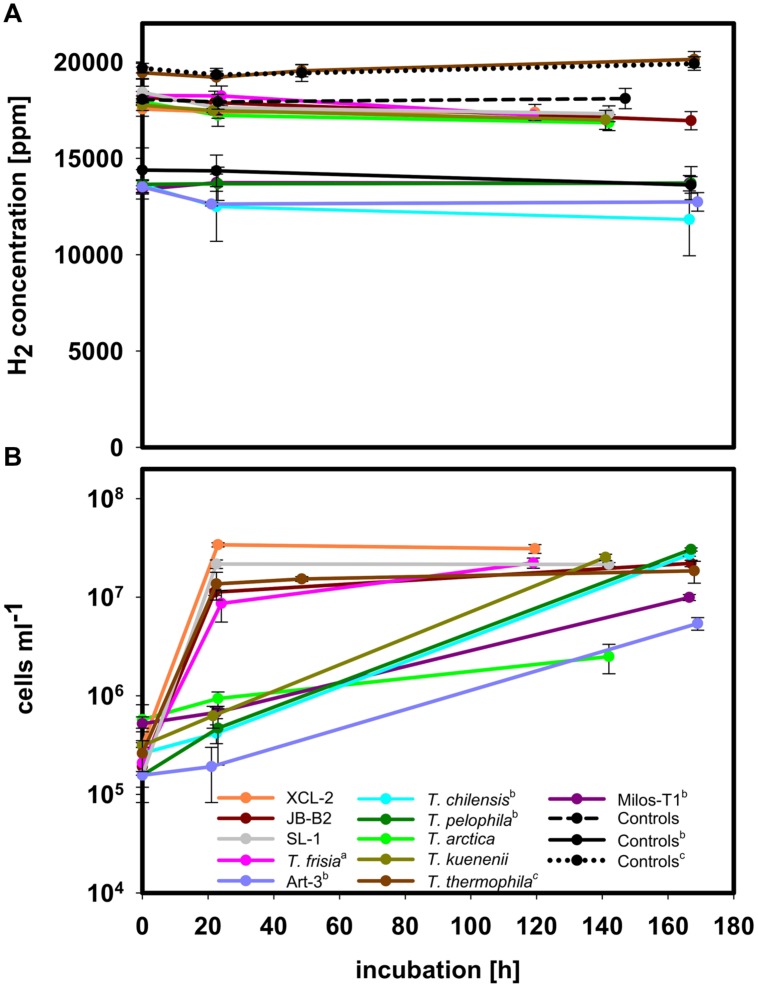
H2 consumption experiments with species not consuming hydrogen under incubation conditions. (A) H2 concentration in the headspace during incubation. (B) Cell density during incubation of the respective species. All experiments were performed at 28°C except for T. arctica and T. thermophila, which were undertaken at 10°C and 37°C, respectively. Experiments were performed in MJ-T medium under an atmosphere of H2:CO2:O2:He (2:20:1:77) or (a) in Tp medium with added Ni and Fe to give the respective concentrations as in MJ-T medium under an atmosphere of H2:CO2:O2:He (2:20:1:77) or (b) in Tp medium with Ni and Fe and in air with added H2 to give a final concentration of approximately 1.5% hydrogen. For the H2:CO2:O2:He gas mix two sets of controls, non-inoculated medium treated the same way as the samples, are shown as broken and dotted black line, respectively, and controls for the mixture of air and H2 one set of controls is shown. (c) Data from Hansen and Perner (2015).
FIGURE 3
FIGURE 3
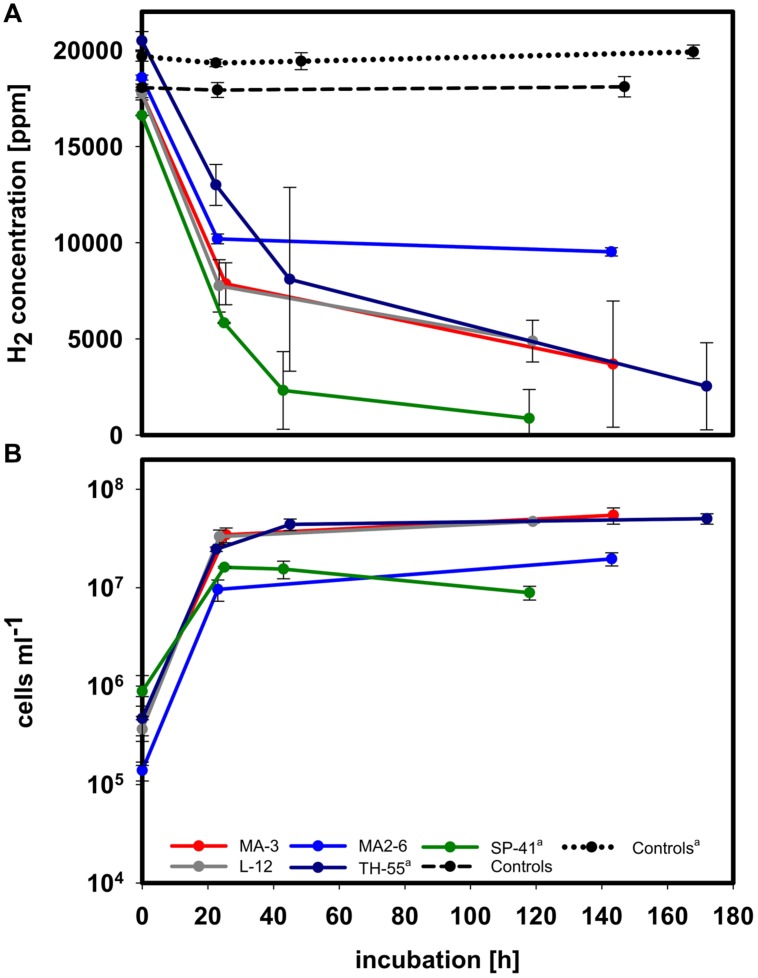
H2 consumption measurements in MJ-T medium and under an atmosphere of H2:CO2:O2:He (2:20:1:77). All experiments were performed at 28°C. (A) H2 concentration in the headspace of all hydrogen consuming species during incubation. (B) Cell density during incubation of the respective species. Exemplarily two sets of controls, non-inoculated medium treated the same way as the samples, are shown. (a) Data from Hansen and Perner (2015).
FIGURE 4
FIGURE 4
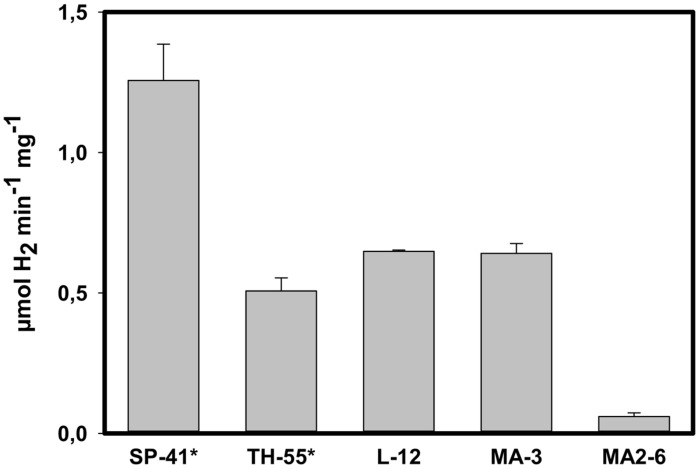
Hydrogen uptake activity in partially purified proteins of the H2 consuming Thiomicrospira species. The activity was located in the 30–50% ammonium sulfate fraction, i.e., solubilized membrane associated proteins precipitating between 30 and 50% ammonium sulfate saturation. Data from Hansen and Perner (2015).
FIGURE 5
FIGURE 5
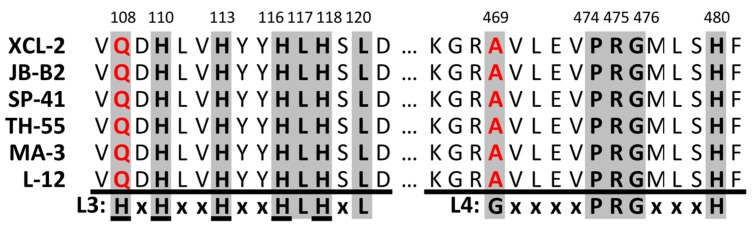
Sequence alignment of cluster II hydrogenases. Shown are the areas of the L3 and L4 motif and the histidine-rich region, respectively. The L3 and L4 motifs are shown in bold below the alignment, amino acids from the histidine-rich region are underlined. An x represents any amino acid, a gray background denotes the positions of conserved amino acids whereas amino acids marked in red indicate differences to the conserved motifs. Amino acid numbering is according to XCL-2.

References

    1. Ahmad A., Barry J. P., Nelson D. C. (1999). Phylogenetic affinity of a wide, vacuolate, nitrate-accumulating Beggiatoa sp. from monterey canyon, California, with Thioploca spp. Appl. Environ. Microbiol. 65 270–277. - PMC - PubMed
    1. Albracht S. P. J. (1994). Nickel hydrogenases: in search of the active site. Biochim. Biophys. Acta 1188 167–204. 10.1016/0005-2728(94)90036-1 - DOI - PubMed
    1. Bell G. R., LeGall L., Peck H. D. (1974). Evidence for the periplasmic location of hydrogenase in Desulfovibrio gigas. J. Bacteriol. 120 994–997. - PMC - PubMed
    1. Bernhard M., Friedrich B., Siddiqui R. A. (2000). Ralstonia eutropha TF93 is blocked in tat-mediated protein export. J. Bacteriol. 182 581–588. 10.1128/JB.182.3.581-588.2000 - DOI - PMC - PubMed
    1. Brazelton W. J., Baross J. A. (2010). Metagenomic comparison of two Thiomicrospira lineages inhabiting contrasting deep-sea hydrothermal environments. PLoS ONE 5:e13530 10.1371/journal.pone.0013530 - DOI - PMC - PubMed

LinkOut - more resources