. 2016 Mar 1;14(8):1841-9.
doi: 10.1016/j.celrep.2016.01.069. Epub 2016 Feb 18.

c21orf59/kurly Controls Both Cilia Motility and Polarization

Affiliations

c21orf59/kurly Controls Both Cilia Motility and Polarization

Kimberly M Jaffe et al. Cell Rep. .

Abstract

Cilia are microtubule-based projections that function in the movement of extracellular fluid. This requires cilia to be: (1) motile and driven by dynein complexes and (2) correctly polarized on the surface of cells, which requires planar cell polarity (PCP). Few factors that regulate both processes have been discovered. We reveal that C21orf59/Kurly (Kur), a cytoplasmic protein with some enrichment at the base of cilia, is needed for motility; zebrafish mutants exhibit characteristic developmental abnormalities and dynein arm defects. kur was also required for proper cilia polarization in the zebrafish kidney and the larval skin of Xenopus laevis. CRISPR/Cas9 coupled with homologous recombination to disrupt the endogenous kur locus in Xenopus resulted in the asymmetric localization of the PCP protein Prickle2 being lost in mutant multiciliated cells. Kur also makes interactions with other PCP components, including Disheveled. This supports a model wherein Kur plays a dual role in cilia motility and polarization.

Keywords: Kurly (Kur); c21orf59; cilia; ciliopathy; disheveled; multiciliated cell; planar cell polarity; primary ciliary dyskinesia.


Figures

Figure 1
Figure 1. kur Mutants Harbor Mutations in c21orf59 and Exhibit Defects Characteristic of Defective Cilia Motility
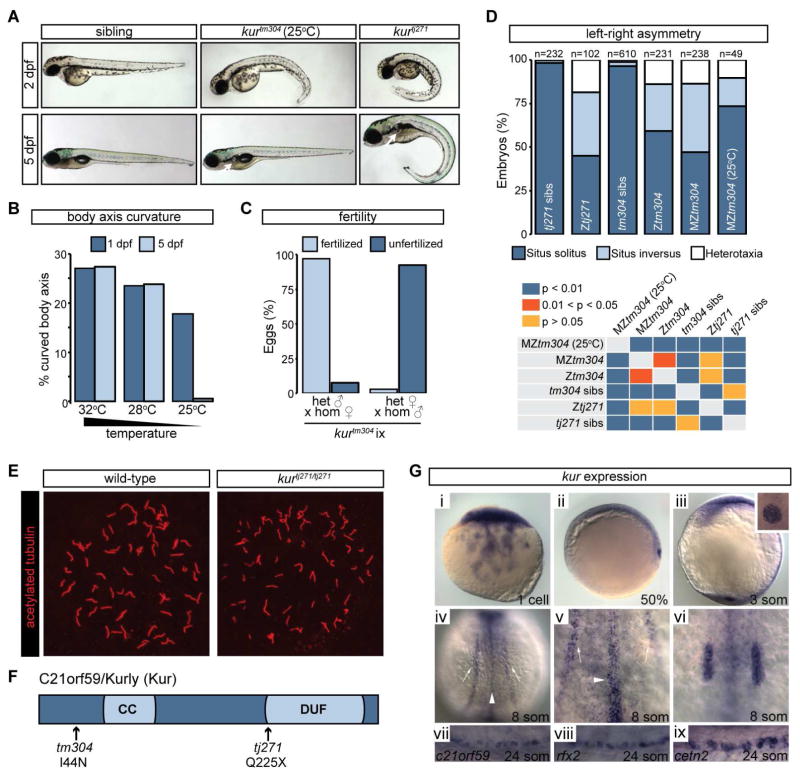
(A) Lateral views of zebrafish sibling control embryos and kurtm304 and kurtj271 mutants at 2 dpf and 5 dpf. At 25°C, kurtm304 mutants exhibit early body axis defects that resolve by 5 dpf whereas kurtj271 mutants do not resolve their body curvatures. Both mutants exhibit kidney cysts (white arrows) but the penetrance is variable in kurtm304/tm304 at 25°C. (B) Embryos from kur+/tm304 intercrosses were raised at 32°C, 28°C, or 25°C and were scored for body curvature defects at 1 dpf and 5 dpf. Whilst abnormalities were present in around 25% of embryos at 32°C and 28°C, mutants raised at 25°C exhibited fewer incidences of axis curvature at 1 dpf and almost all mutants had recovered at 5 dpf. The total number of embryos examined was 32°C n=292; 28°C n=332; and 25°C n=341. Shown is the average percentage of embryos with curved body axis from 4 biological replicates. (C) Fertility of kurtm304 adult mutants was assessed by scoring the number of fertilized eggs following homozygous female crosses to heterozygous males and vice versa. Shown is the average percentage of embryos fertilized from 3 biological replicates. (D) Percentage of embryos showing the indicated situs phenotypes. Embryos were processed by ISH for myl7, ins and fkd2 to mark the heart, pancreas, and liver, respectively, at 2 dpf. Statistical comparison of different genotypes was performed using chi-square analysis with p < 0.05 being considered to report significant differences. (E) Early somite stage embryos were processed for immunostaining using acetylated alpha-tubulin antibodies to mark the ciliary axoneme. Confocal imaging of KV revealed the presence of cilia in sibling control embryos as well as MZkurtm304 mutants and c21orf59 morphants. (F) Schematic diagram of C21orf59/Kurly (Kur) protein showing the approximate positions of the predicted coiled coil (CC) domain and the domain of unknown function (DUF). The position and nature of the kurtm304 (I44N) and kurtj271 (Q225X) mutations are shown. (G) kur expression in zebrafish embryos at the stages indicated. kur is provided maternally at the 1-cell stage (i) followed by expression in the DFCs at 50% epiboly (ii). Expression is observed in KV (iii), pictured here at the 3-somite stage with a close-up of KV in the inset. During somitogenesis, kur is expressed in tissues with motile cilia including the pronephros (white arrows), the floorplate of the neural tube (white arrowheads) and the otic vesicles (iv–vi). Expression in the pronephros at the 24-somite stage overlaps with MCC markers rfx2 and cetn2 (vii–ix).
Figure 2
Figure 2. Kur is a Cytoplasmic Factor Required for the Localization of ODAs to the Cilium
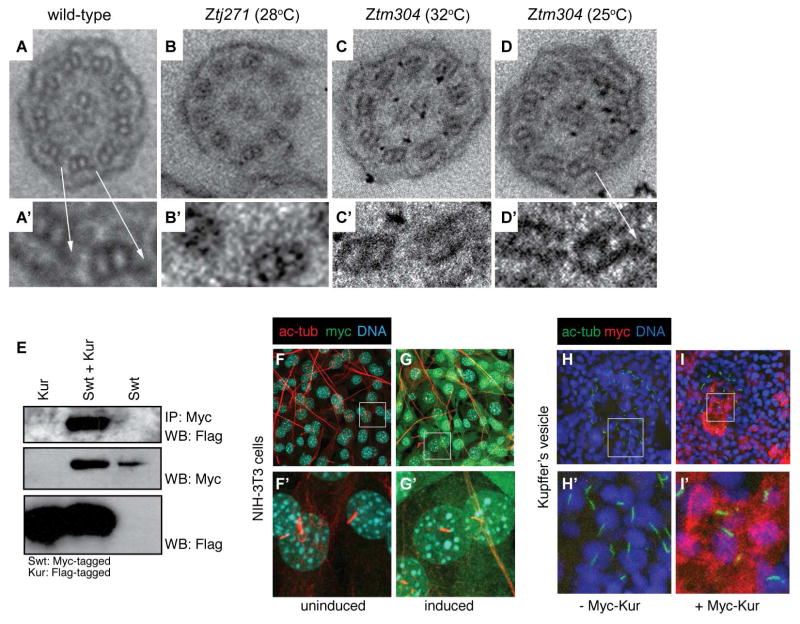
(A–D′) Transmission electron micrographs (TEMs) showing the ultrastructure of pronephric cilia in cross-section. Arrows in A–A′ indicate outer dynein arms (ODAs) which are missing in mutants (B–C′) but are restored in kurtm304/tm304 mutants raised at permissive temperature (D–D′). (E) Immunoprecipitation (IP) of Myc-tagged Swt and subsequent Myc-Swt and Flag-Kur western blot (WB) reveals physical association between Swt and Kur. (F–G′) NIH-3T3 cells transfected with inducible Myc-tagged Kur were immunostained for the ciliary axoneme (acetylated alpha tubulin (ac-tub); red), DNA (Hoechst; blue), and myc (Myc-Kur; green). Kur is not localized to the cilium but instead localizes to the cytoplasm. (H–I′) Immunostaining of Kupffer’s vesicle (KV) in control embryos or embryos injected with Myc-Kur. Cilia were marked by ac-tub (green) staining, DNA with Hoechst (blue), and Myc-Kur was localized with an anti-Myc antibody (red). Myc-Kur, which rescues kur mutants, was present in cells of the KV but appeared absent from cilia themselves.
Figure 3
Figure 3. kur Mutants and Morphants Exhibit Polarity Defects in Zebrafish and Xenopus
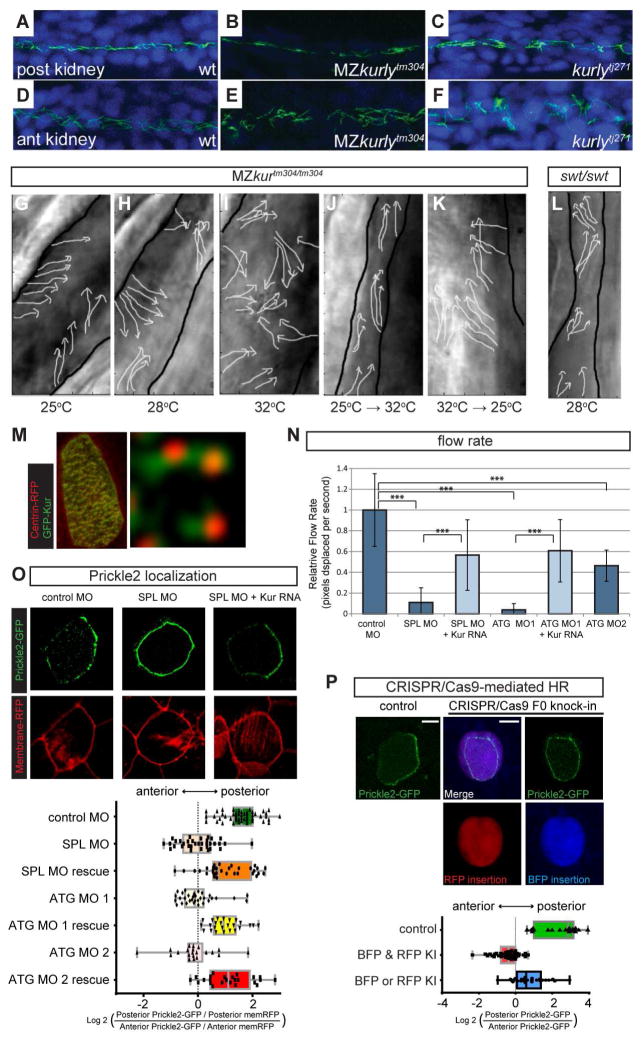
(A–F) Staining of cilia axonemes (ac-tub; green) and nuclei (Hoechst; blue) in zebrafish pronephric tubules show cilia are present but appear disorganized and mispolarized in mutants. (G–L) Stills from live imaging of cilia. Cilia directionality is traced by arrows in MZkurtm304/tm304 (G–K) and lokto237b/to237b mutants (L). Black outlines mark the edges of the tubules. Cilia in MZkurtm304/tm304 are progressively more disorganized at higher temperatures (G–I). Temperature shift experiments in kurtm304/tm304 mutants show that cilia do not becoming disorganized after shifting from permissive to restrictive temperatures (25°C→32°C) (J) and that cilia are able to recover their alignment defects by shifting from restrictive to permissive temperatures (32°C→25°C) (K). swt/swt mutants exhibit dilated tubules but normal cilia alignment (L), suggesting that tubule dilation does not cause alignment defects. (M) Cytoplasmic localization of GFP-Kur in a Xenopus multi-ciliated cell (MCC) showing an enrichment at the basal body and rootlets (inlay). (N) Quantification of cilia generated fluid flow in control embryos and kur morphants. Average flow velocity measured by the displacement of dyed micro-beads along the skin of stage 29 Xenopus embryos. Data represent 3 independent MOs and rescue experiments were performed with GFP-Kur RNA. Values are averages of at least 10 flow lines from 5 embryos from 2 independent experiments. Error bars indicate standard deviation, *** p value < 0.0002. (O) Representative images and quantification of Prickle2-GFP (green) and membrane-RFP (red) localization in control and kur morphants (posterior is right). Box and whisker plots represent the log2 of the posterior fluorescent intensity divided by the anterior fluorescent intensity normalized for membrane-RFP (memRFP) intensity. (P) Representative images and quantification of Prickle2-GFP localization in mosaic F0 CRISPR/Cas9-edited MCCs. Control embryos were injected Cas9 protein and homology arms without kur gRNA. RFP positive MCCs indicate integration of RFP into the short kur allele and BFP positive MCCs indicate integration of BFP into the long kur allele. Box and whisker plot represents the log2 of the posterior Prickle2-GFP fluorescent intensity divided by the anterior fluorescent intensity.
Figure 4
Figure 4. Kur Interacts with PCP Components
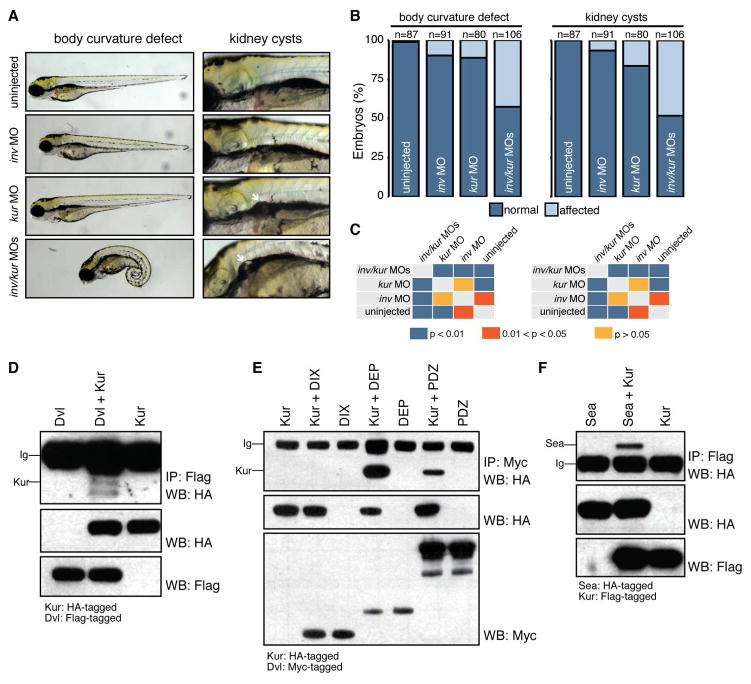
(A–C) Low concentration of inv or kur MO produce few defects but, in combination, produce additive defects in body curvature and presence of kidney cysts. White arrows show kidney cysts. Statistical comparison of different genotypes was performed using chi-square analysis with p < 0.05 being considered to report significant differences. (D) Immunoprecipitation (IP) of Flag-tagged Dvl and subsequent Flag-Dvl and HA-Kur wetern blot (WB) reveals physical association between Dvl and Kur. (E) Immunoprecipitation (IP) of Myc-tagged Dvl domains and subsequent Myc-Dvl and HA-Kur western blot (WB) reveals physical association between Kur and the DEP and PDZ domains but not the DIX domain of Dvl. (F) Immunoprecipitation (IP) of Flag-tagged Kur and subsequent Flag-Kur and HA-Sea western blot (WB) reveals physical association between Sea and Kur.

References

    1. Amack JD. Salient features of the ciliated organ of asymmetry. Bioarchitecture. 2014;4:6–15. - PMC - PubMed
    1. Auer TO, Del Bene F. CRISPR/Cas9 and TALEN-mediated knock-in approaches in zebrafish. Methods. 2014;69:142–150. - PubMed
    1. Austin-Tse C, Halbritter J, Zariwala MA, Gilberti RM, Gee HY, Hellman N, Pathak N, Liu Y, Panizzi JR, Patel-King RS, et al. Zebrafish Ciliopathy Screen Plus Human Mutational Analysis Identifies C21orf59 and CCDC65 Defects as Causing Primary Ciliary Dyskinesia. American journal of human genetics. 2013;93:672–686. - PMC - PubMed
    1. Becker-Heck A, Zohn IE, Okabe N, Pollock A, Lenhart KB, Sullivan-Brown J, McSheene J, Loges NT, Olbrich H, Haeffner K, et al. The coiled-coil domain containing protein CCDC40 is essential for motile cilia function and left-right axis formation. Nature genetics. 2011;43:79–84. - PMC - PubMed
    1. Boutin C, Labedan P, Dimidschstein J, Richard F, Cremer H, Andre P, Yang Y, Montcouquiol M, Goffinet AM, Tissir F. A dual role for planar cell polarity genes in ciliated cells. Proceedings of the National Academy of Sciences of the United States of America. 2014;111:E3129–3138. - PMC - PubMed

Publication types

MeSH terms