Review
. 2017 Jul 1:120:20-37.
doi: 10.1016/j.neuropharm.2016.02.014. Epub 2016 Feb 18.

Noninvasive and targeted delivery of therapeutics to the brain using focused ultrasound

Affiliations
Review

Noninvasive and targeted delivery of therapeutics to the brain using focused ultrasound

Charissa Poon et al. Neuropharmacology. .

Abstract

The range of therapeutic treatment options for central nervous system (CNS) diseases is greatly limited by the blood-brain barrier (BBB). While a variety of strategies to circumvent the blood-brain barrier for drug delivery have been investigated, little clinical success has been achieved. Focused ultrasound (FUS) is a unique approach whereby the transcranial application of acoustic energy to targeted brain areas causes a noninvasive, safe, transient, and targeted opening of the BBB, providing an avenue for the delivery of therapeutic agents from the systemic circulation into the brain. There is a great need for viable treatment strategies for CNS diseases, and we believe that the preclinical success of this technique should encourage a rapid movement towards clinical testing. In this review, we address the versatile applications of FUS-mediated BBB opening, the safety profile of the technique, and the physical and biological mechanisms that drive this process. This article is part of the Special Issue entitled "Beyond small molecules for neurological disorders".

Keywords: Amyloid-beta protein (PubChem CID: 16131051); Blood-brain barrier; Doxorubicin (PubChem CID: 31703); Drug delivery; Evans blue (PubChem CID: 9566057); Focused ultrasound; Gadolinium (PubChem CID: 23982); MRI; Microbubbles; Noninvasive surgery; Texas red (PubChem CID: 5014711).


Figures

Fig. 1
Fig. 1
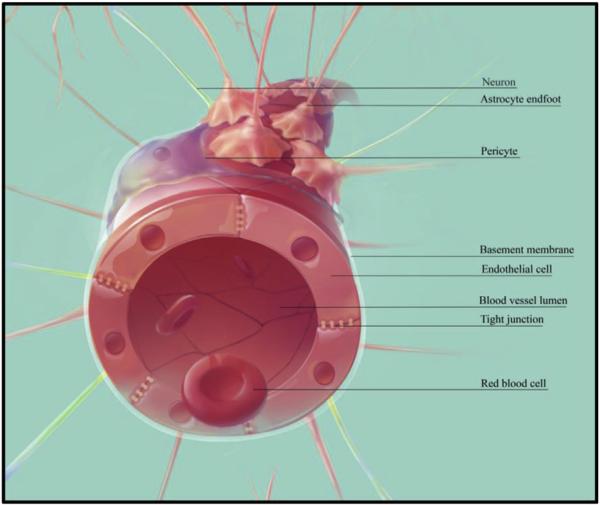
Components of the BBB. The BBB is composed of a layer of specialized vascular ECs, linked together by adherens and TJ proteins. This layer is surrounded by a basement membrane, then a non-continuous layer of pericytes. An additional basement membrane and astrocytic endfeet complete the major anatomical features of the BBB. This configuration contributes to the selective exclusion of a vast majority of therapeutic agents in circulation from entering the brain parenchyma. Abbreviations: BBB = blood-brain barrier, EC = endothelial cell, TJ = tight junction.
Fig. 2
Fig. 2
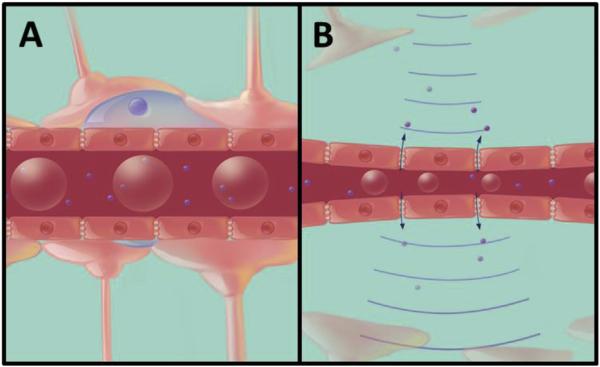
FUS-induced MB oscillation and BBBO. (A) Prior to sonication, MBs (red spheres in the capillary lumen) are intravenously administered and disperse in the systemic circulation. (B) When the MBs enter the focus of the ultrasound field, they expand and contract, stimulating the opening of the BBB, thereby allowing therapeutic agents (small purple spheres) to enter the brain parenchyma. Abbreviations: FUS = focused ultrasound, MB = microbubble, BBBO = blood-brain barrier opening. (For interpretation of the references to colour in this figure legend, the reader is referred to the web version of this article.)
Fig. 3
Fig. 3
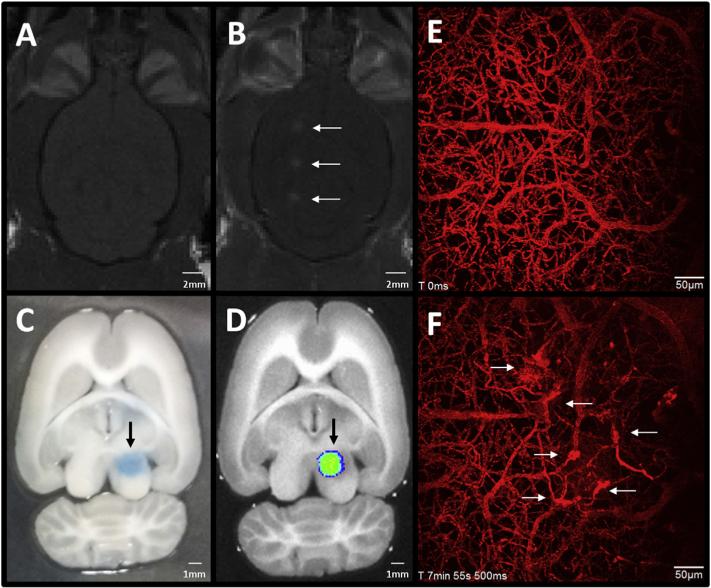
Methods to visualize FUS-mediated BBBO. (A, B) T1-weighted MR images in the horizontal plane show gadolinium contrast enhancement in a rat brain (A) before and (B) 10 min after FUS-mediated BBBO. White arrows indicate the three areas of BBBO. (C, D) Evans blue dye is a commonly used indicator of BBBO. (C) A vibratome-sectioned (500 μm thick), perfused rat brain slice shows the region of Evans blue dye extravasation 2 h following FUS. (D) The same section, imaged with a Xenogen IVIS-200™ system, demonstrates the fluorescent signal emitted by Evans blue, providing a quantitative measure of BBBO. Black arrows indicate the area of BBBO. (E, F) On a microscopic scale, two-photon imaging through a cranial window provides a means of evaluating BBBO with higher temporal and spatial resolution, compared with the methods mentioned above. Here, maximum projection images of 400 μm Z-stacks are shown. (E) Prior to sonication, dextran-conjugated Texas-Red dye is intravenously injected, allowing the visualization of blood vessels, and (F) the time course of BBBO. Regions of dye leakage in the field of view can be observed following FUS (white arrows). Time stamps indicate the time from the start of imaging. Abbreviations: FUS = focused ultrasound, BBBO = blood-brain barrier opening, MR = magnetic resonance. (For interpretation of the references to colour in this figure legend, the reader is referred to the web version of this article.)
Fig. 4
Fig. 4
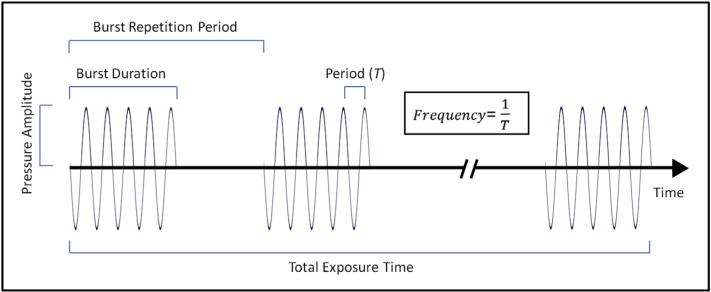
Parameters of an ultrasound wave. The ultrasound wave is depicted as a sinusoidal wave, with areas of compression being above the x-axis and areas of rarefaction below. The relationship between burst duration, burst repetition period, period, frequency, pressure amplitude, and total exposure time are displayed.
Fig. 5
Fig. 5
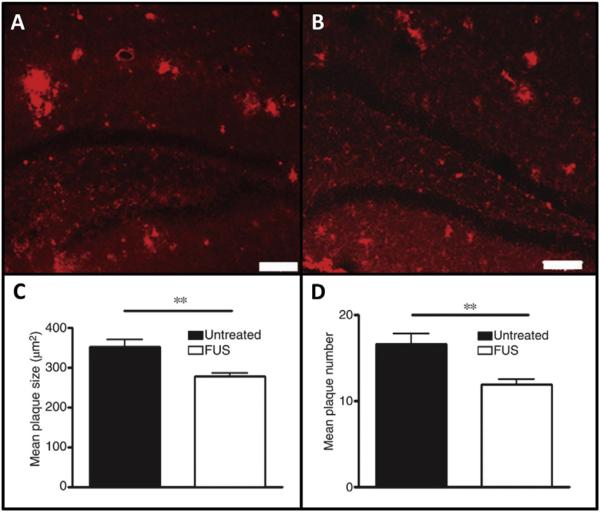
Reduction in Aβ plaque pathology following FUS-mediated BBBO in AD mouse model. The BBB in the hippocampi of TgCRND8 mice was opened once per week for three consecutive weeks with FUS, and the effects on AD pathology were investigated. Aβ plaques were fluorescently labeled with anti-amyloid antibody 6F3D in (A) control and (B) FUS treated hippocampi, demonstrating a significant reduction in (C) mean plaque size and (D) mean plaque number. Importantly, this study also showed a significant improvement in the performance of FUS-treated mice in hippocampal-dependent tasks compared to untreated controls (data not shown). Error bars represent standard errors of the mean. N = 6–8 per group. ** = p < 0.01 (Figure modified from Burgess et al., 2014). Abbreviations: Aβ = amyloid-beta, FUS = focused ultrasound, BBBO = blood-brain barrier opening, AD = Alzheimer's disease.

References

    1. Abbott NJ. Inflammatory mediators and modulation of blood-brain barrier permeability [Internet] Cell Mol. Neurobiol. Neurobiol. 2000;20(2):131–147. Available from: http://dx.doi.org/10.1023/A:1007074420772. - DOI - PMC - PubMed
    1. Abbott NJ, Rönnbäck L, Hansson E. Astrocyteeendothelial interactions at the bloodebrain barrier [Internet] Nat. Rev. Neurosci. 2006;7(1):41–53. Available from: http://dx.doi.org/10.1038/nrn1824. - DOI - PubMed
    1. Afergan E, Epstein H, Dahan R, Koroukhov N, Rohekar K, Danenberg HD, et al. Delivery of serotonin to the brain by monocytes following phagocytosis of liposomes [Internet] Elsevier B.V. J. Control Release. 2008;132(2):84–90. Available from: http://www.ncbi.nlm.nih.gov/pubmed/18805446. - PubMed
    1. Alkins R, Burgess A, Ganguly M, Francia G, Kerbel R, Wels WS, et al. Focused ultrasound delivers targeted immune cells to metastatic brain tumors [Internet] Cancer Res. 2013;73(6):1892–1899. Available from: http://dx.doi.org/10.1016/j.micinf.2011.07.011.Innate. - DOI - PMC - PubMed
    1. Apfel RE, Holland CK. Gauging the likelihood of cavitation from short-pulse, low-duty cycle diagnostic ultrasound [Internet] Ultrasound Med. Biol. 1991;17(2):179–185. Available from: http://dx.doi.org/10.1016/0301-5629(91)90125-G. - DOI - PubMed

MeSH terms

Substances