


Emergency Department Use Among Hispanic Adults: The Role of Acculturation
- PMID: 26908087
- PMCID: PMC4833554
- DOI: 10.1097/MLR.0000000000000511
Emergency Department Use Among Hispanic Adults: The Role of Acculturation
Abstract
Objectives: We provide the first known examination of differences in nonurgent and urgent emergency department (ED) usage between Hispanic and non-Hispanic white individuals, with varying levels of acculturation.
Materials and methods: We pooled cross-sectional data for Hispanic and non-Hispanic white adults (ages 18-64) from the 2011 to 2013 National Health Interview Surveys. Using logistic regression models, we examined differences in past-year ED use, urgent ED use, and nonurgent ED use by acculturation level, which we measure by combining information on respondents' citizenship status, birthplace, and length of stay (immigrants <5, 5-10, >10 y in the United States; naturalized citizens; US born).
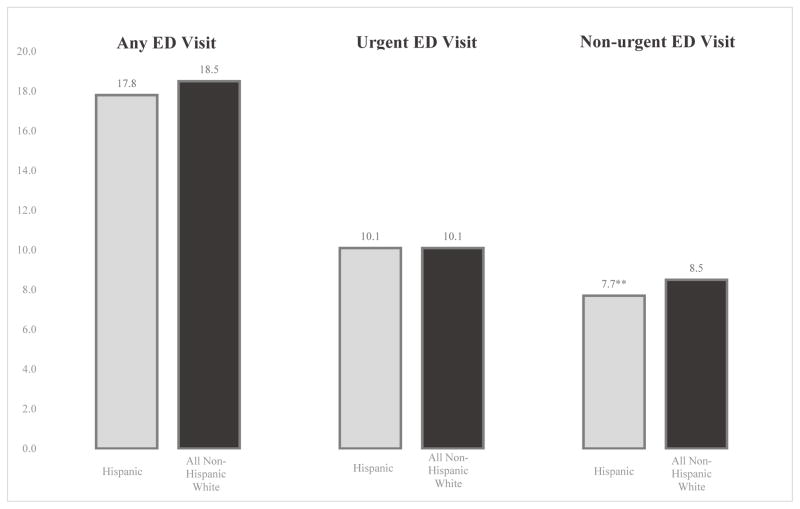
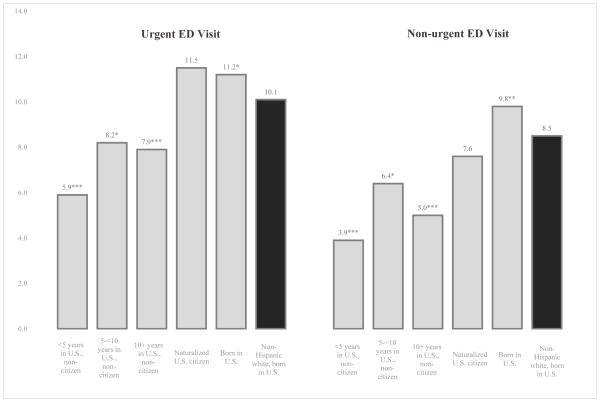
Results: Overall, 17.8% of Hispanic individuals and 18.5% of non-Hispanic white individuals use the ED annually. Compared with US-born non-Hispanic white individuals, the least acculturated Hispanic individuals are 14.4% points (P<0.001) less likely to use the ED for any reason, 9.8% points (P<0.001) less likely to use it for a nonurgent reason, and 5.3% points (P<0.01) less likely to use it for an urgent reason.
Conclusions: Contrary to popular perception, the least acculturated Hispanic individuals are the least likely to use the ED. As acculturation level rises, so does one's likelihood of using the ED, particularly for nonurgent visits.
Figures
References
-
- Niska RB, Farida, Jianmin Xu. National Health Statistics Reports. 2010. National Hospital Ambulatory Medical Care Survey: 2007 Emergency Department Summary; p. 26. - PubMed
-
- Young GP, Wagner MB, Kellermann AL, et al. Ambulatory visits to hospital emergency departments. Patterns and reasons for use. 24 Hours in the ED Study Group. JAMA : the journal of the American Medical Association. 1996;276:460–465. - PubMed
-
- Hospital-Based Emergency Care: At the Breaking Point. The National Academies Press; 2007.
Publication types
MeSH terms
Grants and funding
LinkOut - more resources
Full Text Sources
Other Literature Sources
Miscellaneous
