


Quantifying the economic impact of government and charity funding of medical research on private research and development funding in the United Kingdom
- PMID: 26908129
- PMCID: PMC4765095
- DOI: 10.1186/s12916-016-0564-z
Quantifying the economic impact of government and charity funding of medical research on private research and development funding in the United Kingdom
Abstract
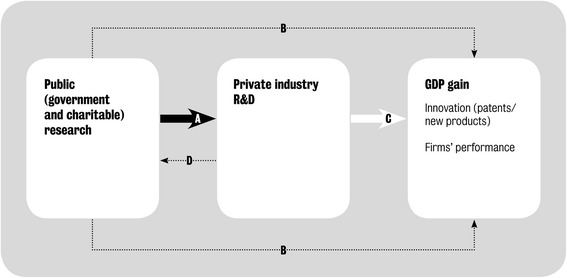
Background: Government- and charity-funded medical research and private sector research and development (R&D) are widely held to be complements. The only attempts to measure this complementarity so far have used data from the United States of America and are inevitably increasingly out of date. This study estimates the magnitude of the effect of government and charity biomedical and health research expenditure in the United Kingdom (UK), separately and in total, on subsequent private pharmaceutical sector R&D expenditure in the UK.
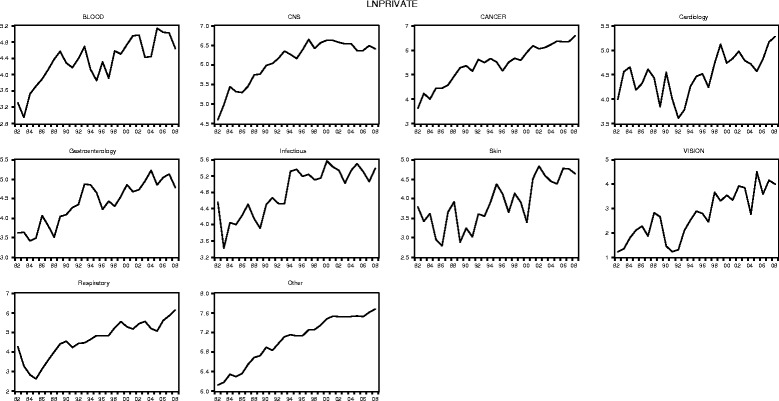
Methods: The results for this study are obtained by fitting an econometric vector error correction model (VECM) to time series for biomedical and health R&D expenditure in the UK for ten disease areas (including 'other') for the government, charity and private sectors. The VECM model describes the relationship between public (i.e. government and charities combined) sector expenditure, private sector expenditure and global pharmaceutical sales as a combination of a long-term equilibrium and short-term movements.
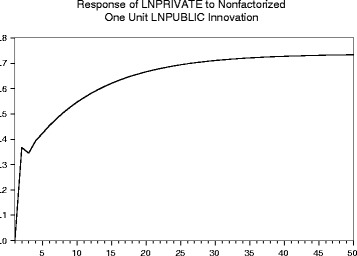
Results: There is a statistically significant complementary relationship between public biomedical and health research expenditure and private pharmaceutical R&D expenditure. A 1% increase in public sector expenditure is associated in the best-fit model with a 0.81% increase in private sector expenditure. Sensitivity analysis produces a similar and statistically significant result with a slightly smaller positive elasticity of 0.68. Overall, every additional £1 of public research expenditure is associated with an additional £0.83-£1.07 of private sector R&D spend in the UK; 44% of that additional private sector expenditure occurs within 1 year, with the remainder accumulating over decades. This spillover effect implies a real annual rate of return (in terms of economic impact) to public biomedical and health research in the UK of 15-18%. When combined with previous estimates of the health gain that results from public medical research in cancer and cardiovascular disease, the total rate of return would be around 24-28%.
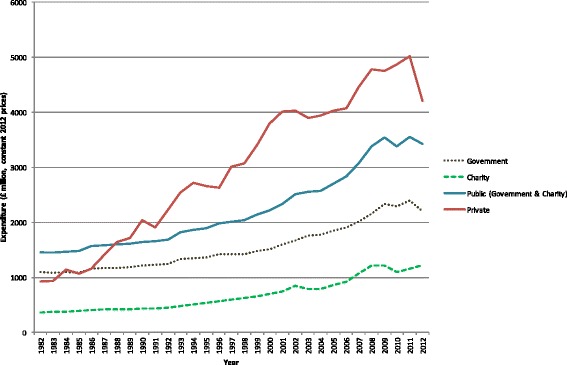
Conclusion: Overall, this suggests that government and charity funded research in the UK crowds in additional private sector R&D in the UK. The implied historical returns from UK government and charity funded investment in medical research in the UK compare favourably with the rates of return achieved on investments in the rest of the UK economy and are greatly in excess of the 3.5% real annual rate of return required by the UK government to public investments generally.
Figures


References
-
- Breschi S, Lissoni F. Knowledge spillovers and local innovation systems. Ind Corp Change. 2001;10(4):975–1005. doi: 10.1093/icc/10.4.975. - DOI
-
- Cockburn I, Henderson R. Absorptive capacity, co-authoring behavior and the organization of research in drug discovery. J Ind Econ. 1998;66(2):157–82.
-
- Cockburn IM, Henderson RM. Publicly funded science and the productivity of the pharmaceutical industry. In: Jaffe AB, Lerner J, Stern S, editors. Innovation Policy and the Economy. Boston, MA: MIT Press; 1980. pp. 1–34.
-
- HERG OHE, Europe RAND. Medical research: what’s it worth? Estimating the economic benefits from medical research in the UK. Report for the Medical Research Council, the Wellcome Trust and the Academy of Medical Sciences. London: Wellcome Trust; 2008.
-
- Toole A. Does public scientific research complement private investment in research and development in the pharmaceutical industry? J Law Econ. 2007;50:81–104. doi: 10.1086/508314. - DOI
Publication types
MeSH terms
Grants and funding
LinkOut - more resources
Full Text Sources
Other Literature Sources
