A Genome-Wide Association Study of Cutaneous Squamous Cell Carcinoma among European Descendants
- PMID: 26908436
- PMCID: PMC4873347
- DOI: 10.1158/1055-9965.EPI-15-1070
A Genome-Wide Association Study of Cutaneous Squamous Cell Carcinoma among European Descendants
Abstract
Background: No GWAS on the risk of cutaneous squamous cell carcinoma (SCC) has been published. We conducted a multistage genome-wide association study (GWAS) to identify novel genetic loci for SCC.
Methods: The study included 745 SCC cases and 12,805 controls of European descent in the discovery stage and 531 SCC cases and 551 controls of European ancestry in the replication stage. We selected 64 independent loci that showed the most significant associations with SCC in the discovery stage (linkage disequilibrium r(2) < 0.4) for replication.
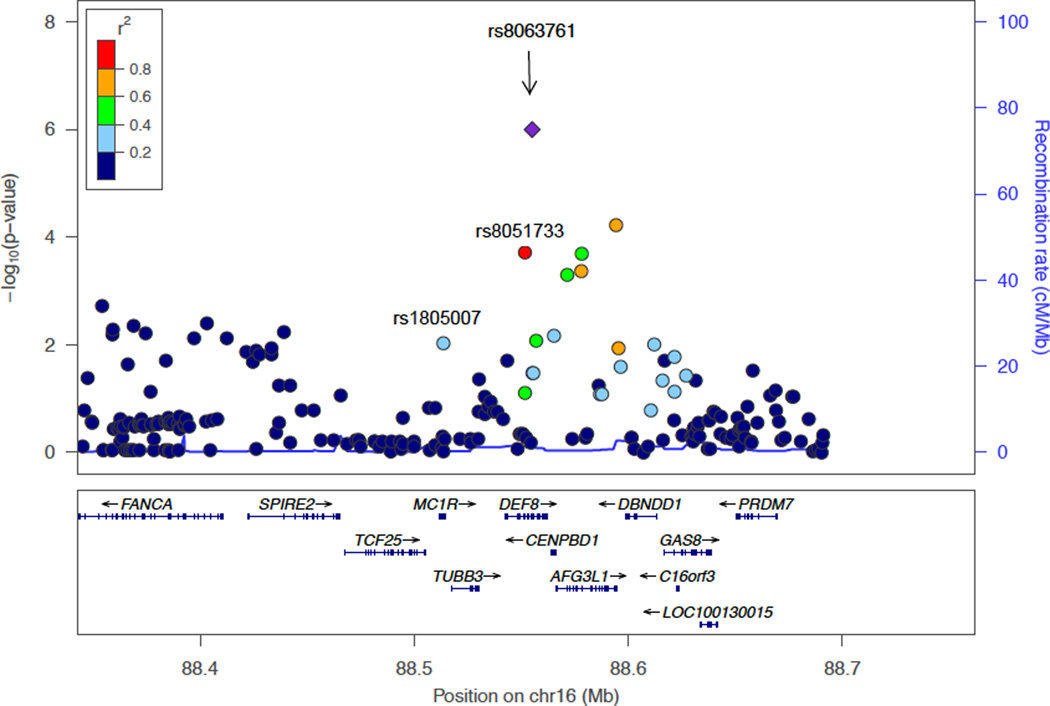
Results: Rs8063761 in the DEF8 gene on chromosome 16 showed the strongest association with SCC (P = 1.7 × 10(-9) in the combined set; P = 1.0 × 10(-6) in the discovery set and P = 4.1 × 10(-4) in the replication set). The variant allele of rs8063761 (T allele) was associated with a decreased expression of DEF8 (P = 1.2 × 10(-6)). Besides, we validated four other SNPs associated with SCC in the replication set, including rs9689649 in PARK2 gene (P = 2.7 × 10(-6) in combined set; P = 3.2 × 10(-5) in the discovery; and P = 0.02 in the replication), rs754626 in the SRC gene (P = 1.1 × 10(-6) in combined set; P = 1.4 × 10(-5) in the discovery and P = 0.02 in the replication), rs9643297 in ST3GAL1 gene (P = 8.2 × 10(-6) in combined set; P = 3.3 × 10(-5) in the discovery; and P = 0.04 in the replication), and rs17247181 in ERBB2IP gene (P = 4.2 × 10(-6) in combined set; P = 3.1 × 10(-5) in the discovery; and P = 0.048 in the replication).
Conclusion: Several genetic variants were associated with risk of SCC in a multistage GWAS of subjects of European ancestry.
Impact: Further studies are warranted to validate our finding and elucidate the genetic function of these variants. Cancer Epidemiol Biomarkers Prev; 25(4); 714-20. ©2016 AACR.
©2016 American Association for Cancer Research.
Conflict of interest statement
Figures
Comment in
-
Disrupting differential hypoxia in peripheral veno-arterial extracorporeal membrane oxygenation.Crit Care. 2015 Jul 22;19(1):280. doi: 10.1186/s13054-015-0997-3. Crit Care. 2015. PMID: 27391473 Free PMC article.
-
A GWAS of Cutaneous Squamous Cell Carcinoma-Letter.Cancer Epidemiol Biomarkers Prev. 2016 Nov;25(11):1534. doi: 10.1158/1055-9965.EPI-16-0502. Cancer Epidemiol Biomarkers Prev. 2016. PMID: 27803070 Free PMC article. No abstract available.
References
-
- Box NF, Duffy DL, Irving RE, Russell A, Chen W, Griffyths LR, et al. Melanocortin-1 receptor genotype is a risk factor for basal and squamous cell carcinoma. The Journal of investigative dermatology. 2001;116:224–229. - PubMed
-
- Han J, Kraft P, Colditz GA, Wong J, Hunter DJ. Melanocortin 1 receptor variants and skin cancer risk. International journal of cancer. 2006;119:1976–1984. - PubMed
Publication types
MeSH terms
Grants and funding
LinkOut - more resources
Full Text Sources
Other Literature Sources
Medical
Research Materials
Miscellaneous