


Genome-wide association analysis of self-reported events in 6135 individuals and 252 827 controls identifies 8 loci associated with thrombosis
- PMID: 26908601
- PMCID: PMC4986325
- DOI: 10.1093/hmg/ddw037
Genome-wide association analysis of self-reported events in 6135 individuals and 252 827 controls identifies 8 loci associated with thrombosis
Abstract
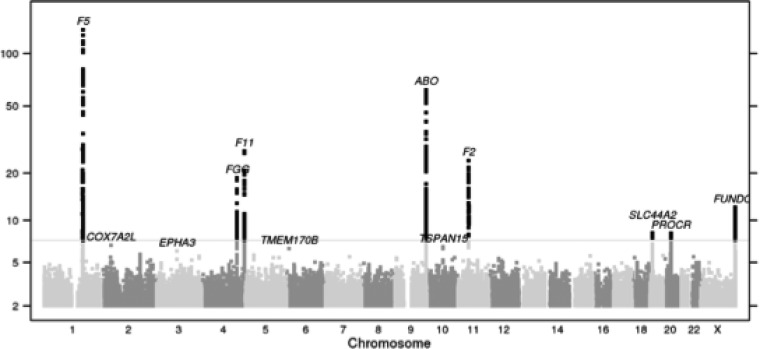
Thrombotic diseases are among the leading causes of morbidity and mortality in the world. To add insights into the genetic regulation of thrombotic disease, we conducted a genome-wide association study (GWAS) of 6135 self-reported blood clots events and 252 827 controls of European ancestry belonging to the 23andMe cohort of research participants. Eight loci exceeded genome-wide significance. Among the genome-wide significant results, our study replicated previously known venous thromboembolism (VTE) loci near the F5, FGA-FGG, F11, F2, PROCR and ABO genes, and the more recently discovered locus near SLC44A2 In addition, our study reports for the first time a genome-wide significant association between rs114209171, located upstream of the F8 structural gene, and thrombosis risk. Analyses of expression profiles and expression quantitative trait loci across different tissues suggested SLC44A2, ILF3 and AP1M2 as the three most plausible candidate genes for the chromosome 19 locus, our only genome-wide significant thrombosis-related locus that does not harbor likely coagulation-related genes. In addition, we present data showing that this locus also acts as a novel risk factor for stroke and coronary artery disease (CAD). In conclusion, our study reveals novel common genetic risk factors for VTE, stroke and CAD and provides evidence that self-reported data on blood clots used in a GWAS yield results that are comparable with those obtained using clinically diagnosed VTE. This observation opens up the potential for larger meta-analyses, which will enable elucidation of the genetics of thrombotic diseases, and serves as an example for the genetic study of other diseases.
© The Author 2016. Published by Oxford University Press. All rights reserved. For Permissions, please email: journals.permissions@oup.com.
Figures
References
-
- Nordstrom M., Lindblad B., Bergqvist D., Kjellstrom T. (1992) A prospective study of the incidence of deep-vein thrombosis within a defined urban population. J. Intern. Med., 232, 155–160. - PubMed
-
- Oger E. (2000) Incidence of venous thromboembolism: a community-based study in Western France. EPI-GETBP Study Group. Groupe d'Etude de la Thrombose de Bretagne Occidentale. Thromb. Haemost., 83, 657–660. - PubMed
-
- Naess I.A., Christiansen S.C., Romundstad P., Cannegieter S.C., Rosendaal F.R., Hammerstrom J. (2007) Incidence and mortality of venous thrombosis: a population-based study. J. Thromb. Haemost., 5, 692–699. - PubMed
-
- Peden J., Hopewell J.C., Saleheen D. (2011) A genome-wide association study in Europeans and South Asians identifies five new loci for coronary artery disease. Nat. Genet., 43, 339–344. - PubMed
Publication types
MeSH terms
Substances
Grants and funding
LinkOut - more resources
Full Text Sources
Other Literature Sources
Medical
Molecular Biology Databases
Miscellaneous
