


Trends in Metabolic Syndrome Severity and Lifestyle Factors Among Adolescents
- PMID: 26908664
- PMCID: PMC4771130
- DOI: 10.1542/peds.2015-3177
Trends in Metabolic Syndrome Severity and Lifestyle Factors Among Adolescents
Erratum in
-
Lee et al. Trends in Metabolic Syndrome Severity and Lifestyle Factors Among Adolescents. Pediatrics. 2016;137(3);doi:10.1542/peds.2015-3177.Pediatrics. 2016 Jul;138(1):e20161255. doi: 10.1542/peds.2016-1255. Pediatrics. 2016. PMID: 27365305 Free PMC article. No abstract available.
Abstract
Background and objectives: Childhood metabolic syndrome (MetS) is a risk factor for adverse outcomes later in life. Our goal was to identify temporal trends among US adolescents in the severity of MetS, its individual components, and factors related to diet and physical activity.
Methods: We analyzed 5117 participants aged 12 to 19 from NHANES. We used regression analysis of individual waves of data, 1999 to 2012. MetS severity was calculated using a gender- and race/ethnicity-specific MetS severity z score.
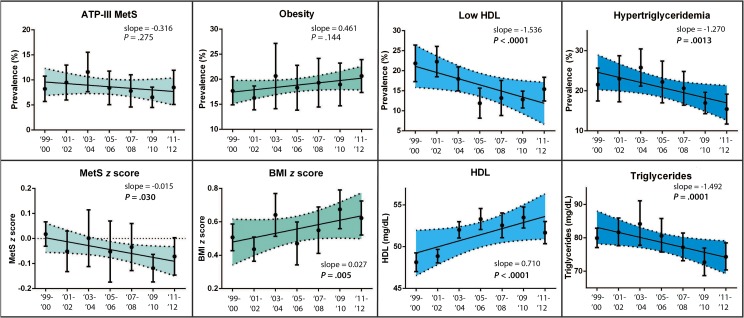
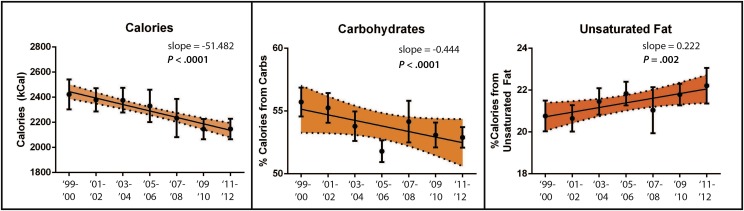
Results: There was a linear trend of decreasing MetS severity in US adolescents from 1999 to 2012 (P = .030). This occurred despite a trend of increasing BMI z score (P = .005); instead, the decrease in MetS severity appeared to be due to trends in increasing high-density lipoprotein (HDL; P < .0001) and decreasing triglyceride (P = .0001) levels. In considering lifestyle factors, there was no change in physical activity over the time period. Regarding dietary patterns, total calorie consumption and carbohydrate consumption were positively associated with triglyceride levels and negatively associated with HDL levels, whereas unsaturated fat consumption exhibited the opposite associations. Consistent with these associations, there was a trend of decreasing total calorie consumption (P < .0001), decreasing carbohydrate consumption (P < .0001), and increasing unsaturated fat consumption (P = .002).
Conclusions: The healthier trend of declining MetS severity in adolescents appeared to be due to favorable increases in HDL and decreases in fasting triglyceride measurements. These were in turn associated with favorable changes in dietary patterns among US adolescents. Future studies should investigate the causality of dietary differences on changes in MetS severity in adolescents.
Copyright © 2016 by the American Academy of Pediatrics.
Conflict of interest statement
Figures
References
-
- Grundy SM, Cleeman JI, Daniels SR, et al. ; American Heart Association; National Heart, Lung, and Blood Institute . Diagnosis and management of the metabolic syndrome: an American Heart Association/National Heart, Lung, and Blood Institute Scientific Statement. Circulation. 2005;112(17):2735–2752 - PubMed
-
- Ford ES, Li C, Cook S, Choi HK. Serum concentrations of uric acid and the metabolic syndrome among US children and adolescents. Circulation. 2007;115(19):2526–2532 - PubMed
-
- Malik S, Wong ND, Franklin SS, et al. Impact of the metabolic syndrome on mortality from coronary heart disease, cardiovascular disease, and all causes in United States adults. Circulation. 2004;110(10):1245–1250 - PubMed
-
- Alberti KG, Eckel RH, Grundy SM, et al. ; International Diabetes Federation Task Force on Epidemiology and Prevention; National Heart, Lung, and Blood Institute; American Heart Association; World Heart Federation; International Atherosclerosis Society; International Association for the Study of Obesity . Harmonizing the metabolic syndrome: a joint interim statement of the International Diabetes Federation Task Force on Epidemiology and Prevention; National Heart, Lung, and Blood Institute; American Heart Association; World Heart Federation; International Atherosclerosis Society; and International Association for the Study of Obesity. Circulation. 2009;120(16):1640–1645 - PubMed
-
- Ford ES, Ajani UA, Mokdad AH; National Health and Nutrition Examination . The metabolic syndrome and concentrations of C-reactive protein among U.S. youth. Diabetes Care. 2005;28(4):878–881 - PubMed
Publication types
MeSH terms
Grants and funding
LinkOut - more resources
Full Text Sources
Other Literature Sources
Medical
