. 2016 Apr 15;213(8):1289-98.
doi: 10.1093/infdis/jiw054. Epub 2016 Feb 9.

Role of Granulocyte-Macrophage Colony-Stimulating Factor Signaling in Regulating Neutrophil Antifungal Activity and the Oxidative Burst During Respiratory Fungal Challenge

Affiliations

Role of Granulocyte-Macrophage Colony-Stimulating Factor Signaling in Regulating Neutrophil Antifungal Activity and the Oxidative Burst During Respiratory Fungal Challenge

Shinji Kasahara et al. J Infect Dis. .

Abstract

Granulocyte-macrophage colony-stimulating factor (GM-CSF) is a pleiotropic cytokine that plays a critical role in regulating myeloid cell host defense. In this study, we demonstrated that GM-CSF signaling plays an essential role in antifungal defense against Aspergillus fumigatus. Mice that lack the GM-CSF receptor β chain (GM-CSFRβ) developed invasive hyphal growth and exhibited impaired survival after pulmonary challenge with A. fumigatus conidia. GM-CSFRβ signaling regulated the recruitment of inflammatory monocytes to infected lungs, but not the recruitment of effector neutrophils. Cell-intrinsic GM-CSFRβ signaling mediated neutrophil and inflammatory monocyte antifungal activity, because lung GM-CSFRβ(-/-) leukocytes exhibited impaired conidial killing compared with GM-CSFRβ(+/+) counterparts in mixed bone marrow chimeric mice. GM-CSFRβ(-/-) neutrophils exhibited reduced (hydrogenated) nicotinamide adenine dinucleotide phosphate (NADPH) oxidase activity in vivo. Conversely, administration of recombinant GM-CSF enhanced neutrophil NADPH oxidase function, conidiacidal activity, and lung fungal clearance in A. fumigatus-challenged mice. Thus, our study illustrates the functional role of GM-CSFRβ signaling on lung myeloid cell responses against inhaled A. fumigatus conidia and demonstrates a benefit for systemic GM-CSF administration.

Keywords: Aspergillus; GM-CSF; ROS; monocytes; neutrophils.


Figures

Figure 1.
Figure 1.
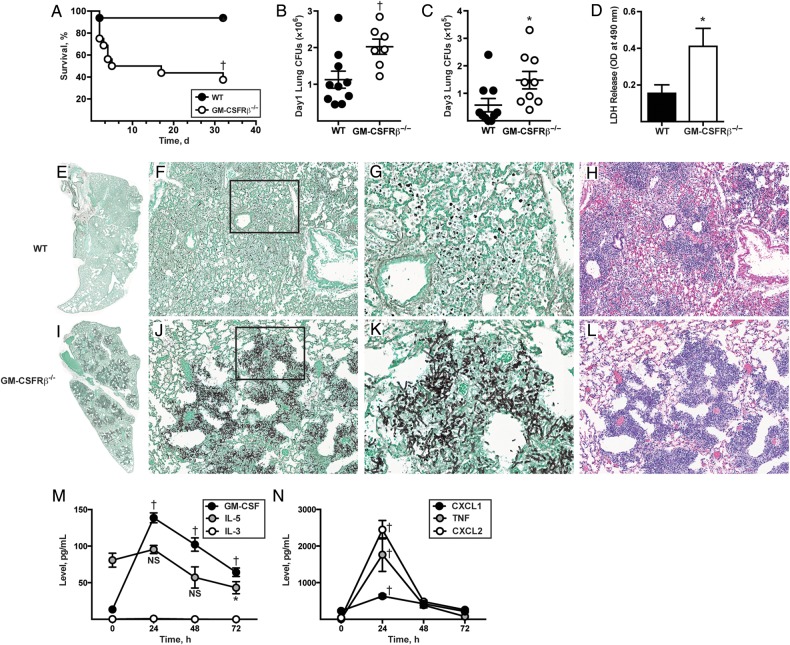
Granulocyte-macrophage colony-stimulating factor (GM-CSF) receptor β chain (GM-CSFRβ) signaling is critical for survival, fungal clearance, and lung integrity during Aspergillus fumigatus challenge. A–D, Wild-type (WT) and GM-CSFRβ−/− mice were challenged with 8 × 10⁷ CEA10 conidia and monitored for survival (Kaplan–Meier survival plot of WT [black circles; n = 16] and GM-CSFRβ−/− [white circles; n = 16] mice; data pooled from 2 independent experiments) (A); challenged with 3 × 10⁷ CEA10 conidia tested for lung fungal burden 24 (B) hours and 72 (C) hours after infection (representative data from 3 experiments [B]) and 1 experiment [C]); and challenged with 8 × 10⁷ CEA10 conidia and examined for bronchoalveolar lavage fluid lactate dehydrogenase (LDH) levels 48 hours after infection (bar graphs show mean [standard error of the mean {SEM}] from an experiment with 6–10 mice per genotype) (D). EL, Representative micrographs of hematoxylin-eosin– and Gomori ammoniacal silver–stained lung sections from WT and GM-CSFRβ−/− mice 48 hours after infection. Images were captured at ×2 (E, I), ×20 (F, H, J, L), and ×60 (G, K) magnification, with G and K corresponding to insets in F and J, respectively. M, N, Graph shows mean (SEM) lung cytokine and chemokine levels at the indicated time points in C57BL/6 WT mice infected with 3 × 10⁷ CEA10 conidia, with representative data from 1 of 2 independent experiments (5, 8, 9 and 8 mice at 0, +24, +48, and +72 hours, respectively). *P < .05; P < .01. Abbreviations: CFUs, colony-forming units; IL-3, interleukin 3; IL-5, interleukin 5; NS, not significant; TNF, tumor necrosis factor.
Figure 2.
Figure 2.
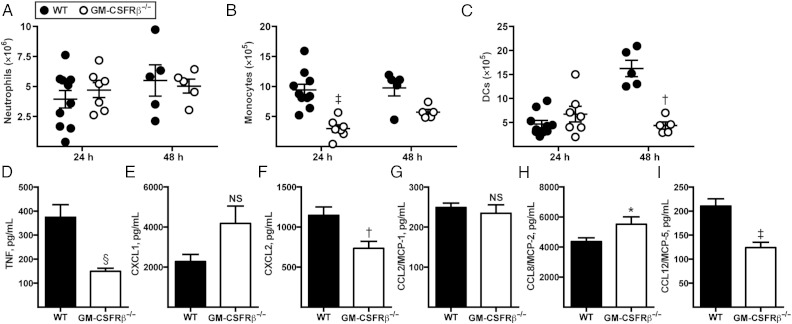
Granulocyte-macrophage colony-stimulating factor receptor β chain (GM-CSFRβ) signaling and neutrophil and monocyte recruitment during respiratory fungal infection. AC, Wild-type (WT) mice were infected with 3 × 10⁷ CEA10 conidia, and recruitment of neutrophils (A), inflammatory monocytes (B), and monocyte-derived dendritic cells (DCs) (C) in lungs was measured with flow cytometry at the indicated time points; representative data from 3 independent experiments are shown (WT: n = 10, GM-CSFRβ−/−: n = 7). DI, Graphs show mean (standard error of the mean) lung cytokine and chemokine levels 24 hours after infection in C57BL/6 WT or GM-CSFRβ−/− mice infected with 3 × 10⁷ CEA10 conidia; representative data from 2 independent experiments are shown (WT: n = 10; GM-CSFRβ−/−: n = 13). *P < .05; P < .01; P < .001; §P < .0001. Abbreviations: MCP-5, monocyte chemotactic protein 5; NS, not significant; TNF, tumor necrosis factor.
Figure 3.
Figure 3.
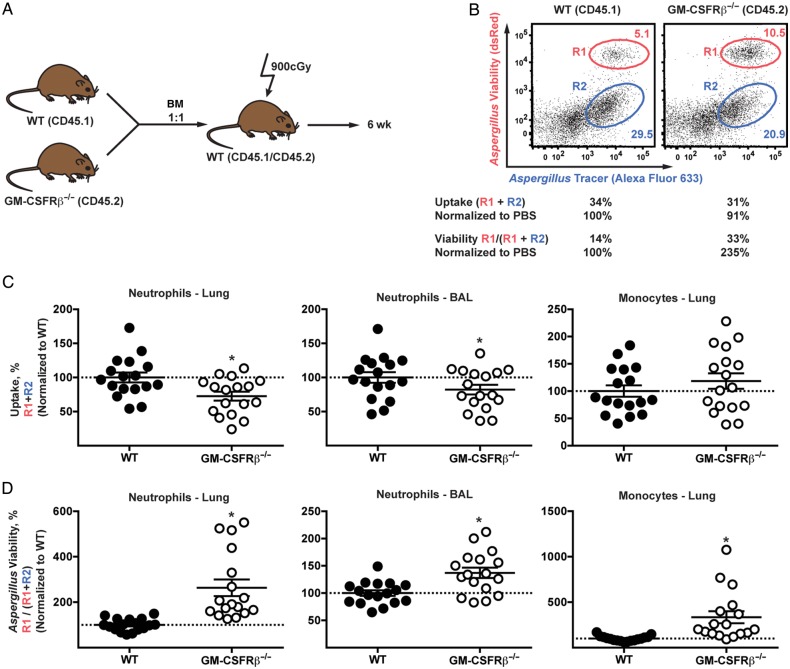
Cell intrinsic role of granulocyte-macrophage colony-stimulating factor receptor β chain (GM-CSFRβ) signaling in antifungal activity in neutrophils and monocytes. AD, Mixed bone marrow (BM) chimeric mice of wild-type (WT) and GM-CSFRβ−/− were generated and infected with 3 × 10⁷ AF293 fluorescent Aspergillus reporter (FLARE). Bronchoalveolar lavage (BAL) fluid and lungs were harvested at 48 hours after infection and fungal uptake and viability were analyzed with flow cytometry. A, Schematic showing how to generate mixed BM chimeric mice. B, Representative plots showing fungal uptake and killing in neutrophils from WT and GM-CSFRβ−/− compartment showing live (R1) and dead (R2) conidia. C, D, Fungal uptake (C) and viability (D) in neutrophils and monocytes were measured, and monocytes were identified as CD45+CD11b+Ly6ChiLy6GLy6B.2+. Data from 3 independent experiments were pooled and normalized, and relative levels were indicated (n = 17). *P < .001. Abbreviation: PBS, phosphate-buffered saline.
Figure 4.
Figure 4.
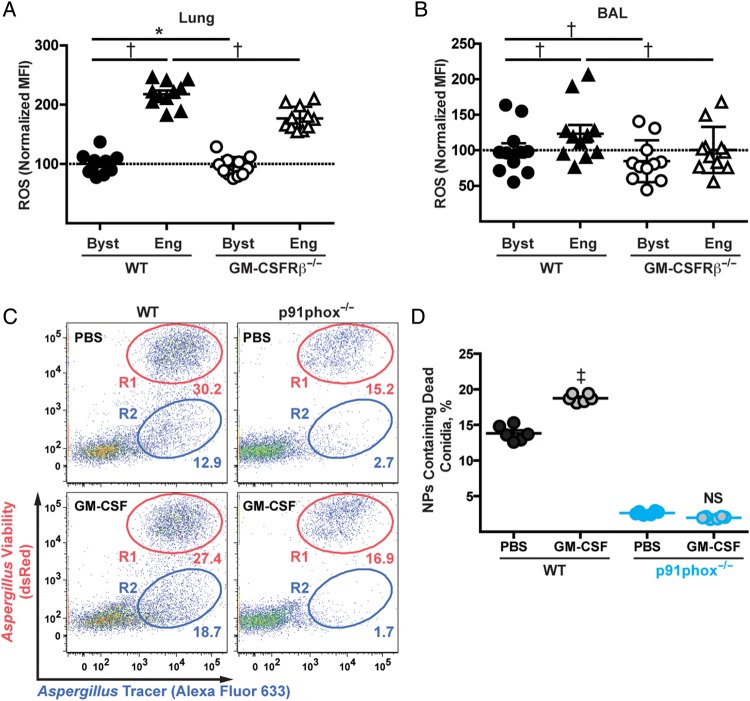
Granulocyte-macrophage colony-stimulating factor (GM-CSF) receptor β chain (GM-CSFRβ) signaling and neutrophil reactive oxygen species (ROS) production. Mixed bone marrow chimeric mice of wild-type (WT) and GM-CSFRβ−/− were infected with 3 × 10⁷ AF293 fluorescent Aspergillus reporter (FLARE) and lungs and bronchoalveolar lavage (BAL) were harvested at 24 hours after infection. A, B, ROS production in neutrophils from lungs (A) and BAL fluid (B) were analyzed with flow cytometry. Median fluorescence intensity (MFI) for ROS levels was measured and normalized to the ROS levels in WT bystander neutrophils; data from 2 independent experiments were pooled and relative values are presented (n = 11). C, Neutrophils were enriched from the bone marrow of WT or p91phox−/− mice and cocultured with FLARE, with or without recombinant GM-CSF. Representative plots show fungal uptake and killing in neutrophils from WT and p91phox−/− mice, with live (R1) and dead (R2) conidia. D, Frequency of neutrophils (NPs) containing dead conidia (R2) was measured. C, D, Data from 1 experiment (n = 6). *P < .01; P < .001; P < .0001. Abbreviations: Byst, bystander neutrophils; Eng, fungus-engaged neutrophils; NS, not significant; PBS, phosphate-buffered saline.
Figure 5.
Figure 5.
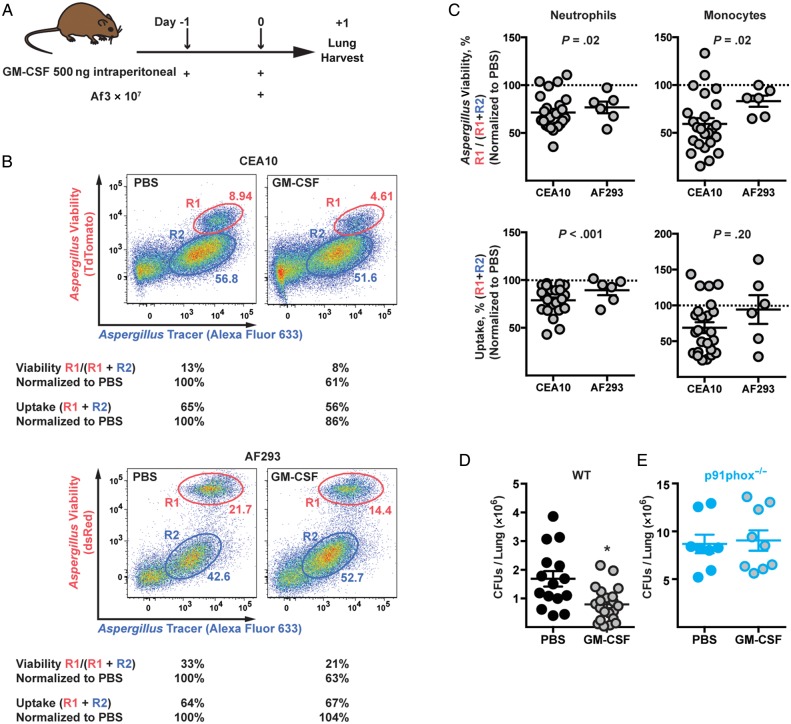
Granulocyte-macrophage colony-stimulating factor (GM-CSF) administration can enhance fungal killing and clearance in the lung. A, Schematic of experimental design. B, Representative plot shows lung neutrophils analyzed on the basis of conidial uptake and viability. The R1 gates represent fungus-engaged neutrophils with live conidia, and the R2 gates, fungus-engaged neutrophils with dead conidia. C, Dot plots show normalized conidial viability in (top row) and conidial uptake by (bottom row) lung neutrophils (left panels) and inflammatory monocytes (right panels) isolated from C57BL/6 mice challenged with CEA10 fluorescent Aspergillus reporter (FLARE) or Af293 FLARE conidia. Data were normalized to phosphate-buffered saline (PBS) controls (dotted lines) from 3 independent experiments (CEA10; n = 20 for PBS, n = 24 for GM-CSF) and 1 experiment (AF293; n = 7 for PBS, n = 6 for GM-CSF), and relative values are presented. D, Fungal burden in the lungs from PBS (n = 15) or GM-CSF (n = 21) injected wild-type (WT) mice challenged with CEA10 FLARE conidia. E, Fungal burden in the lungs from PBS- (n = 8) or GM-CSF– (n = 9) injected p91phox−/− mice challenged with CEA10 FLARE conidia. *P < .01. Abbreviations: Af, Aspergillus fumigatus; CFUs, colony-forming units.

References

    1. Segal BH. Aspergillosis. N Engl J Med 2009; 360:1870–84. - PubMed
    1. Bonnett CR, Cornish EJ, Harmsen AG, Burritt JB. Early neutrophil recruitment and aggregation in the murine lung inhibit germination of Aspergillus fumigatus conidia. Infect Immun 2006; 74:6528–39. - PMC - PubMed
    1. Espinosa V, Jhingran A, Dutta O et al. Inflammatory monocytes orchestrate innate antifungal immunity in the lung. PLoS Pathog 2014; 10:e1003940. - PMC - PubMed
    1. Mircescu MM, Lipuma L, van Rooijen N, Pamer EG, Hohl TM. Essential role for neutrophils but not alveolar macrophages at early time points following Aspergillus fumigatus infection. J Infect Dis 2009; 200:647–56. - PMC - PubMed
    1. Cordonnier C, Ribaud P, Herbrecht R et al. Prognostic factors for death due to invasive aspergillosis after hematopoietic stem cell transplantation: a 1-year retrospective study of consecutive patients at French transplantation centers. Clin Infect Dis 2006; 42:955–63. - PubMed

Publication types

MeSH terms

Substances