Recurrent urinary tract infections and complications after symptomatic versus antibiotic treatment: follow-up of a randomised controlled trial
- PMID: 26909012
- PMCID: PMC4749724
- DOI: 10.3205/000228
Recurrent urinary tract infections and complications after symptomatic versus antibiotic treatment: follow-up of a randomised controlled trial
Abstract
Background: Uncomplicated urinary tract infections (UTI) are common in general practice, and are usually treated with antibiotics. Recurrent UTI often pose a serious problem for affected women. Little is known about recurrent UTI and complications when uncomplicated UTI are treated without antibiotics. With ICUTI (Immediate vs. conditional antibiotic use in uncomplicated UTI, funded by BMBF No. 01KG1105) we assessed whether initial symptomatic treatment with ibuprofen could be a treatment alternative for uncomplicated UTI. The presented analysis aims to assess the influence of initial (non-)antibiotic treatment on recurrent UTI rates and pyelonephritis after day 28 up to 6 months after trial participation.
Methods: This study is a retrospective long-term follow-up analysis of ICUTI patients, surveyed telephonically six months after inclusion in the trial. Recurrent UTI, pyelonephritis or hospitalizations were documented. Statistical evaluation was performed by descriptive and multivariate analyses with SPSS 21.
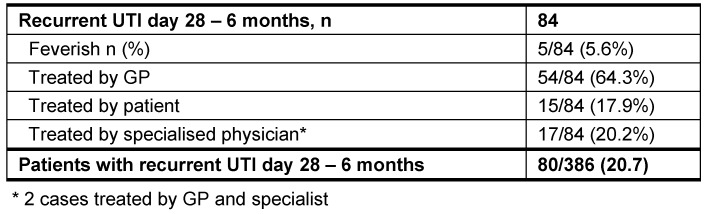
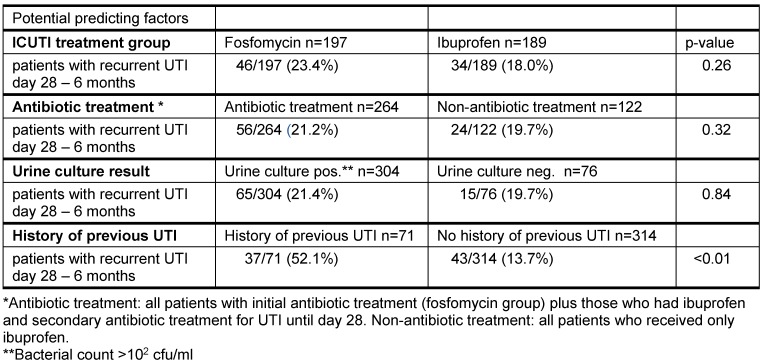
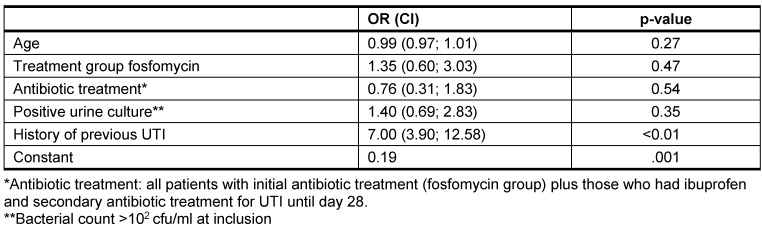
Results: For the six months follow-up survey, 386 trial participants could be contacted (494 had been included in ICUTI initially, 446 had completed the trial). From day 28 until 6 months after inclusion in ICUTI, 84 recurrent UTI were reported by 80 patients. Univariate and multivariate analyses showed no effect of initial treatment group or antibiotic treatment on number of patients with recurrent UTI. Yet, both analyses showed that patients with a history of previous UTI had significantly more often recurrent UTI. Pyelonephritis occurred in two patients of the antibiotic group and in one patient in the non-antibiotic group.
Conclusion: This follow-up analysis of a trial comparing antibiotic vs. symptomatic treatment for uncomplicated UTI showed that non-antibiotic treatment has no negative impact on recurrent UTI rates or pyelonephritis after day 28 and up to six months after initial treatment. Thus, a four week follow-up in UTI trials seems adequate.
Hintergrund: Unkomplizierte Harnwegsinfekte (HWI) sind eine häufige Erkrankung in der Allgemeinmedizin und werden üblicherweise antibiotisch behandelt. Rezidive stellen dabei ein ernstzunehmendes Problem für betroffene Frauen dar. Über Rezidive und Komplikationen nach nicht-antibiotischer Behandlung unkomplizierter Harnwegsinfekte ist wenig bekannt.Mit der Studie ICUTI (Immediate vs. conditional antibiotic use in uncomplicated UTI, gefördert vom BMBF 01KG1105) wurde untersucht, ob eine initial symptomatische Behandlung mit Ibuprofen eine alternative Behandlungsmöglichkeit beim Harnwegsinfekt darstellt. Die hier vorgestellte Analyse hatte zum Ziel, den Einfluss einer initialen (nicht)antibiotischen Therapie auf das Auftreten von Rezidiven und Pyelonephritiden zwischen Tag 28 und 6 Monaten nach Einschluss in die Studie darzustellen.Methode: Retrospektive Analyse der 6-Monats-Nachbefragung der ICUTI-Teilnehmer. Durch telefonische Befragung 6 Monate nach Einschluss in die Studie wurde das Auftreten von Rezidiven, Pyelonephritiden und Krankenhausaufnahmen dokumentiert. Die statistische Auswertung erfolgte durch deskriptive und multivariate Analysen mit SPSS 21.Ergebnisse: Bei der 6-Monats-Nachbefragung wurden 386 ICUTI-Teilnehmerinnen erreicht (494 waren in ICUTI eingeschlossen worden, 446 hatten die Studie beendet). Zwischen Tag 28 und 6 Monaten nach Einschluss in ICUTI berichteten 80 Patientinnen insgesamt 84 Rezidive. In der univariaten und in der multivariaten Analyse zeigte sich kein Einfluss der initialen Behandlungsgruppe oder einer antibiotischen Behandlung auf die Zahl der Patientinnen mit Rezidiven. Allerdings zeigten beide Analysen, dass Patientinnen mit vorherigen Harnwegsinfekten signifikant häufiger weitere Rezidive bekamen. Pyelonephritiden traten bei zwei Patientinnen in der antibiotisch behandelten Gruppe und bei einer Patientin in der nicht antibiotisch behandelten Gruppe auf.Schlussfolgerung: Die Follow-up-Analyse der Nachbefragung nach einem Vergleich einer sofortigen antibiotischen mit einer zunächst symptomatischen Therapie des unkomplizierten Harnwegsinfektes ergab, dass eine nicht antibiotische Therapie keinen Einfluss auf das Auftreten von Rezidiven oder Pyelonephritiden zwischen Tag 28 und 6 Monaten nach der initialen Therapie hat. In weiteren Harnwegsinfektstudien scheint daher eine Nachbeobachtung von vier Wochen ausreichend.
Keywords: follow-up; pyelonephritis; recurrent UTI; urinary tract infections.
Figures



References
-
- Butler CC, Hawking MK, Quigley A, McNulty CA. Incidence, severity, help seeking, and management of uncomplicated urinary tract infection: a population-based survey. Br J Gen Pract. 2015 Oct;65(639):e702–e707. doi: 10.3399/bjgp15X686965. Available from: http://dx.doi.org/10.3399/bjgp15X686965. - DOI - PMC - PubMed
-
- Flower A, Winters D, Bishop FL, Lewith G. The challenges of treating women with recurrent urinary tract infections in primary care: a qualitative study of GPs' experiences of conventional management and their attitudes towards possible herbal options. Prim Health Care Res Dev. 2015 Nov;16(6):597–606. doi: 10.1017/S1463423615000201. Available from: http://dx.doi.org/10.1017/S1463423615000201. - DOI - PubMed
-
- Hooton TM. Clinical practice. Uncomplicated urinary tract infection. N Engl J Med. 2012 Mar;366(11):1028–1037. doi: 10.1056/NEJMcp1104429. Available from: http://dx.doi.org/10.1056/NEJMcp1104429. - DOI - PubMed
-
- Ong DS, Kuyvenhoven MM, van Dijk L, Verheij TJ. Antibiotics for respiratory, ear and urinary tract disorders and consistency among GPs. J Antimicrob Chemother. 2008 Sep;62(3):587–592. doi: 10.1093/jac/dkn230. Available from: http://dx.doi.org/10.1093/jac/dkn230. - DOI - PubMed
-
- Epidemiologie, Diagnostik, Therapie und Management unkomplizierter bakterieller ambulant erworbener Harnwegsinfektionen bei erwachsenen Patienten: S-3 Leitlinie. AWMF-Register-Nr. 043/044. 2010. (Ger). Available from: http://www.awmf.org/leitlinien/detail/ll/043-044.html.
Publication types
MeSH terms
Substances
LinkOut - more resources
Full Text Sources
Medical
Molecular Biology Databases