


Incidence, consequences and treatment of bone metastases in breast cancer patients-Experience from a single cancer centre
- PMID: 26909284
- PMCID: PMC4723382
- DOI: 10.1016/j.jbo.2013.09.001
Incidence, consequences and treatment of bone metastases in breast cancer patients-Experience from a single cancer centre
Abstract
Background: There is a paucity of literature about the benefits of bone-targeted agents for breast cancer patients with bone metastases treated in the non-trial setting. We explored the incidence, consequences, and treatment of bone metastases at a single cancer centre.
Methods: Electronic records of metastatic breast cancer patients were reviewed and pertinent information was extracted.
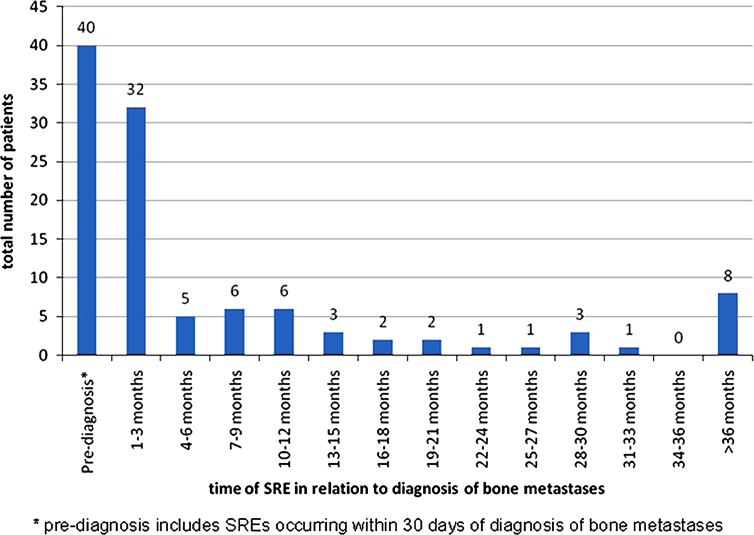
Results: Of 264 metastatic breast cancer patients, 195 (73%) developed bone metastases. Of these patients, 176 were eligible for analysis. Median age at bone metastases diagnosis was 56.9 years (IQR 48-67) and initial presentation of bone metastases included asymptomatic radiological findings (58%), bone pain (40%), or a SRE (12.5%). Most patients (88%) received a bone-targeted agent, starting a median of 1.5 months (IQR 0.8-3.30) after bone metastasis diagnosis. 62% of patients had ≥1 SRE. The median time from bone metastasis diagnosis to first SRE was 1.8 months (IQR 0.20-8.43 months). Median number of SREs per patient was 1.5 (IQR 0-3). Overall, 26.8% of all SREs were clinically asymptomatic. Within the entire cohort, 51% required opioids and 20% were hospitalized due to either an SRE or bone pain.
Conclusions: Despite extensive use of bone-targeted agents, the incidence of SREs remains high. Nearly half of SREs occur prior to starting a bone-targeted agent. Use of opioids and hospitalizations secondary to bone metastases remain common. More effective treatment options are clearly needed.
Keywords: Bone metastases; Bone targeted agents; Breast cancer; Pain; Skeletal related events.
Figures
References
-
- Costa L., Badia X., Chow E., Lipton A., Wardley A. Impact of skeletal complications on patients’ quality of life, mobility, and functional independence. Supportive Care in Cancer: Official Journal of the Multinational Association of Supportive Care in Cancer. 2008;16:879–889. - PubMed
-
- Hortobagyi G.N., Theriault R.L., Porter L., Blayney D., Lipton A., Sinoff C. Efficacy of pamidronate in reducing skeletal complications in patients with breast cancer and lytic bone metastases. Protocol 19 Aredia Breast Cancer Study Group. New England Journal of Medicine. 1996;335:1785–1791. - PubMed
-
- Theriault R.L., Lipton A., Hortobagyi G.N., Leff R., Gluck S., Stewart J.F. Pamidronate reduces skeletal morbidity in women with advanced breast cancer and lytic bone lesions: a randomized, placebo-controlled trial. Protocol 18 Aredia Breast Cancer Study Group. Journal of Clinical Oncology: Official Journal of the American Society of Clinical Oncology. 1999;17:846–854. - PubMed
-
- Kohno N., Aogi K., Minami H., Nakamura S., Asaga T., Iino Y. Zoledronic acid significantly reduces skeletal complications compared with placebo in Japanese women with bone metastases from breast cancer: a randomized, placebo-controlled trial. Journal of Clinical Oncology: Official Journal of the American Society of Clinical Oncology. 2005;23:3314–3321. - PubMed
LinkOut - more resources
Full Text Sources
Other Literature Sources
