


Prevalence of risk factors for non-communicable diseases in Bangladesh: Results from STEPS survey 2010
- PMID: 26911213
- PMCID: PMC6349138
- DOI: 10.4103/0019-557X.177290
Prevalence of risk factors for non-communicable diseases in Bangladesh: Results from STEPS survey 2010
Abstract
Background: Nationally representative data on noncommunicable disease (NCD) risk factors are lacking in Bangladesh. This study was done to determine the prevalence of common risk factors for major NCDs among men and women of rural and urban areas of Bangladesh.
Materials and methods: This survey was done with 9,275 individuals aged 25 years or older randomly drawn from all over the country. Information on diet, physical activity, tobacco and alcohol, and treatment history for hypertension and diabetes were collected. Height, weight, waist circumference, and blood pressure (BP) were measured.
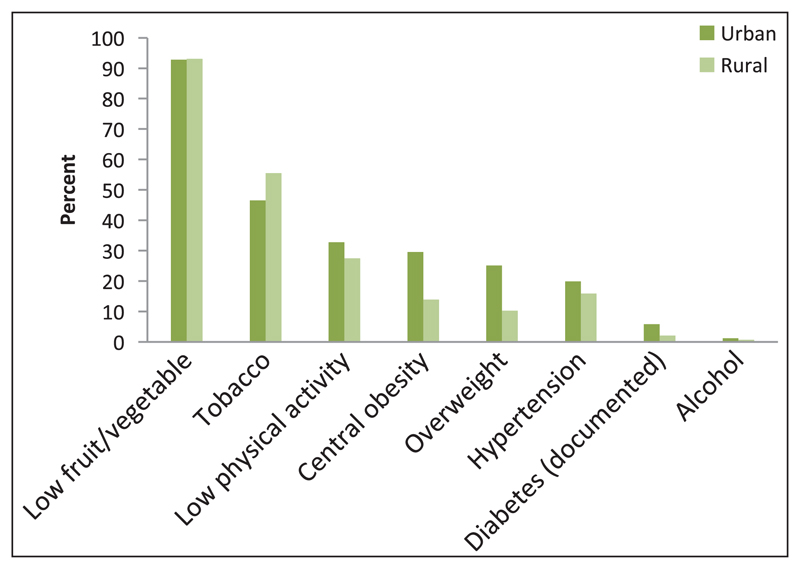
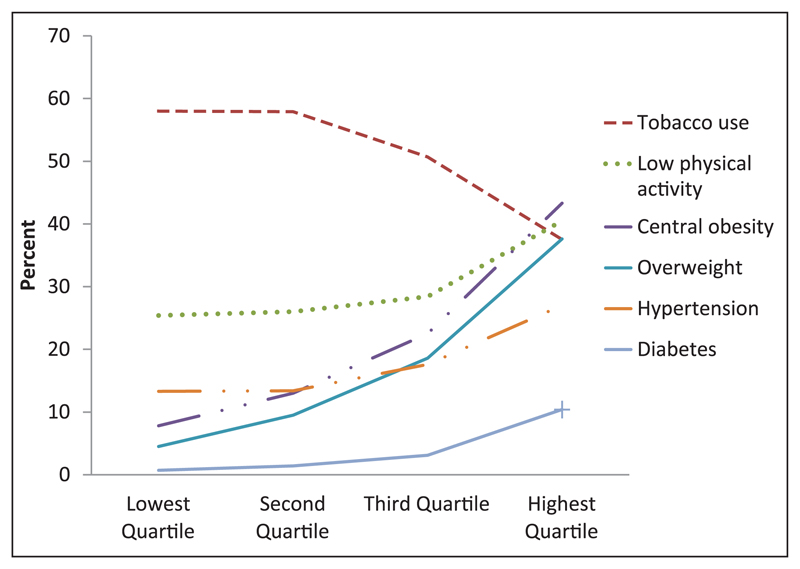
Results: There were 4,312 men and 4,963 women with the mean age of 42 years (standard deviation 13 years). Half of them (54%) used tobacco in some form, <1% consumed alcohol within the past 30 days, 92% did not consume adequate fruit and vegetables (five servings or more), and 35% had low physical activity level [<600 metabolic equivalent (MET) min per week]. Documented diabetes was found in 4% of the participants. Seventeen percent were overweight [body mass index (BMI) ≥25 kg/m 2 and 21% had abdominal obesity (men ≥94, women ≥80 cm). Overall, 21% people had hypertension (blood pressure ≥140/90 mmHg or medication). Physical inactivity, alcohol intake, hypertension, obesity, and diabetes were more prevalent in urban areas, as opposed to tobacco. Tobacco intake showed a decreasing gradient, but hypertension, obesity, diabetes, and low physical activity showed an increasing gradient across the wealth quartiles.
Conclusion: Risk factors are widely prevalent in Bangladeshi people across sexes and across both rural and urban areas of residences. NCD prevention through risk factor control, and early detection and treatment of hypertension and diabetes are warranted.
Conflict of interest statement
The authors alone are responsible for the views expressed in this article and they do not necessarily represent the views, decisions, or policies of the institutions with which they are affiliated.
Figures
References
-
- World Health Organization. The World Health Report 2002: Reducing Risks, Promoting Healthy Life. Geneva: WHO; 2002. pp. 1–230. - PubMed
-
- World Health Organization. Preventing Chronic Diseases: A Vital Investment. Geneva: World Health Organization; 2005. pp. 26–27.
-
- United Nations General Assembly resolution 66/2. [Last accessed on 2014 Nov 06]; Available from: http://www.who.int/nmh/events/un_ncd_summit2011/political_declaration_en....
-
- World Health Organization. Follow-up to the political declaration of the high-level meeting of the Gneral Assembly on the prevention and control of non-communicable diseases. Sixty-sixth World Health Assembly; May 2013; [Last accessed on 2014 Nov 06]. Available from: http://www.fdiworldental.org/media/26435/who_ncd-actionplan_2013-20_a66_....
-
- World Health Organization. Health Profile of Bangladesh. WHO; Bangladesh: 2003. [Last accessed on 2010 Oct 22]. Available from: http://www.whoban.org/country_health_profile.html.
MeSH terms
Grants and funding
LinkOut - more resources
Full Text Sources
Other Literature Sources
Miscellaneous
