Review
. 2016 Feb 15:7:151.
doi: 10.3389/fmicb.2016.00151. eCollection 2016.

Co-infections and Pathogenesis of KSHV-Associated Malignancies

Affiliations
Review

Co-infections and Pathogenesis of KSHV-Associated Malignancies

Suhani Thakker et al. Front Microbiol. .

Abstract

Kaposi's sarcoma-associated herpesvirus (KSHV), also known as human herpes virus 8 (HHV-8) is one of the several carcinogenic viruses that infect humans. KSHV infection has been implicated in the development of Kaposi's sarcoma (KS), primary effusion lymphoma, and multicentric Castleman's Disease. While KSHV infection is necessary for the development of KSHV associated malignancies, it is not sufficient to induce tumorigenesis. Evidently, other co-factors are essential for the progression of KSHV induced malignancies. One of the most important co-factors, necessary for the progression of KSHV induced tumors, is immune suppression that frequently arises during co-infection with HIV and also by other immune suppressants. In this mini-review, we discuss the roles of co-infection with HIV and other pathogens on KSHV infection and pathogenesis.

Keywords: KSHV; herpesviruses; polymicrobial infections.


Figures
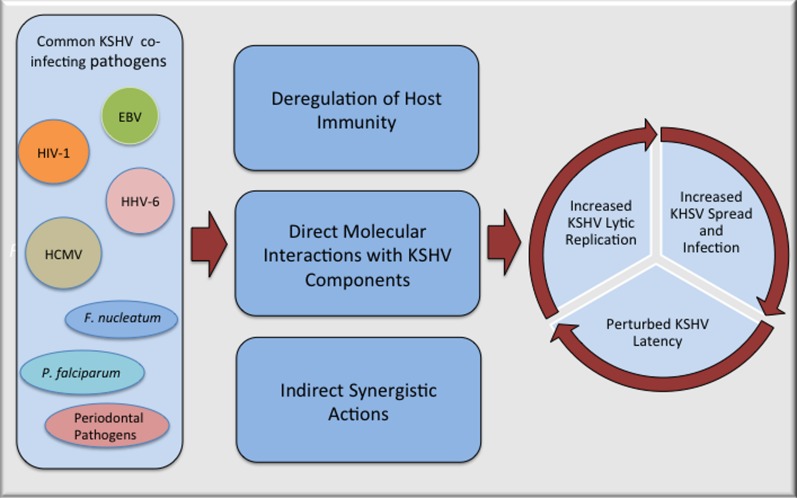
FIGURE 1
FIGURE 1
Potential mechanisms of interactions between Kaposi’s sarcoma-associated herpesvirus (KSHV) and co-infecting pathogens that can accelerate pathogenesis of KSHV associated malignancies. Many of the commonly observed co-pathogenic infections can perturb KSHV life cycle either through direct physical interactions with KSHV components or in more complex ways that includes suppression of host immunity and manipulation of cellular pathways that can make cellular microenvironment more favorable for KSHV replication and/or spread.

References

    1. Abbas W., Tariq M., Iqbal M., Kumar A., Herbein G. (2015). Eradication of HIV-1 from the macrophage reservoir: an uncertain goal? Viruses 7 1578–1598. 10.3390/v7041578 - DOI - PMC - PubMed
    1. Ablashi D., Agut H., Alvarez-Lafuente R., Clark D. A., Dewhurst S., DiLuca D., et al. (2014). Classification of HHV-6A and HHV-6B as distinct viruses. Arch. Virol. 159 863–870. 10.1007/s00705-013-1902-5 - DOI - PMC - PubMed
    1. Adland E., Klenerman P., Goulder P., Matthews P. C. (2015). Ongoing burden of disease and mortality from HIV/CMV coinfection in Africa in the antiretroviral therapy era. Front. Microbiol. 6:1016 10.3389/fmicb.2015.01016 - DOI - PMC - PubMed
    1. Albini A., Soldi R., Giunciuglio D., Giraudo E., Benelli R., Primo L., et al. (1996). The angiogenesis induced by HIV-1 tat protein is mediated by the Flk-1/KDR receptor on vascular endothelial cells. Nat. Med. 2 1371–1375. 10.1038/nm1296-1371 - DOI - PubMed
    1. Ambroziak J. A., Blackbourn D. J., Herndier B. G., Glogau R. G., Gullett J. H., McDonald A. R., et al. (1995). Herpes-like sequences in HIV-infected and uninfected Kaposi’s sarcoma patients. Science 268 582–583. 10.1126/science.7725108 - DOI - PubMed

LinkOut - more resources
