Patterns of Nonrandom Mating Within and Across 11 Major Psychiatric Disorders
- PMID: 26913486
- PMCID: PMC5082975
- DOI: 10.1001/jamapsychiatry.2015.3192
Patterns of Nonrandom Mating Within and Across 11 Major Psychiatric Disorders
Abstract
Importance: Psychiatric disorders are heritable, polygenic traits, which often share risk alleles and for which nonrandom mating has been suggested. However, despite the potential etiological implications, the scale of nonrandom mating within and across major psychiatric conditions remains unclear.
Objective: To quantify the nature and extent of nonrandom mating within and across a broad range of psychiatric conditions at the population level.
Design, setting, and participants: Population-based cohort using Swedish population registers. Participants were all Swedish residents with a psychiatric diagnosis of interest (attention-deficit/hyperactivity disorder, autism spectrum disorder, schizophrenia, bipolar disorder, major depression, generalized anxiety disorder, agoraphobia, social phobia, obsessive-compulsive disorder, anorexia, or substance abuse), along with their mates. Individuals with select nonpsychiatric disorders (Crohn's disease, type 1 and type 2 diabetes mellitus, multiple sclerosis, or rheumatoid arthritis) were included for comparison. General population samples were also derived and matched 1:5 with each case proband. Inpatient and outpatient diagnostic data were derived from the Swedish National Patient Register (1973-2009), with analyses conducted between June 2014 and May 2015.
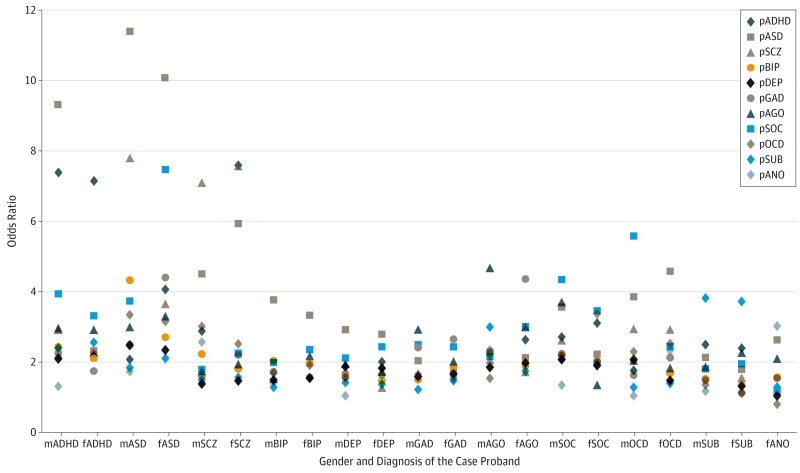
Main outcomes and measures: Correlation in the diagnostic status of mates both within and across disorders. Conditional logistic regression was used to quantify the odds of each diagnosis in the mates of cases relative to matched population controls.
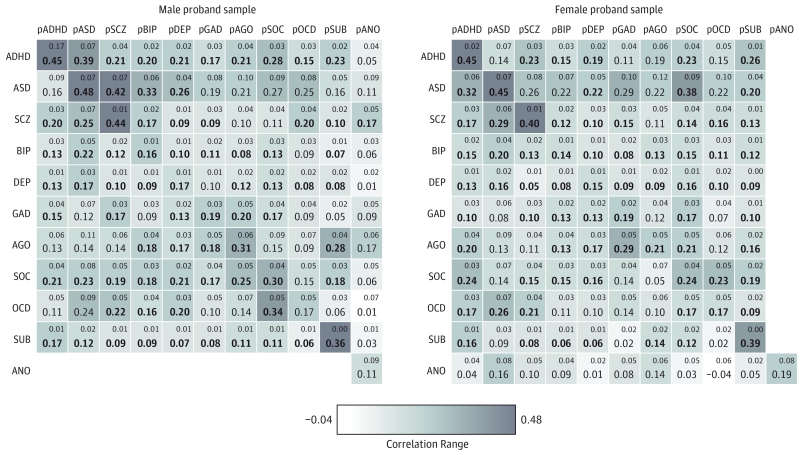
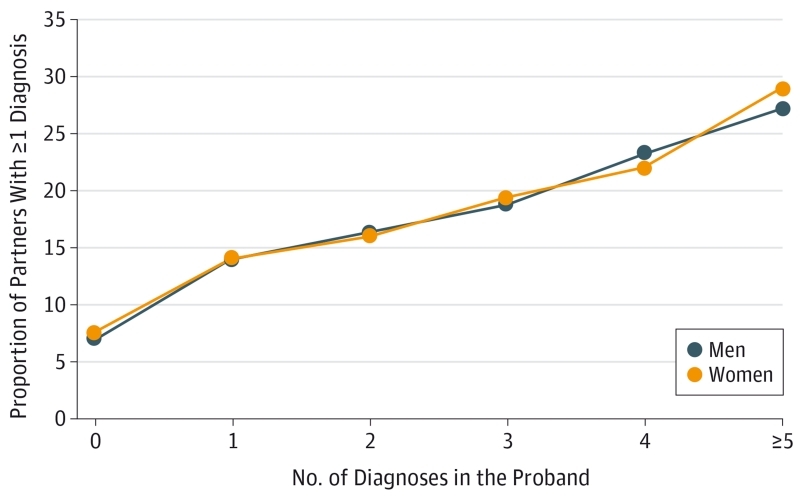
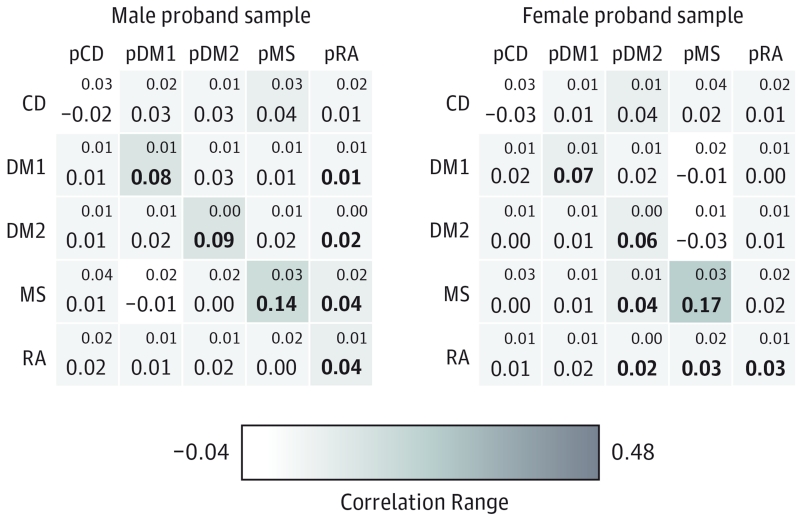
Results: Across cohorts, data corresponded to 707 263 unique case individuals, with women constituting 45.7% of the full population. Positive correlations in diagnostic status were evident between mates. Within-disorder correlations were marginally higher (range, 0.11-0.48) than cross-disorder correlations (range, 0.01-0.42). Relative to matched populations, the odds of psychiatric case probands having an affected mate were significantly elevated. Differences in the magnitude of observed relationships were apparent by disorder (odds ratio range, 0.8-11.4). The number of comorbidities in a case proband was associated with the proportion of affected mates. These relationships were not apparent or weaker in magnitude among nonpsychiatric conditions (correlation range, -0.03 to 0.17).
Conclusions and relevance: Nonrandom mating is evident in psychiatric populations both within specific disorders and across the spectrum of psychiatric conditions. This phenomenon may hold important implications for how we understand the familial transmission of these disorders and for psychiatric genetic research.
Figures
Comment in
-
Assortative Mating-A Missing Piece in the Jigsaw of Psychiatric Genetics.JAMA Psychiatry. 2016 Apr;73(4):323-4. doi: 10.1001/jamapsychiatry.2015.3204. JAMA Psychiatry. 2016. PMID: 26914795 Free PMC article.
References
-
- Merikangas KR, Spiker DG. Assortative mating among in-patients with primary affective disorder. Psychol Med. 1982;12(4):753–764. - PubMed
-
- Krueger RF, Moffitt TE, Caspi A, Bleske A, Silva PA. Assortative mating for antisocial behavior: developmental and methodological implications. Behav Genet. 1998;28(3):173–186. - PubMed
-
- Grant JD, Heath AC, Bucholz KK, et al. Spousal concordance for alcohol dependence: evidence for assortative mating or spousal interaction effects? Alcohol Clin Exp Res. 2007;31(5):717–728. - PubMed
-
- Agrawal A, Heath AC, Grant JD, et al. Assortative mating for cigarette smoking and for alcohol consumption in female Australian twins and their spouses. Behav Genet. 2006;36(4):553–566. - PubMed
Publication types
MeSH terms
Grants and funding
LinkOut - more resources
Full Text Sources
Other Literature Sources
Medical