


Metabolic Risk Factors and Type 2 Diabetes Incidence in American Indian Children
- PMID: 26913636
- PMCID: PMC4880167
- DOI: 10.1210/jc.2015-4309
Metabolic Risk Factors and Type 2 Diabetes Incidence in American Indian Children
Abstract
Context: Data are lacking on how metabolic risk factors during childhood affect the long-term risk of type 2 diabetes.
Objectives: Assess four metabolic risk factors as predictors of type 2 diabetes and determine whether the risk differs between younger and older children.
Design: In a prospective cohort study conducted between 1965 and 2007, participants were followed for development of diabetes. Baseline measurements included body mass index (BMI), blood pressure, serum cholesterol, and 2-hour plasma glucose after an oral glucose tolerance test. Additional analyses divided subjects into two groups according to baseline age, 5–11 and 12–19 years.
Setting: Gila River Indian Community in Arizona.
Participants: A total of 5532 nondiabetic Pima Indian children 5–19 years old.
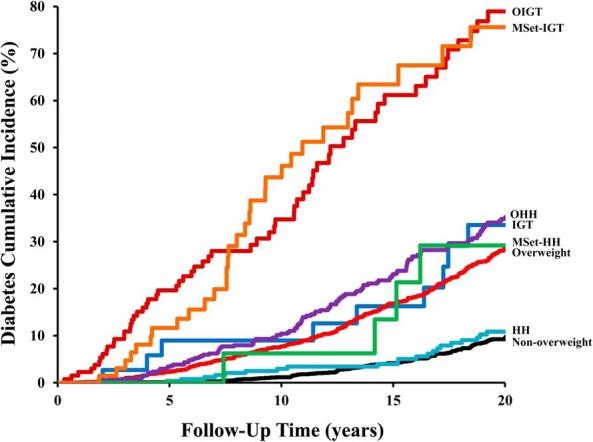
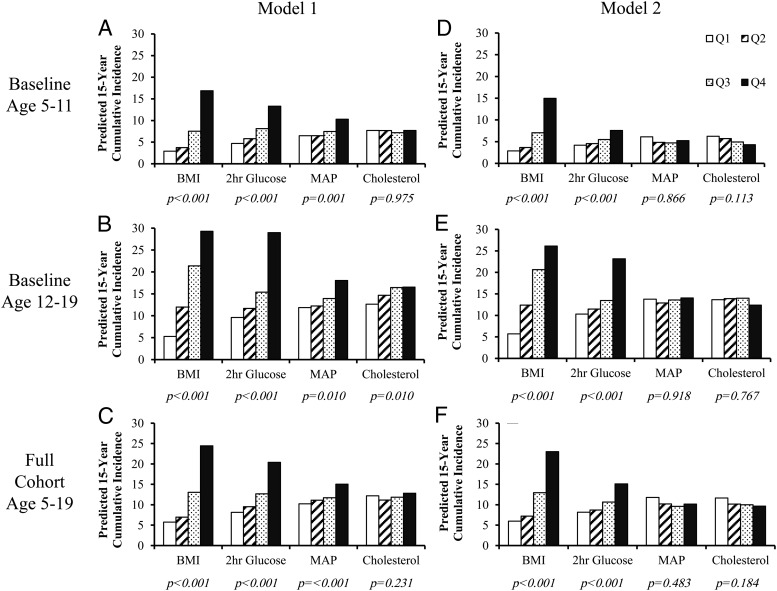
Results: A total of 1281 children developed diabetes (median follow-up, 12.4 years). Diabetes incidence was higher in overweight children (BMI ≥ 85th percentile) than in nonoverweight children. Nonoverweight children had the lowest risk of diabetes (20-year cumulative incidence, 9.5%), whereas overweight children with impaired glucose tolerance (2-hour glucose ≥ 140 mg/dL) had the highest (79.0%). The relative risk for children with metabolic abnormalities compared with their healthy counterparts was higher in younger children than in older children early in follow-up. BMI and 2-hour glucose were related to incident diabetes in multivariable models (predicted 15-year cumulative incidence for the highest vs lowest quartile was 3.9 and 1.8 times as high for BMI and 2-hour glucose, respectively; P < .001), whereas blood pressure and cholesterol were not.
Conclusions: BMI and impaired glucose tolerance in children are strong predictors of type 2 diabetes. Other components of the “metabolic syndrome” are not.
Figures
References
-
- Morrison JA, Friedman LA, Wang P, Glueck CJ. Metabolic syndrome in childhood predicts adult metabolic syndrome and type 2 diabetes mellitus 25 to 30 years later. J Pediatr. 2008;152:201–206. - PubMed
-
- McCance DR, Pettitt DJ, Hanson RL, Jacobsson LT, Bennett PH, Knowler WC. Glucose, insulin concentrations and obesity in childhood and adolescence as predictors of NIDDM. Diabetologia. 1994;37:617–623. - PubMed
-
- Magnussen CG, Koskinen J, Chen W, et al. Pediatric metabolic syndrome predicts adulthood metabolic syndrome, subclinical atherosclerosis, and type 2 diabetes mellitus but is no better than body mass index alone: the Bogalusa Heart Study and the Cardiovascular Risk in Young Finns Study. Circulation. 2010;122:1604–1611. - PMC - PubMed
-
- Morrison JA, Glueck CJ, Wang P. Childhood risk factors predict cardiovascular disease, impaired fasting glucose plus type 2 diabetes mellitus, and high blood pressure 26 years later at a mean age of 38 years: the Princeton-lipid research clinics follow-up study. Metabolism. 2012;61:531–541. - PMC - PubMed
Publication types
MeSH terms
Substances
LinkOut - more resources
Full Text Sources
Other Literature Sources
Medical
