


Xerostomia health-related quality of life: NRG oncology RTOG 0537
- PMID: 26914104
- PMCID: PMC4982852
- DOI: 10.1007/s11136-016-1255-0
Xerostomia health-related quality of life: NRG oncology RTOG 0537
Abstract
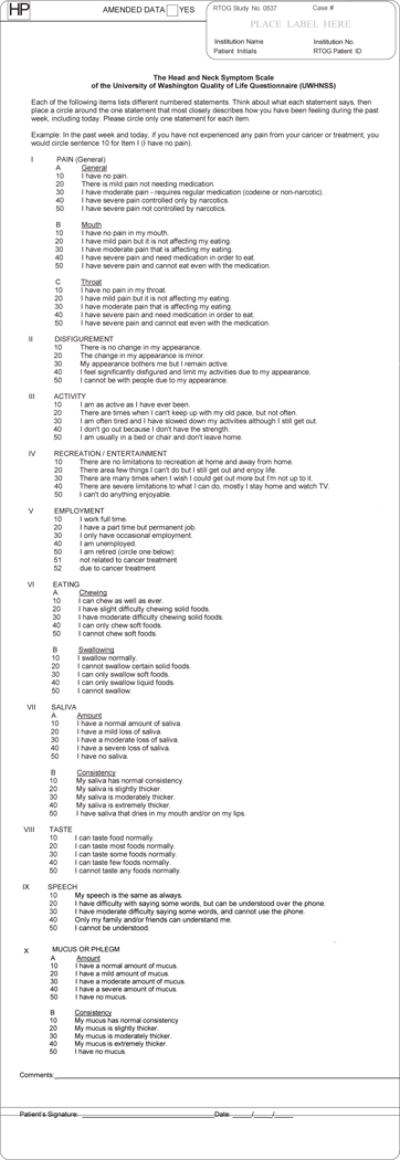
Purpose: The purpose of this secondary analysis was to determine change in overall health-related quality of life (HRQOL) based on patient data obtained from NRG Oncology RTOG 0537 as measured by the RTOG-modified University of Washington Head and Neck Symptom Score (RM-UWHNSS).
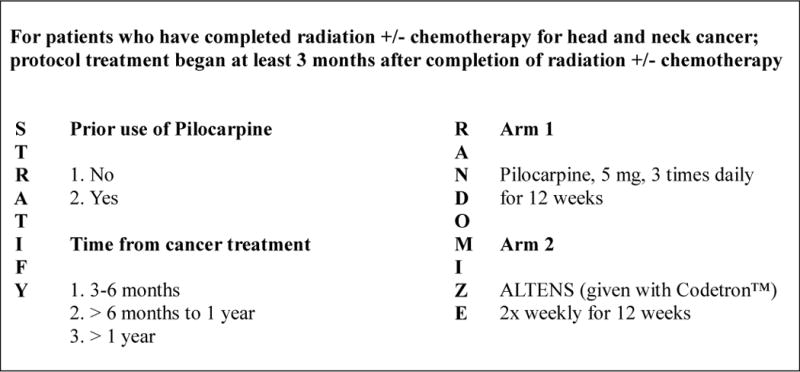
Methods: A multi-site prospective randomized clinical trial design stratified 137 patients with post-radiation therapy xerostomia according to prior pilocarpine (PC) treatment and time after radiation therapy and/or chemotherapy and randomized patients into two groups. Patients were assigned to acupuncture or PC. Twenty-four sessions of acupuncture-like transcutaneous electrical nerve stimulation (ALTENS) were administered over 12 weeks, or oral PC (5 mg) three times daily over the same 12 weeks. The RM-UWHNSS was administered at baseline and at 4, 6, 9, and 15 months after the date of randomization.
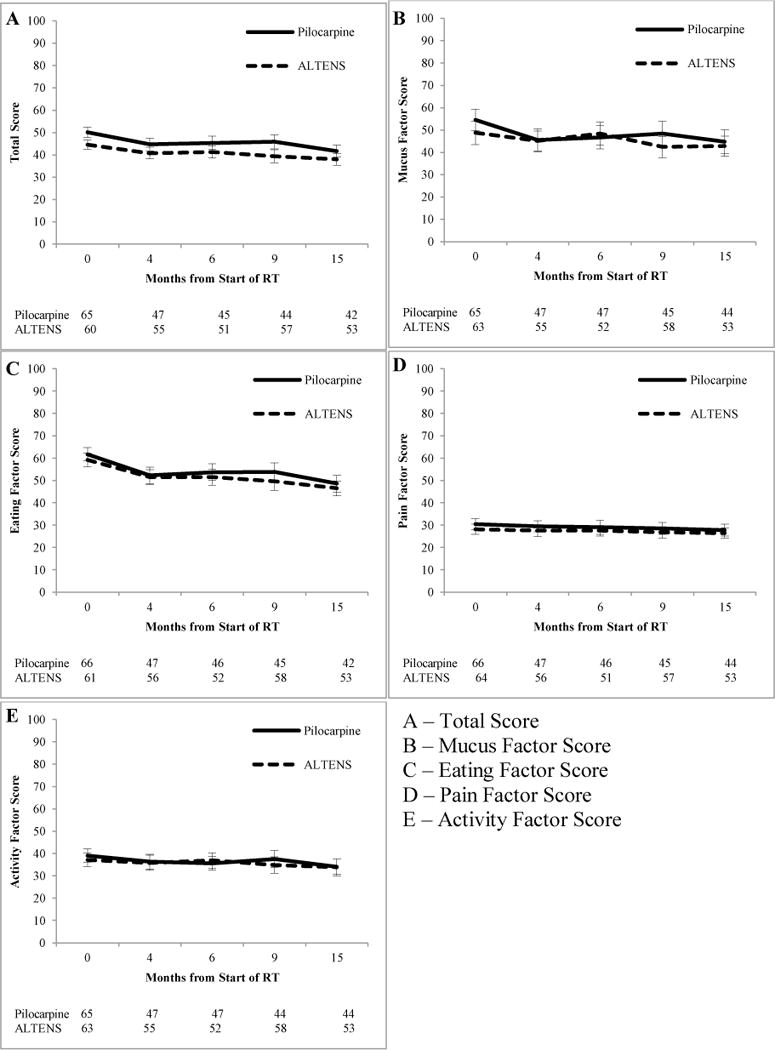
Results: There were no between-arm differences in change scores on the RM-UWHNSS in the individual items, total score, or factor scores. For statistical modeling, race and time were significant for all outcomes (total and factor scores), while treatment arm was not significant. The ALTENS arm showed greater yet nonsignificant improvement in outcomes compared to the PC arm.
Conclusion: Although no significant treatment differences were seen in this trial, patients receiving ALTENS consistently had lower scores, indicating better function, as compared to those receiving PC. Radiation-induced xerostomia improved over time for all patients.
Keywords: Acupuncture-like transcutaneous electrical nerve stimulation (ALTENS); Head and neck cancer; Radiation-induced xerostomia (RIX); Symptom management.
Conflict of interest statement
Figures

References
-
- Dirix P, Nuytx S, Vander Poorten V, Delaere P, Van den Bogaert W. The influence of xerostomia after radiotherapy on quality of life: results of a questionnaire in head and neck cancer. Supportive Care in Cancer. 2008;16(2):171–179. - PubMed
-
- Scarantino CLF, Swann RS, et al. Effect of pilocarpine during radiation therapy: Results of RTOG 97-09, a phase III randomized study in head and neck cancer patients. Journal of Support Oncology. 2006;4(5):252–258. - PubMed
-
- Wong R, Jones G, Sagar S, Babjak A, Whelan T. A Phase I-II study in the use of acupuncture-like transcutaneous nerve stimulation in the treatment of radiation-induced xerostomia in head-and-neck cancer patients treated with radical radiotherapy. International Journal of Radiation Oncology Biology Physics. 2003 Oct 1;57(2):472–480. - PubMed
-
- Wong R, James J, Sagar S, et al. Phase 2 results from Radiation Therapy Oncology Group Study 0537: a phase 2/3 study comparing acupuncture-like transcutaneous electrical nerve stimulation versus pilocarpine in treating early radiation-induced xerostomia. Cancer. 2012 Sep 1;118(17):4244–4252. - PMC - PubMed
Publication types
MeSH terms
Grants and funding
LinkOut - more resources
Full Text Sources
Other Literature Sources
Medical
