


doi: 10.1002/adma.201506420.
Epub 2016 Feb 24.
A Bioactive Carbon Nanotube-Based Ink for Printing 2D and 3D Flexible Electronics
Affiliations
- PMID: 26915715
- PMCID: PMC4850092
- DOI: 10.1002/adma.201506420
Item in Clipboard
A Bioactive Carbon Nanotube-Based Ink for Printing 2D and 3D Flexible Electronics
Adv Mater.
2016 May.
Erratum in
-
Correction to "A Bioactive Carbon Nanotube-Based Ink for Printing 2D and 3D Flexible Electronics".Adv Mater. 2025 Jul;37(30):e2511074. doi: 10.1002/adma.202511074. Epub 2025 Jun 25. Adv Mater. 2025. PMID: 40556558 No abstract available.
Abstract
The development of electrically conductive carbon nanotube-based inks is reported. Using these inks, 2D and 3D structures are printed on various flexible substrates such as paper, hydrogels, and elastomers. The printed patterns have mechanical and electrical properties that make them beneficial for various biological applications.
Keywords: 3D printing; biomaterials; carbon nanotubes; conductive inks; flexible electronics.
© 2016 WILEY-VCH Verlag GmbH & Co. KGaA, Weinheim.
Figures
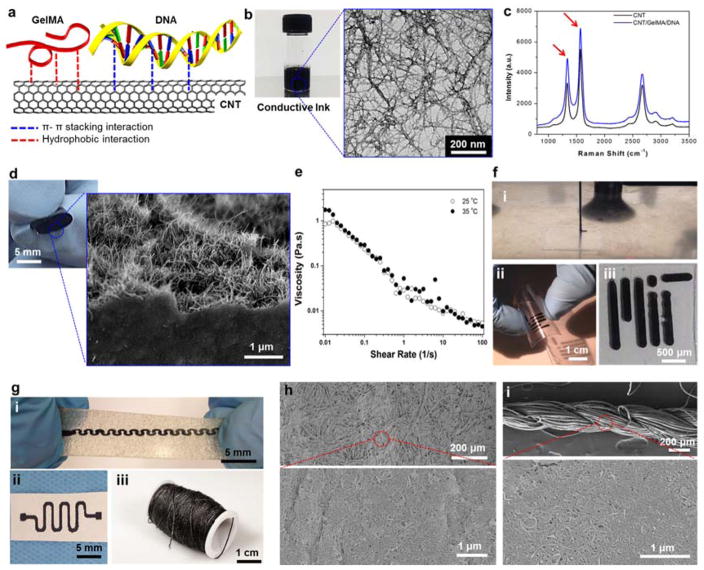
(a) Schematic diagram showing the GelMA/DNA-coated MWCNT inks formed though hydrogen bonding, hydrophobic interactions, and π-π stacking interactions between MWCNT and GelMA/DNA. (b) Photograph of black conductive ink and HRTEM image of individual or bundled GelMA/DNA-wrapped MWCNTs. (c) Raman spectrum of the MWCNTs and GelMA/DNA-coated MWCNTs. (d) Representative images of highly flexible hybrid films after rolling and an magnified SEM image showing a cross-section of MWCNTs coated with GelMA/DNA. (e) Viscosity dependence as a function of shear rate for GelMA/DNA-coated MWCNT inks. (f) Photograph of (i) nozzle-based printing using a glass capillary (ii) on a PEG coated PET film, and (iii) cellulose paper substrate. (g) Screen printing on (i) stretchable hydrocolloid substrate and (ii) cellulose paper (iii) dip coating on cotton thread. (h) SEM image of screen printed cellulose paper by GelMA/DNA-coated MWCNT ink. (i) SEM image of uniformly covered GelMA/DNA-coated MWCNT ink on a cotton thread.
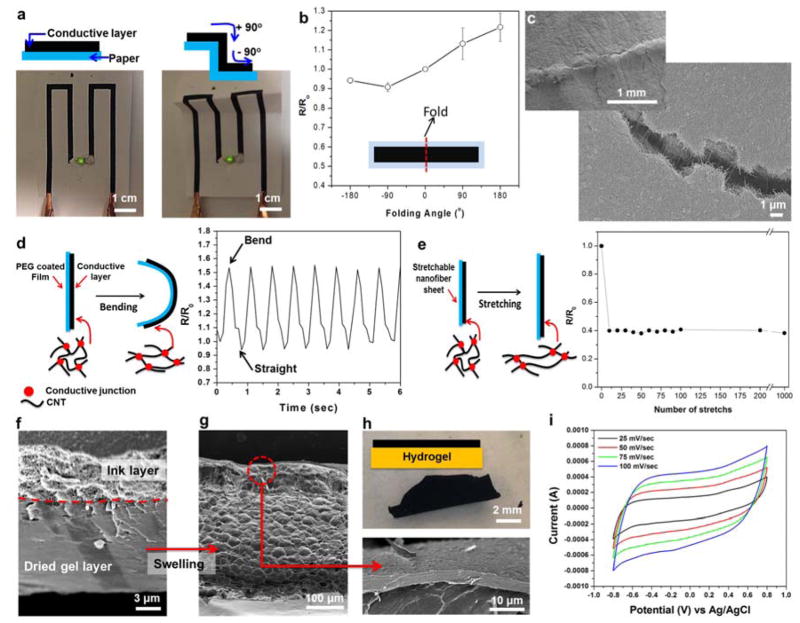
(a) Operation of a LED connected by ink circuits screen-printed on a cellulose paper substrate before and after folding. (b) Relative resistance change of the screen printed ink circuits fabricated on cellulose paper substrates and folded under various curvature angles. The inset is a schematic diagram of the ink circuit used for the measurement (Length × width = 5 cm × 1 cm). (c) SEM image of ink circuits on cellulose paper substrates after folding (180o). (d) Schematic diagram and the change in relative resistance after dynamic and cyclic bending deformation of the screen printed ink circuit on a PEG coated PET film. (e) Schematic diagram and relative resistance change as a function of elongation for ink circuits on stretchable PGS/PCL substrate (ε = 0.2 tensile strain). (f and g) Representative SEM images showing cross-section of the ink covered 7% GelMA hydrogel (Double layer) (f) before and (g) after swelling in PBS. (h) Photographs showing ink covered GelMA hydrogels after swelling in PBS. (i) Cyclic voltammetry of the ink coated 7% GelMA hydrogel in PBS.
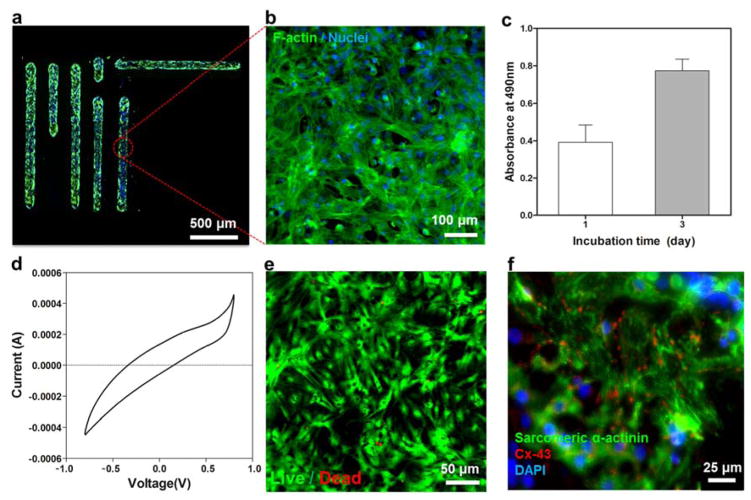
(a,b) Fluorescence images of cardiac fibroblasts cultured on ink patterns printed on PEG-coated PET film. F-actin and cell nuclei were immunostained and fluorescently labeled green and blue respectively. (c) MTS assay confirming the metabolic activity of the cells cultured on the printed ink after 1 and 3 days of culture. (d) Cyclic voltammetry of cardiomyocytes cultured on ink electrodes fabricated on PEG-coated PET films. (e) Live/dead assay after 200 charge and discharge cycles indicating high viability of cardiomyocytes. (f) Immunostaining of sarcomeric α-actinin (green), cell nuclei (blue), and Cx-43 (red) revealed that the cardiac tissues (8-day culture) created on ink patterns printed on PEG-coated PET film were phenotypically normal.
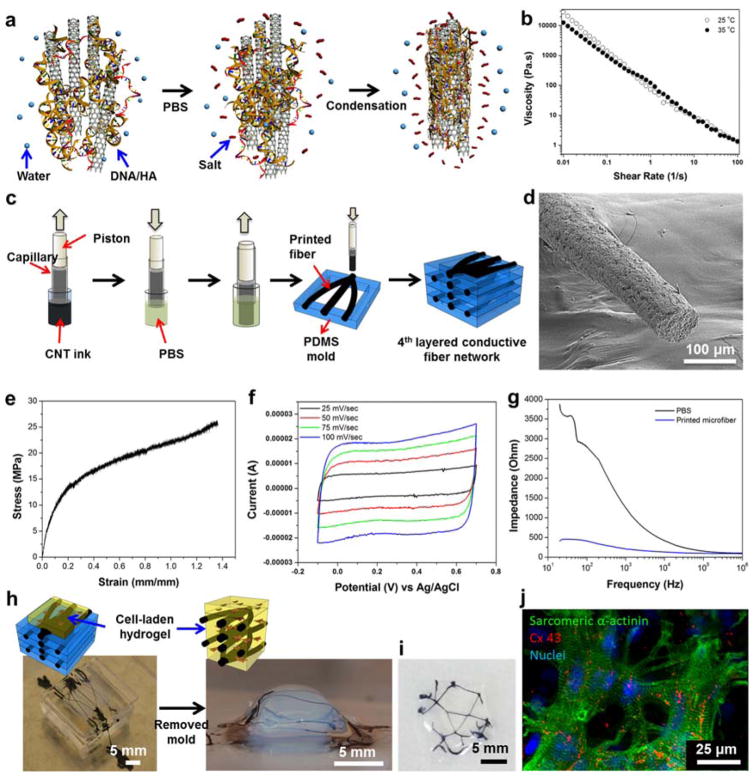
(a) Schematic diagram of coagulation process of DNA/HA-coated SWCNT inks. (b) Viscosity dependence as a function of shear rate for DNA/HA-coated SWCNT inks. (c) Schematic diagram of the 3D printing process. (d) SEM image of the porous printed fibers. (e) Strain-stress curve of swollen printed fibers (Elastic modulus: 63.56 ± 21.79 MPa, Toughness: 17.55 ± 7.14 MJ/m3, Elongation: 115.33 ± 18.58 %, Electrical conductivity: 128 ± 15 S/cm, (f) CV curve in PBS (Capacitance: 22.81 ± 1.5 F/g). (g) Overall impedance of printed microfibers in PBS. (h) Schematic diagram showing the incorporation of printed fiber network inside GelMA hydrogels. (i) Top view of printed fiber incorporated GelMA hydrogels. (j) Encapsulated cardiomyocytes in GelMA hydrogels with 3D stacked CNT fibers on day 10 immunostained for sarcomeric α-actinin (green), cell nuclei (blue), and Cx-43 (red).
References
-
- Gaikwad AM, Whiting GL, Steingart DA, Arias AC. Adv Mater. 2011;23:3251. - PubMed
- Kim Dae-Hyeong, Lu Nanshu, Ghaffari Roozbeh, Rogers JA. NPG Asia Materials. 2012;4:15.
- Garnier F, Hajlaoui R, Yassar A, Srivastava P. Science. 1994;265:1684. - PubMed
- Duan X, Fu TM, Liu J, Lieber CM. Nano Today. 2013;8:351. - PMC - PubMed
-
- Lu N, Kim D-H. Soft Robotics. 2014;1:9.
- Jeong GS, Baek DH, Jung HC, Song JH, Moon JH, Hong SW, Kim IY, Lee SH. Nat Commun. 2012;3:977. - PubMed
-
- Jung S, Kim JH, Kim J, Choi S, Lee J, Park I, Hyeon T, Kim DH. Advanced Materials. 2014;26:4825. - PubMed
-
- Kim DH, Lu N, Ma R, Kim YS, Kim RH, Wang S, Wu J, Won SM, Tao H, Islam A, Yu KJ, Kim TI, Chowdhury R, Ying M, Xu L, Li M, Chung HJ, Keum H, McCormick M, Liu P, Zhang YW, Omenetto FG, Huang Y, Coleman T, Rogers JA. Science. 2011;333:838. - PubMed
-
- Cheng T, Zhang Y, Lai WY, Huang W. Advanced Materials. 2015;27:3349. - PubMed
Publication types
MeSH terms
Substances
Grants and funding
LinkOut - more resources
Full Text Sources
Other Literature Sources
