


Assessment of the effectiveness of the CD3+ tool to detect counterfeit and substandard anti-malarials
- PMID: 26917250
- PMCID: PMC4766612
- DOI: 10.1186/s12936-016-1180-2
Assessment of the effectiveness of the CD3+ tool to detect counterfeit and substandard anti-malarials
Abstract
Background: The US FDA recently developed CD3+, a counterfeit detection tool that is based on sample illumination at specific wavelengths of light and visual comparison of suspect sample and packaging materials to an authentic sample. To test performance of the CD3+ in field conditions, a study was conducted in Ghana which compared the CD3+ side-by-side with two existing medicine quality screening technologies-TruScan™ Portable Raman spectrometer and GPHF Minilab(®).
Methods: A total of 84 anti-malarial test samples comprising artemether-lumefantrine tablets and artesunate-amodiaquine tablets were used. The technologies were evaluated for sensitivity in determining counterfeit/substandard (The term counterfeit or falsified is used in this article to refer to medicines that carry a false representation of identity or source or both. The term substandard is used to refer to medicines that do not meet the quality specifications given in the accepted pharmacopeia.) medicines, specificity in determining authentic products, and reliability of the results. Authentic samples obtained from manufacturers were used as reference standards. HPLC analysis data was used as the "gold standard" for decisions regarding a sample being authentic or substandard/counterfeit.
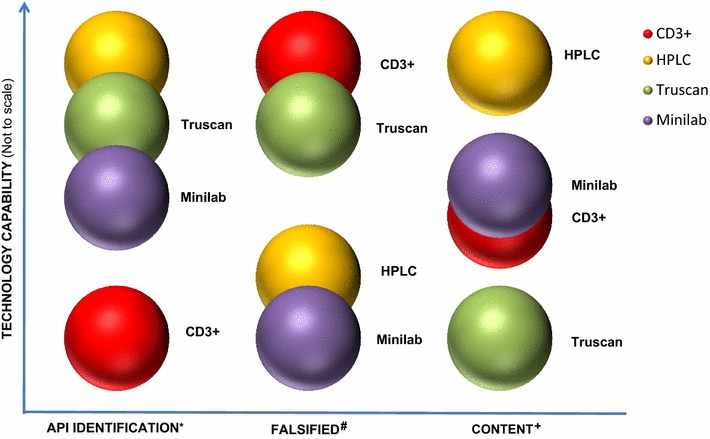
Results: CD3+ had a sensitivity of 1.00 in detecting counterfeit/substandard products compared to Minilab (0.79) and TruScan (0.79). CD3+ had a lower specificity (0.53) in determining authentic products compared to the specificities reached by Minilab (0.99) and TruScan (1.00). High sensitivity in this context means that the technology is effective in identifying substandard/counterfeit products whereas the low specificity means that the technique can sometimes mischaracterize good products as substandard/counterfeit. Examination of dosage units only (and not packaging) using CD3+ yielded improved specificity 0.64. When only assessment of sample identification was done, the TruScan provided sensitivity (1.00) and specificity (0.99); and the Minilab provided sensitivity (1.00) and specificity (1.00). All three technologies demonstrated 100 % reliability when used to analyse the same set of samples over 3 days by a single analyst and also when used to determine the same set of samples by three different analysts. Eight of the field samples were confirmed to be counterfeits with no active pharmaceutical ingredient content. All three technologies identified these samples as counterfeits.
Conclusions: The study revealed the relative effectiveness of the technologies as quality control tools. Using a combination of CD3+, with either the Minilab or TruScan, to screen for medicine quality will allow for complete examination of both the dosage units and the packaging to decide whether it is authentic or counterfeit.
Figures
References
-
- USP DQI United States pharmacopeia drug quality and information program. 2010. Survey of the quality of selected antimalarial medicines circulating in Madagascar, Senegal, and Uganda. 2010. http://www.usp.org/sites/default/files/usp_pdf/EN/PQM/QAMSAReport.pdf.
-
- Survey of the quality of selected antimalarial medicines circulating in six countries of sub-Saharan Africa. http://www.who.int/medicines/publications/WHO_QAMSA_report.pdf.
-
- Survey of the quality of anti-tuberculosis medicines circulating in selected newly independent States of the Former Soviet Union, November 2011. http://apps.who.int/medicinedocs/documents/s19053en/s19053en.pdf.
-
- Survey of the quality of antiretroviral medicines circulating in selected African countries, September 2007. http://apps.who.int/medicinedocs/documents/s14230e/s14230e.pdf.
Publication types
MeSH terms
Substances
LinkOut - more resources
Full Text Sources
Other Literature Sources
Medical
