


Isolated Hepatitis B Core Antibody Status Is Not Associated With Accelerated Liver Disease Progression in HIV/Hepatitis C Coinfection
- PMID: 26918547
- PMCID: PMC4911240
- DOI: 10.1097/QAI.0000000000000969
Isolated Hepatitis B Core Antibody Status Is Not Associated With Accelerated Liver Disease Progression in HIV/Hepatitis C Coinfection
Abstract
Background: Isolated hepatitis B core antibody (anti-HBc) is a common serologic finding in HIV-infected persons, but the clinical significance is uncertain. We studied HIV/hepatitis C virus (HCV)-infected women over time to determine whether the trajectory of liver disease progression is affected by isolated anti-HBc serologic status.
Methods: We performed serial enhanced liver fibrosis (ELF) markers on HIV/HCV-coinfected women to assess liver disease progression trajectory over time comparing women with isolated anti-HBc to women with either negative HB serologies, anti-HBs alone, or anti-HBc and anti-HBs. ELF, a serum marker that combines direct markers of extracellular matrix remodeling and fibrosis, was performed on serum stored biannually. Women with at least 3 ELF determinations and persistent HCV RNA positivity were included.
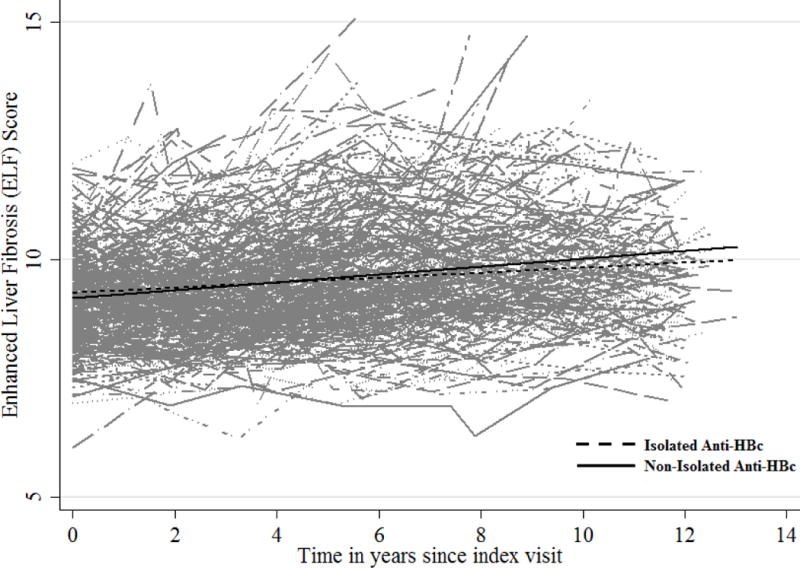
Results: Three hundred forty-four women, including 132 with isolated anti-HBc and 212 with other serologic findings, were included. A median of 6 (interquartile range, 5-7) biannual ELF values was available for each woman, totaling 2119 visits. ELF increased over time from a median of 9.07 for women with isolated anti-HBc and 9.10 for those without isolated anti-HBc to 9.83 and 9.88, respectively, with no difference in degree of change or slope in the mixed-effects model including age, race, CD4 count, antiretroviral therapy, and drug and alcohol use. Factors independently associated with liver disease progression were older age, lower CD4, antiretroviral therapy nonuse, and Hispanic ethnicity.
Conclusion: Isolated anti-HBc serologic status was not associated with accelerated liver disease progression over a median of 9.5 years among HIV/HCV-coinfected women.
Conflict of interest statement
Conflicts of Interest: All other authors, no conflicts of interest.
Figures
Similar articles
-
Significance and Management of Isolated Hepatitis B Core Antibody (Anti-HBc) in HIV and HCV: Strategies in the DAA Era.Curr HIV/AIDS Rep. 2018 Apr;15(2):172-181. doi: 10.1007/s11904-018-0379-y. Curr HIV/AIDS Rep. 2018. PMID: 29572624 Free PMC article. Review.
-
Long-term serologic follow-up of isolated hepatitis B core antibody in HIV-infected and HIV-uninfected women.Clin Infect Dis. 2009 Jul 1;49(1):148-54. doi: 10.1086/599610. Clin Infect Dis. 2009. PMID: 19480573 Free PMC article.
-
Frequency of isolated hepatitis B core antibody in HIV-hepatitis C virus co-infected individuals.Int J STD AIDS. 2009 May;20(5):336-8. doi: 10.1258/ijsa.2008.008377. Int J STD AIDS. 2009. PMID: 19386971
-
Predictors of the isolated hepatitis B core antibody pattern in HIV-infected and -uninfected men in the multicenter AIDS cohort study.Clin Infect Dis. 2013 Feb;56(4):606-12. doi: 10.1093/cid/cis908. Epub 2012 Oct 22. Clin Infect Dis. 2013. PMID: 23090927 Free PMC article.
-
Isolated anti-HBc: The Relevance of Hepatitis B Core Antibody-A Review of New Issues.Am J Gastroenterol. 2017 Dec;112(12):1780-1788. doi: 10.1038/ajg.2017.397. Epub 2017 Oct 31. Am J Gastroenterol. 2017. PMID: 29087395 Review.
Cited by
-
The Enhanced Liver Fibrosis Index Predicts Hepatic Fibrosis Superior to FIB4 and APRI in HIV/HCV Infected Patients.Clin Infect Dis. 2021 Aug 2;73(3):450-459. doi: 10.1093/cid/ciaa646. Clin Infect Dis. 2021. PMID: 32459305 Free PMC article.
-
Enhanced liver fibrosis score as a noninvasive biomarker in hepatitis C virus patients after direct-acting antiviral agents.Front Pharmacol. 2022 Aug 17;13:891398. doi: 10.3389/fphar.2022.891398. eCollection 2022. Front Pharmacol. 2022. PMID: 36059971 Free PMC article.
-
Update in HIV-hepatitis C virus coinfection in the direct acting antiviral era.Curr Opin Gastroenterol. 2017 May;33(3):120-127. doi: 10.1097/MOG.0000000000000347. Curr Opin Gastroenterol. 2017. PMID: 28234770 Free PMC article. Review.
-
Significance and Management of Isolated Hepatitis B Core Antibody (Anti-HBc) in HIV and HCV: Strategies in the DAA Era.Curr HIV/AIDS Rep. 2018 Apr;15(2):172-181. doi: 10.1007/s11904-018-0379-y. Curr HIV/AIDS Rep. 2018. PMID: 29572624 Free PMC article. Review.
References
-
- Grob P, Jilg W, Bornhak H, et al. Serological pattern “anti-HBc alone”: report on a workshop. J Med Virol. 2000;62(4):450–455. - PubMed
-
- Neau D, Winnock M, Jouvencel AC, et al. Occult hepatitis B virus infection in HIV-infected patients with isolated antibodies to hepatitis B core antigen: Aquitaine cohort, 2002–2003. Clin Infect Dis. 2005;40(5):750–753. - PubMed
-
- Gandhi RT, Wurcel A, McGovern B, et al. Low prevalence of ongoing hepatitis B viremia in HIV-positive individuals with isolated antibody to hepatitis B core antigen. J Acquir Immune Defic Syndr. 2003;34(4):439–441. - PubMed
-
- Quaglio G, Lugoboni F, Vento S, et al. Isolated presence of antibody to hepatitis B core antigen in injection drug users: do they need to be vaccinated? Clin Infect Dis. 2001;32(10):E143–144. - PubMed
Publication types
MeSH terms
Substances
Grants and funding
- U01 AI103397/AI/NIAID NIH HHS/United States
- U01 AI031834/AI/NIAID NIH HHS/United States
- U01 AI035004/AI/NIAID NIH HHS/United States
- P30 DK026743/DK/NIDDK NIH HHS/United States
- U01 AI034989/AI/NIAID NIH HHS/United States
- U01 AI034994/AI/NIAID NIH HHS/United States
- P30 AI027763/AI/NIAID NIH HHS/United States
- U01 AI103401/AI/NIAID NIH HHS/United States
- U01 AI103390/AI/NIAID NIH HHS/United States
- U01 AI034993/AI/NIAID NIH HHS/United States
- U01 AI103408/AI/NIAID NIH HHS/United States
- U01 AI042590/AI/NIAID NIH HHS/United States
LinkOut - more resources
Full Text Sources
Other Literature Sources
Medical
Research Materials
