


Graphene Paper Decorated with a 2D Array of Dendritic Platinum Nanoparticles for Ultrasensitive Electrochemical Detection of Dopamine Secreted by Live Cells
- PMID: 26918612
- PMCID: PMC5067619
- DOI: 10.1002/chem.201504454
Graphene Paper Decorated with a 2D Array of Dendritic Platinum Nanoparticles for Ultrasensitive Electrochemical Detection of Dopamine Secreted by Live Cells
Abstract
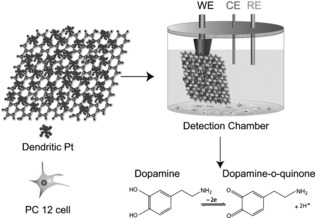
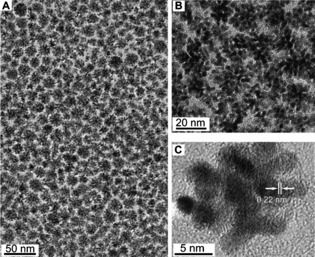
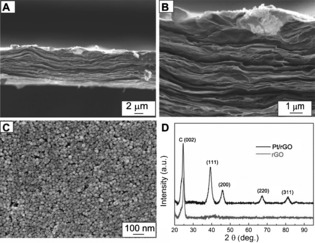
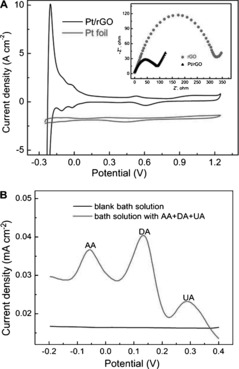
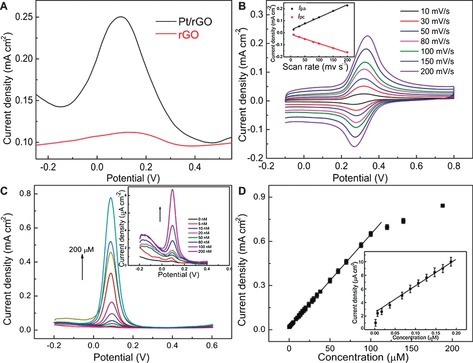
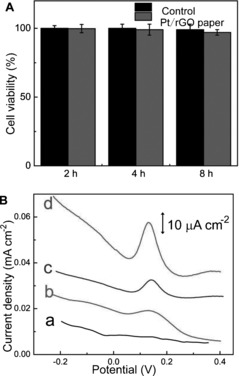
To circumvent the bottlenecks of non-flexibility, low sensitivity, and narrow workable detection range of conventional biosensors for biological molecule detection (e.g., dopamine (DA) secreted by living cells), a new hybrid flexible electrochemical biosensor has been created by decorating closely packed dendritic Pt nanoparticles (NPs) on freestanding graphene paper. This innovative structural integration of ultrathin graphene paper and uniform 2D arrays of dendritic NPs by tailored wet chemical synthesis has been achieved by a modular strategy through a facile and delicately controlled oil-water interfacial assembly method, whereby the uniform distribution of catalytic dendritic NPs on the graphene paper is maximized. In this way, the performance is improved by several orders of magnitude. The developed hybrid electrode shows a high sensitivity of 2 μA cm(-2) μM(-1), up to about 33 times higher than those of conventional sensors, a low detection limit of 5 nM, and a wide linear range of 87 nM to 100 μM. These combined features enable the ultrasensitive detection of DA released from pheochromocytoma (PC 12) cells. The unique features of this flexible sensor can be attributed to the well-tailored uniform 2D array of dendritic Pt NPs and the modular electrode assembly at the oil-water interface. Its excellent performance holds much promise for the future development of optimized flexible electrochemical sensors for a diverse range of electroactive molecules to better serve society.
Keywords: dopamine; graphene; living cells; platinum; sensors.
© 2016 The Authors. Published by Wiley-VCH Verlag GmbH & Co. KGaA.
Figures
Similar articles
-
Real-time electrochemical detection of hydrogen peroxide secretion in live cells by Pt nanoparticles decorated graphene-carbon nanotube hybrid paper electrode.Biosens Bioelectron. 2015 Jun 15;68:358-364. doi: 10.1016/j.bios.2015.01.017. Epub 2015 Jan 8. Biosens Bioelectron. 2015. PMID: 25603401
-
Highly exposed Pt nanoparticles supported on porous graphene for electrochemical detection of hydrogen peroxide in living cells.Biosens Bioelectron. 2015 Dec 15;74:71-7. doi: 10.1016/j.bios.2015.06.042. Epub 2015 Jun 20. Biosens Bioelectron. 2015. PMID: 26120812
-
Freestanding graphene paper decorated with 2D-assembly of Au@Pt nanoparticles as flexible biosensors to monitor live cell secretion of nitric oxide.Biosens Bioelectron. 2013 Nov 15;49:71-8. doi: 10.1016/j.bios.2013.05.006. Epub 2013 May 9. Biosens Bioelectron. 2013. PMID: 23722044
-
Ultrasonic-electrodeposition of PtPd alloy nanoparticles on ionic liquid-functionalized graphene paper: towards a flexible and versatile nanohybrid electrode.Nanoscale. 2016 Jan 21;8(3):1523-34. doi: 10.1039/c5nr06912b. Nanoscale. 2016. PMID: 26681401
-
Using Graphene-Based Biosensors to Detect Dopamine for Efficient Parkinson's Disease Diagnostics.Biosensors (Basel). 2021 Oct 31;11(11):433. doi: 10.3390/bios11110433. Biosensors (Basel). 2021. PMID: 34821649 Free PMC article. Review.
Cited by
-
Synthesis of metal-fluoride nanoparticles supported on thermally reduced graphite oxide.Beilstein J Nanotechnol. 2017 Nov 22;8:2474-2483. doi: 10.3762/bjnano.8.247. eCollection 2017. Beilstein J Nanotechnol. 2017. PMID: 29234583 Free PMC article.
-
A review on graphene-based nanocomposites for electrochemical and fluorescent biosensors.RSC Adv. 2019 Mar 18;9(16):8778-8881. doi: 10.1039/c8ra09577a. eCollection 2019 Mar 15. RSC Adv. 2019. PMID: 35517682 Free PMC article. Review.
-
Superlattice stacking by hybridizing layered double hydroxide nanosheets with layers of reduced graphene oxide for electrochemical simultaneous determination of dopamine, uric acid and ascorbic acid.Mikrochim Acta. 2019 Jan 9;186(2):61. doi: 10.1007/s00604-018-3158-y. Mikrochim Acta. 2019. PMID: 30627779
-
Electrical Property of Graphene and Its Application to Electrochemical Biosensing.Nanomaterials (Basel). 2019 Feb 20;9(2):297. doi: 10.3390/nano9020297. Nanomaterials (Basel). 2019. PMID: 30791566 Free PMC article. Review.
-
Synthesis of Metal Nanoparticles and Metal Fluoride Nanoparticles from Metal Amidinate Precursors in 1-Butyl-3-Methylimidazolium Ionic Liquids and Propylene Carbonate.ChemistryOpen. 2016 Dec 13;6(1):137-148. doi: 10.1002/open.201600105. eCollection 2017 Feb. ChemistryOpen. 2016. PMID: 28168159 Free PMC article.
References
-
- None
-
- Bernsmann F., Ponche A., Ringwald C., Hemmerlé J., Raya J., Bechinger B., Voegel J.-C., Schaaf P., Ball V., J. Phys. Chem. C 2009, 113, 8234–8242;
-
- Fante C., Eldar-Boock A., Satchi-Fainaro R., Osborn H. M. I., Greco F., J. Med. Chem. 2011, 54, 5255–5259; - PubMed
-
- Venton B. J., Wightman R. M., Anal. Chem. 2003, 75, 414A–421A.
-
- None
MeSH terms
Substances
LinkOut - more resources
Full Text Sources
Other Literature Sources
