. 2016 Jun;37(6):2013-26.
doi: 10.1002/hbm.23153. Epub 2016 Feb 25.

The implication of frontostriatal circuits in young smokers: A resting-state study

Affiliations

The implication of frontostriatal circuits in young smokers: A resting-state study

Kai Yuan et al. Hum Brain Mapp. 2016 Jun.

Abstract

The critical roles of frontostriatal circuits had been revealed in addiction. With regard to young smokers, the implication of frontostriatal circuits resting-state functional connectivity (RSFC) in smoking behaviors and cognitive control deficits remains unclear. In this study, the volume of striatum subsets, i.e., caudate, putamen, and nucleus accumbens, and corresponding RSFC differences were investigated between young smokers (n1 = 60) and nonsmokers (n2 = 60), which were then correlated with cigarette smoking measures, such as pack_years-cumulative effect of smoking, Fagerström Test for Nicotine Dependence (FTND)-severity of nicotine addiction, Questionnaire on Smoking Urges (QSU)-craving state, and Stroop task performances. Additionally, mediation analysis was carried out to test whether the frontostriatal RSFC mediates the relationship between striatum morphometry and cognitive control behaviors in young smokers when applicable. We revealed increased volume of right caudate and reduced RSFC between caudate and dorsolateral prefrontal cortex (DLPFC), orbitofrontal cortex in young smokers. Significant positive correlation between right caudate volume and QSU as well as negative correlation between anterior cingulate cortex-right caudate RSFC and FTND were detected in young smokers. More importantly, DLPFC-caudate RSFC strength mediated the relationship between caudate volume and incongruent errors during Stroop task in young smokers. Our results demonstrated that young smokers showed abnormal interactions within frontostriatal circuits, which were associated with smoking behaviors and cognitive control impairments. It is hoped that our study focusing on frontostriatal circuits could provide new insights into the neural correlates and potential novel therapeutic targets for treatment of young smokers. Hum Brain Mapp 37:2013-2026, 2016. © 2016 Wiley Periodicals, Inc.

Keywords: cognitive control; frontostriatal circuits; resting-state functional connectivity; striatum; young smokers.


Figures

Figure 1
Figure 1
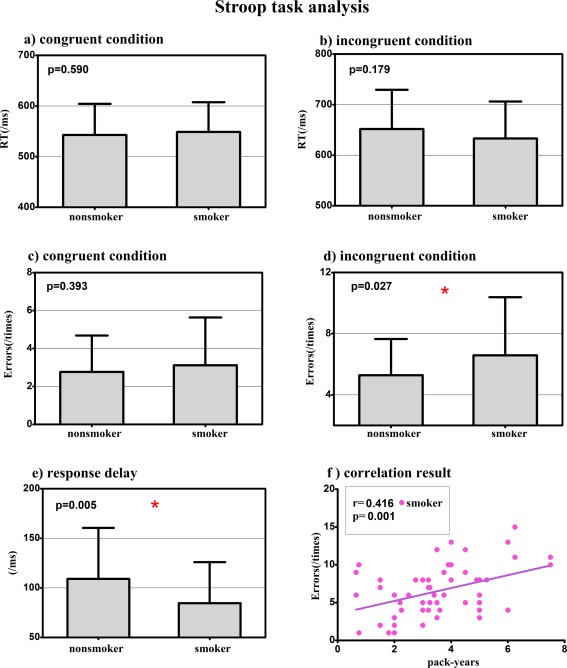
Cognitive control measurements in young smokers and nonsmokers. The young smokers committed more errors and shorter response delay (RD) than the nonsmokers during the incongruent condition. The pack_years, calculated by multiplying the average number of packs of cigarettes smoked per day with the number of years the participant smoked, were positively correlated with the incongruent errors in young smokers (r = 0. 164, P = 0.001). This result demonstrated that the cognitive control deficits measured by Stroop task was the behavioral marker of cumulative effect of long‐term smoking in young smokers. [Color figure can be viewed in the online issue, which is available at http://wileyonlinelibrary.com.]
Figure 2
Figure 2
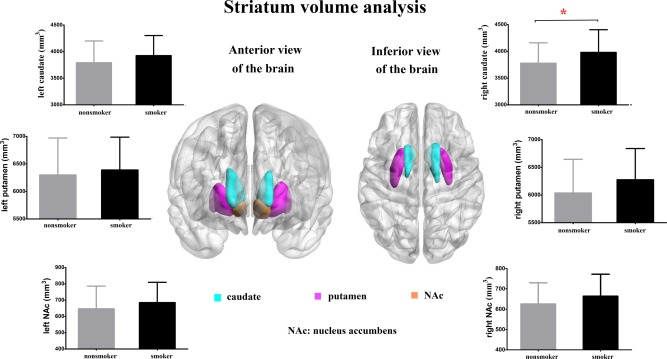
Striatum volume comparisons between young smokers and nonsmokers. The increased volumes of right caudate (F = 7.526, P =0.007) in young smokers were observed as compared with nonsmokers (Bonferroni corrected). No other significant differences were found between young smokers and nonsmokers when comparing the volume of the other subsets of the striatum. [Color figure can be viewed in the online issue, which is available at http://wileyonlinelibrary.com.]
Figure 3
Figure 3
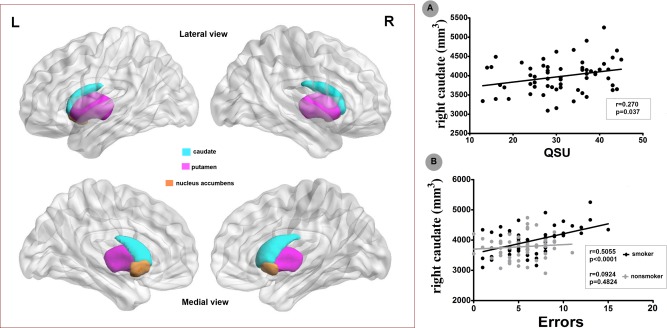
Striatum volume and incongruent condition errors of Stroop task. Correlation analysis revealed significant positive correlations between the right caudate volume and QSU‐the measurement of craving state (r = 0.27, P = 0.037) as well as the errors (r = 0.5055, P < 0.0001) during incongruent condition in Stroop task in young smokers. With regard to the nonsmokers, no significant correlations were detected between the striatum morphometry and Stroop task performances. These results suggested that the volume of caudate could reflect the craving state and cognitive control deficits in young smokers. [Color figure can be viewed in the online issue, which is available at http://wileyonlinelibrary.com.]
Figure 4
Figure 4
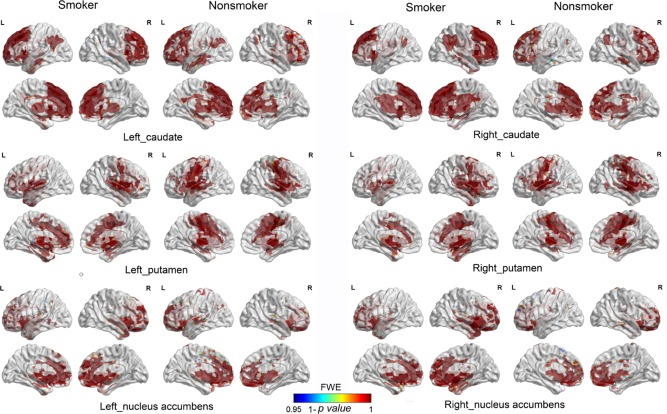
Striatum resting‐state functional connectivity (RSFC) networks. RSFC analysis generated similar caudate, putamen, and NAc networks in young smokers and nonsmokers, including the cortical regions (DLPFC, ACC, OFC, temporal, parietal, occipital, and limbic cortices), subcortical regions (thalamus, putamen, globus pallidus, caudate, midbrain, and pons), and cerebellum. [Color figure can be viewed in the online issue, which is available at http://wileyonlinelibrary.com.]
Figure 5
Figure 5
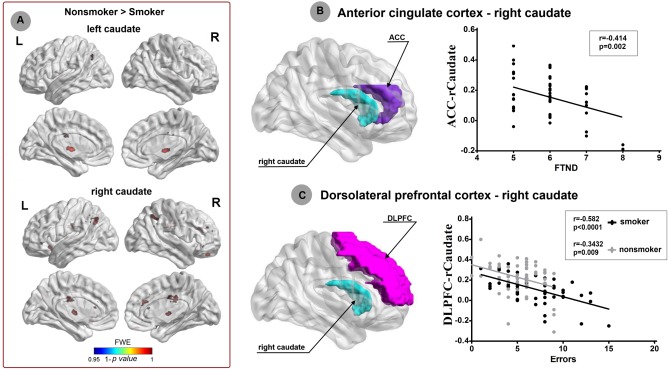
Striatum networks patterns and smoking behaviors. We revealed reduced RSFC between right caudate and several regions in young smokers (P < 0.05, FWE corrected), i.e., bilateral OFC, ACC, thalamus, angular gyrus, right DLPFC, and hippocampus. In addition, the left caudate showed decreased RSFC with bilateral ACC, thalamus, and right superior frontal gyrus (P < 0.05, FWE corrected). Significant negative correlation (r = −0.414; P = 0.002) was found between the ACC‐right caudate RSFC and FTND‐the severity of nicotine addiction in young smokers. Additionally, the incongruent response errors during Stroop task were negatively correlated with the right DLPFC‐caudate RSFC strength in young smokers (r = −0.582; P < 0.0001) and nonsmokers (r = −0.3432; P = 0.009). The results suggested that the ACC‐right caudate RSFC and right DLPFC‐caudate RSFC strength could reflect the severity of nicotine addiction and cognitive control deficits in young smokers, respectively. [Color figure can be viewed in the online issue, which is available at http://wileyonlinelibrary.com.]
Figure 6
Figure 6
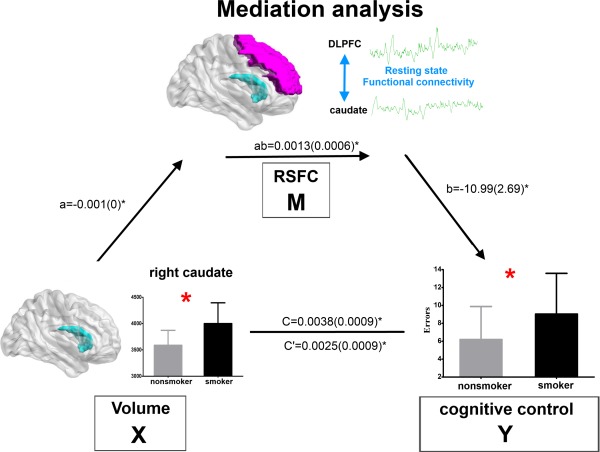
Mediation analysis. The frontostriatal RSFC z value (i.e., DLPFC‐caudate) mediated the relationship between caudate volume and committed errors during incongruent condition in the Stroop task (a × b = 0.0013 (0.006), P < 0.05; c′ = 0.0025 (0.0009), P < 0.05). [Color figure can be viewed in the online issue, which is available at http://wileyonlinelibrary.com.]

References

    1. Alexander GE, DeLong MR, Strick PL (1986): Parallel organization of functionally segregated circuits linking basal ganglia and cortex. Annu Rev Neuroscience 9:357–381. - PubMed
    1. Baron RM, Kenny DA (1986): The moderator–mediator variable distinction in social psychological research: Conceptual, strategic, and statistical considerations. J Personality Social Psychol 51:1173 - PubMed
    1. Barrett SP, Boileau I, Okker J, Pihl RO, Dagher A (2004): The hedonic response to cigarette smoking is proportional to dopamine release in the human striatum as measured by positron emission tomography and [11C] raclopride. Synapse 54:65–71. - PubMed
    1. Bauer UE, Briss PA, Goodman RA, Bowman BA (2014): Prevention of chronic disease in the 21st century: Elimination of the leading preventable causes of premature death and disability in the USA. Lancet 384:45–52. - PubMed
    1. Y Bi, K Yuan, Y Guan, J Cheng, Y Zhang, Y Li, D Yu, W Qin, J Tian (2016): Altered resting state functional connectivity of anterior insula in young smokers. Brain Imag Behav DOI: 10.1007/s11682-016-9511-z. - DOI - PubMed

MeSH terms