


Efficacy of virtual reality exposure therapy for treatment of dental phobia: a randomized control trial
- PMID: 26920573
- PMCID: PMC4769551
- DOI: 10.1186/s12903-016-0186-z
Efficacy of virtual reality exposure therapy for treatment of dental phobia: a randomized control trial
Abstract
Background: Virtual Reality Exposure Therapy (VRET) is found to be a promising and a viable alternative for in vivo exposure in the treatment of specific phobias. However, its usefulness for treating dental phobia is unexplored. The aims of the present study are to determine: (a) the efficacy of VRET versus informational pamphlet (IP) control group in terms of dental trait and state anxiety reductions at 1 week, 3 months and 6 months follow-up (b) the real-time physiological arousal [heart rate (HR)] of VRET group participants during and following therapy (c) the relation between subjective (presence) and objective (HR) measures during VRET.
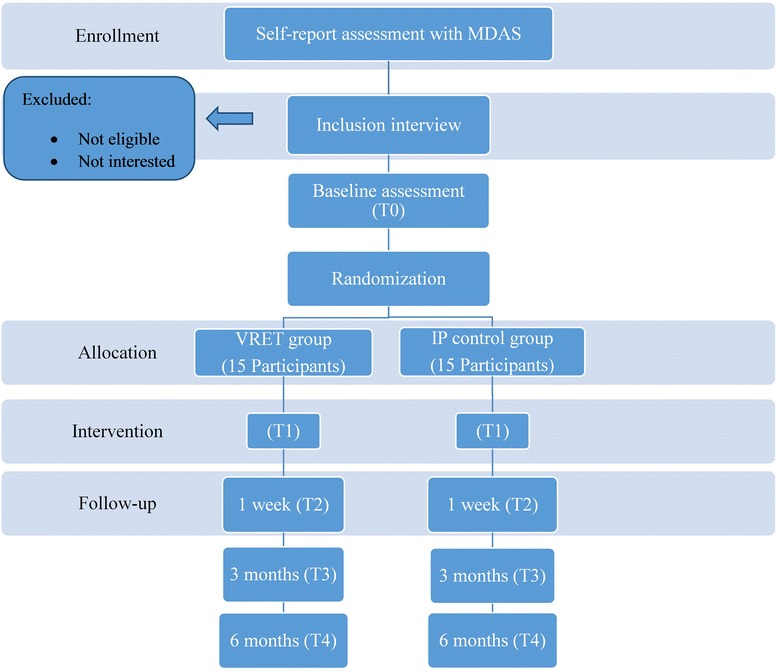
Methods: This study is a single blind, randomized controlled trial with two parallel arms in which participants will be allocated to VRET or IP with a ratio of 1:1. Thirty participants (18-50 years) meeting the Phobia Checklist criteria of dental phobia will undergo block randomization with allocation concealment. The primary outcome measures include participants' dental trait anxiety (Modified Dental Anxiety Scale and Dental Fear Survey) and state anxiety (Visual Analogue Scale) measured at baseline (T0), at intervention (T1), 1-week (T2), 3 months (T3) and 6 months (T4) follow-up. A behavior test will be conducted before and after the intervention. The secondary outcome measures are real-time evaluation of HR and VR (Virtual Reality) experience (presence, realism, nausea) during and following the VRET intervention respectively. The data will be analyzed using intention-to-treat and per-protocol analysis.
Discussion: This study uses novel non-invasive VRET, which may provide a possible alternative treatment for dental anxiety and phobia.
Trial registration number: ISRCTN25824611 , Date of registration: 26 October 2015.
Figures
References
-
- Getka EJ, Glass CR. Behavioral and cognitive-behavioral approaches to the reduction of dental anxiety. Behav Ther. 1992;23(3):433–448. doi: 10.1016/S0005-7894(05)80168-6. - DOI
-
- Milgrom PWP, Getz T. Treating Fearful Dental Patients: A Patient Management Handbook. 2. Seattle, Wash: University of Washington; 1995.
Publication types
MeSH terms
Associated data
LinkOut - more resources
Full Text Sources
Other Literature Sources
Medical
