A Comprehensive Review of the Treatment of Atopic Eczema
- PMID: 26922927
- PMCID: PMC4773205
- DOI: 10.4168/aair.2016.8.3.181
A Comprehensive Review of the Treatment of Atopic Eczema
Abstract
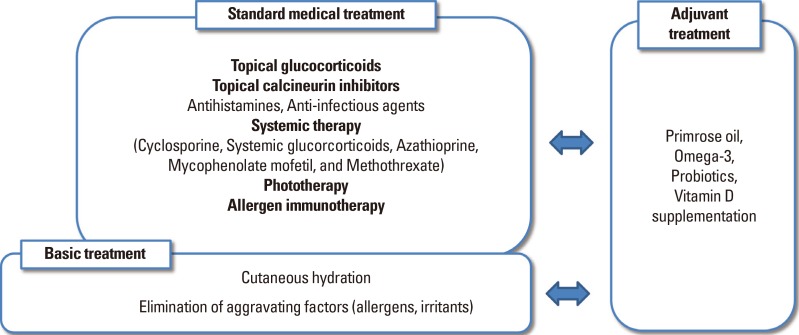
Atopic eczema (AE) is a chronic, inflammatory skin disorder which usually develops in early childhood. In spite of intensive investigations, the causes of AE remain unclear, but are likely to be multifactorial in nature. Environmental factors or genetic-environmental interactions seem to play a key role in disease progression. Among various measures of AE managment, cutaneous hydration, which improves barrier function and relieve itchiness, may be helpful to reduce the need for topical steroid use and therefore should be used as a basic treatment. Avoiding aggravating factors is also a basic treatment of AE. Standard medical treatment with a pharmacologic approach may be necessary if basic treatment fails to control symptoms satisfactorily. Recently, more attention is given to a proactive therapeutic by regular intermittent application of low potency steroids or topical calcineurin inhibitors to prevent new flares. Furthermore, various targeted biologics are being introduced for AE control and are proposed as promising therapies. This paper provides a summary of the recent literature on the manangement of AE and a treatment guideline.
Keywords: Eczema; atopic dermatitis; atopic eczema; epidemiology; prevention; treatment.
Conflict of interest statement
There are no financial or other issues that might lead to conflict of interest.
Figures
References
-
- Williams HC, Strachan DP. The natural history of childhood eczema: observations from the British 1958 birth cohort study. Br J Dermatol. 1998;139:834–839. - PubMed
-
- Friedmann PS. The pathogenesis of atopic eczema. Hosp Med. 2002;63:653–656. - PubMed
-
- Palmer CN, Irvine AD, Terron-Kwiatkowski A, Zhao Y, Liao H, Lee SP, et al. Common loss-of-function variants of the epidermal barrier protein filaggrin are a major predisposing factor for atopic dermatitis. Nat Genet. 2006;38:441–446. - PubMed
-
- Asher MI, Montefort S, Björkstén B, Lai CK, Strachan DP, Weiland SK, et al. Worldwide time trends in the prevalence of symptoms of asthma, allergic rhinoconjunctivitis, and eczema in childhood: ISAAC Phases One and Three repeat multicountry cross-sectional surveys. Lancet. 2006;368:733–743. - PubMed