. 2016 Feb 29:17:152.
doi: 10.1186/s12864-016-2489-5.

Antagonism between Staphylococcus epidermidis and Propionibacterium acnes and its genomic basis

Affiliations

Antagonism between Staphylococcus epidermidis and Propionibacterium acnes and its genomic basis

Gitte J M Christensen et al. BMC Genomics. .

Abstract

Background: Propionibacterium acnes and Staphylococcus epidermidis live in close proximity on human skin, and both bacterial species can be isolated from normal and acne vulgaris-affected skin sites. The antagonistic interactions between the two species are poorly understood, as well as the potential significance of bacterial interferences for the skin microbiota. Here, we performed simultaneous antagonism assays to detect inhibitory activities between multiple isolates of the two species. Selected strains were sequenced to identify the genomic basis of their antimicrobial phenotypes.

Results: First, we screened 77 P. acnes strains isolated from healthy and acne-affected skin, and representing all known phylogenetic clades (I, II, and III), for their antimicrobial activities against 12 S. epidermidis isolates. One particular phylogroup (I-2) exhibited a higher antimicrobial activity than other P. acnes phylogroups. All genomes of type I-2 strains carry an island encoding the biosynthesis of a thiopeptide with possible antimicrobial activity against S. epidermidis. Second, 20 S. epidermidis isolates were examined for inhibitory activity against 25 P. acnes strains. The majority of S. epidermidis strains were able to inhibit P. acnes. Genomes of S. epidermidis strains with strong, medium and no inhibitory activities against P. acnes were sequenced. Genome comparison underlined the diversity of S. epidermidis and detected multiple clade- or strain-specific mobile genetic elements encoding a variety of functions important in antibiotic and stress resistance, biofilm formation and interbacterial competition, including bacteriocins such as epidermin. One isolate with an extraordinary antimicrobial activity against P. acnes harbors a functional ESAT-6 secretion system that might be involved in the antimicrobial activity against P. acnes via the secretion of polymorphic toxins.

Conclusions: Taken together, our study suggests that interspecies interactions could potentially jeopardize balances in the skin microbiota. In particular, S. epidermidis strains possess an arsenal of different mechanisms to inhibit P. acnes. However, if such interactions are relevant in skin disorders such as acne vulgaris remains questionable, since no difference in the antimicrobial activity against, or the sensitivity towards S. epidermidis could be detected between health- and acne-associated strains of P. acnes.


Figures
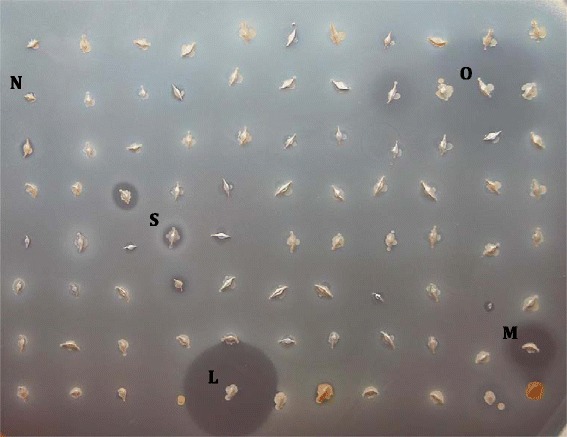
Fig. 1
Fig. 1
Simultaneous antagonism assay of S. epidermidis against P. acnes. A representative result of a simultaneous antagonism assay is shown. A large TS agar plate was floated with a suspension of a P. acnes indicator strain, and strains of S. epidermidis were point-inoculated on the agar surface. Growth inhibition around several of the S. epidermidis colonies is apparent. Diameters of the depicted inhibitory zones ranged from 3 mm to 20 mm. Arrows point to the individual zones of inhibition, i.e., opaque (O), small (S), medium (M), large (L) zones, or no inhibition zone (N)
Fig. 2
Fig. 2
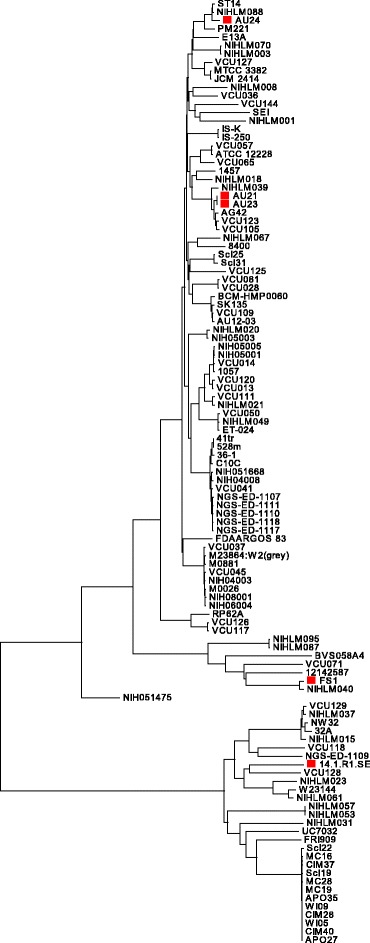
Phylogenetic tree of 112 S. epidermidis strains based on the shared core genome. Phylogenetic analysis the core genome sequence of approximately 1.7 Mb divides the S. epidermidis strain population in two distinct clades. The sequenced strains used in the antagonism assay are highlighted in red
Fig. 3
Fig. 3
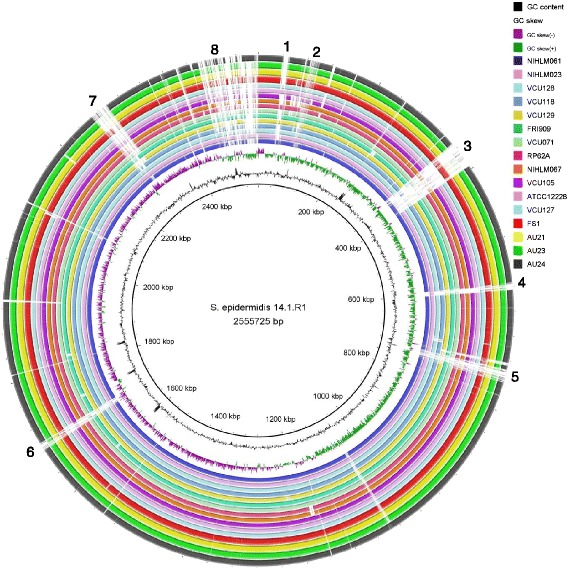
Genome comparison of 17 S. epidermidis strains. Strain 14.1.R1 was used as the reference genome. The four newly sequenced genomes of strains FS1, AU23, AU21 and AU24 are represented by the four outermost rings. The other 13 genomes were selected based on their position in the phylogenetic core genome tree, which shows the clustering of strains VCU128, NIHLM023, NIHLM061, VCU118 and VCU129 with strain 14.1.R1 (Fig. 2). Regions of genomic variability (1-8) can be detected (see Additional file 7C for their gene content). The BRIG program was used to generate the figure
Fig. 4
Fig. 4
Genomic locus in S. epidermidis 14.1.R1 encoding an ESAT-6 secretion system and multiple nuclease/immunity protein pairs. In orange, ESAT-6 secretion system (ESS) and secreted effectors (from right to left: esxA, esaA, essA, esaB, essB, essC, unknown effector, esxB), In red: proteins with DNA/RNA nuclease domains, possible toxin components; in green, SMI1/KNR4 family (SUKH-1) domain proteins, possible immunity components; lila, serine protease (NfeD-like protein); in blue, proteins with domains of unknown function (DUF600, DUF1851, DUF4467). PTS, polymorphic toxin system. See Additional file 7C for the genomic location and annotation

References

    1. Findley K, Oh J, Yang J, Conlan S, Deming C, Meyer JA, et al. Topographic diversity of fungal and bacterial communities in human skin. Nature. 2013;498:367–370. doi: 10.1038/nature12171. - DOI - PMC - PubMed
    1. Oh J, Byrd AL, Deming C, Conlan S, Kong HH, Segre JA. Biogeography and individuality shape function in the human skin metagenome. Nature. 2014;514:59–64. doi: 10.1038/nature13786. - DOI - PMC - PubMed
    1. Grice EA, Segre JA. The skin microbiome. Nat Rev Microbiol. 2011;9:244–253. doi: 10.1038/nrmicro2537. - DOI - PMC - PubMed
    1. Vuong C, Otto M. Staphylococcus epidermidis infections. Microbes Infect. 2002;4:481–489. doi: 10.1016/S1286-4579(02)01563-0. - DOI - PubMed
    1. Coates R, Moran J, Horsburgh MJ. Staphylococci: colonizers and pathogens of human skin. Future Microbiol. 2014;9:75–91. doi: 10.2217/fmb.13.145. - DOI - PubMed

Publication types

MeSH terms