Review
. 2016 Apr:196:14-24.
doi: 10.1016/j.autneu.2016.02.010. Epub 2016 Feb 23.

Central neural control of thermoregulation and brown adipose tissue

Affiliations
Review

Central neural control of thermoregulation and brown adipose tissue

Shaun F Morrison. Auton Neurosci. 2016 Apr.

Abstract

Central neural circuits orchestrate the homeostatic repertoire that maintains body temperature during environmental temperature challenges and alters body temperature during the inflammatory response. This review summarizes the experimental underpinnings of our current model of the CNS pathways controlling the principal thermoeffectors for body temperature regulation: cutaneous vasoconstriction controlling heat loss, and shivering and brown adipose tissue for thermogenesis. The activation of these effectors is regulated by parallel but distinct, effector-specific, core efferent pathways within the CNS that share a common peripheral thermal sensory input. Via the lateral parabrachial nucleus, skin thermal afferent input reaches the hypothalamic preoptic area to inhibit warm-sensitive, inhibitory output neurons which control heat production by inhibiting thermogenesis-promoting neurons in the dorsomedial hypothalamus that project to thermogenesis-controlling premotor neurons in the rostral ventromedial medulla, including the raphe pallidus, that descend to provide the excitation of spinal circuits necessary to drive thermogenic thermal effectors. A distinct population of warm-sensitive preoptic neurons controls heat loss through an inhibitory input to raphe pallidus sympathetic premotor neurons controlling cutaneous vasoconstriction. The model proposed for central thermoregulatory control provides a useful platform for further understanding of the functional organization of central thermoregulation and elucidating the hypothalamic circuitry and neurotransmitters involved in body temperature regulation.

Keywords: Brown adipose tissue; Cutaneous vasoconstriction; Dorsomedial hypothalamus; Fever; Preoptic hypothalamus; Rostral raphe pallidus; Shiver; Sympathetic nerve activity; Thermogenesis.


Figures

Figure 1
Figure 1
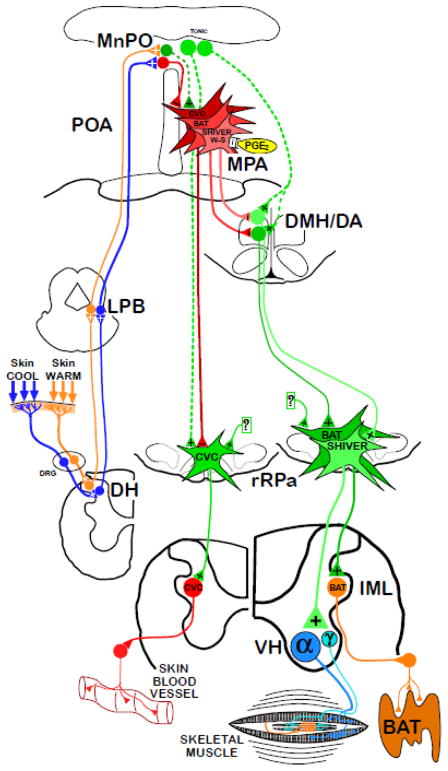
Functional neuroanatomical model for the fundamental pathways providing the thermoregulatory control and pyrogenic activation of cutaneous vasoconstriction (CVC), brown adipose tissue (BAT) and shivering thermogenesis. Cool and warm cutaneous thermoreceptors transmit signals to respective primary sensory neurons in the dorsal root ganglia (DRG) which relay this information to second-order thermal sensory neurons in the dorsal horn (DH). Cool sensory DH neurons glutamatergically activate third-order sensory neurons in the external lateral subnucleus of the lateral parabrachial nucleus (LPB), while warm sensory DH neurons project to third-order sensory neurons in the dorsal subnucleus of the LPB. Thermosensory signals driving thermoregulatory responses are transmitted from the LPB to the preoptic area (POA) where GABAergic interneurons (red) in the median preoptic (MnPO) subnucleus are activated by glutamatergic inputs from cool-activated neurons in LPB and inhibit each of the distinct populations of warm-sensitive (W-S) neurons in the medial preoptic area (MPA) that control CVC, BAT and shivering. In contrast, glutamatergic interneurons (dark green) in the MnPO are postulated to be excited by glutamatergic inputs from warm-activated neurons in LPB and, in turn, excite W-S neurons in MPA. Prostaglandin (PG) E2 binds to EP3 receptors on each of the classes of W-S neurons in the POA to inhibit their activity. The MnPO also contains neurons (light green) that provide an excitatory input to CVC premotor neurons in the rostral raphe pallidus (rRPa), and neurons (light green) that excite BAT- and shivering- promoting neurons in the dorsomedial hypothalamus and dorsal hypothalamic area (DMH/DA). Preoptic W-S neurons provide inhibitory control of CVC by inhibiting CVC sympathetic premotor neurons in the rostral ventromedial medulla, including the rRPa, that project to CVC sympathetic preganglionic neurons in the intermediolateral nucleus (IML). Preoptic W-S neurons providing inhibitory thermoregulatory control of BAT and shivering thermogenesis inhibit BAT sympathoexcitatory neurons and shivering promoting neurons, respectively, in the DMH/DA, which, when disinhibited during skin and core cooling, provide respective excitatory drives to BAT sympathetic premotor neurons and to skeletal muscle shivering premotor neurons in the rRPa. These, in turn, project, respectively, to BAT sympathetic preganglionic neurons in the IML, and to alpha (α) and gamma (γ) motoneurons in the ventral horn (VH) of the spinal cord.

References

    1. Almeida MC, Steiner AA, Branco LG, Romanovsky AA. Neural substrate of cold-seeking behavior in endotoxin shock. PLoS ONE. 2006;1:e1. - PMC - PubMed
    1. Andresen MC, Hofmann ME, Fawley JA. The unsilent majority-TRPV1 drives “spontaneous” transmission of unmyelinated primary afferents within cardiorespiratory NTS. Am J Physiol Regul Integr Comp Physiol. 2012;303:R1207–1216. - PMC - PubMed
    1. Baker MA, Doris PA. Control of evaporative heat loss during changes in plasma osmolality in the cat. J Physiol. 1982;328:535–545. - PMC - PubMed
    1. Bamshad M, Song CK, Bartness TJ. CNS origins of the sympathetic nervous system outflow to brown adipose tissue. Am J Physiol. 1999;276:R1569–1578. - PubMed
    1. Bautista DM, Siemens J, Glazer JM, Tsuruda PR, Basbaum AI, Stucky CL, Jordt SE, Julius D. The menthol receptor TRPM8 is the principal detector of environmental cold. Nature. 2007;448:204–208. - PubMed

MeSH terms