


Impact of the Baby-friendly Hospital Initiative on breastfeeding and child health outcomes: a systematic review
- PMID: 26924775
- PMCID: PMC6860129
- DOI: 10.1111/mcn.12294
Impact of the Baby-friendly Hospital Initiative on breastfeeding and child health outcomes: a systematic review
Abstract
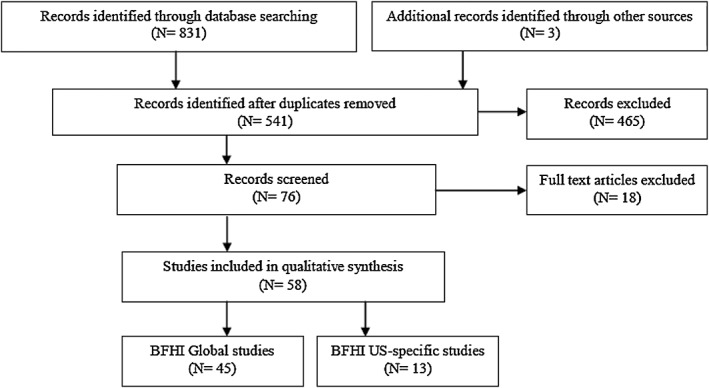
The Baby-friendly Hospital Initiative (BFHI) is a key component of the World Health Organization/United Nations Children's Fund Global Strategy for Infant and Young Child Feeding. The primary aim of this narrative systematic review was to examine the impact of BFHI implementation on breastfeeding and child health outcomes worldwide and in the United States. Experimental, quasi-experimental and observational studies were considered eligible for this review if they assessed breastfeeding outcomes and/or infant health outcomes for healthy, term infants born in a hospital or birthing center with full or partial implementation of BFHI steps. Of the 58 reports included in the systematic review, nine of them were published based on three randomized controlled trials, 19 followed quasi-experimental designs, 11 were prospective and 19 were cross-sectional or retrospective. Studies were conducted in 19 different countries located in South America, North America, Western Europe, Eastern Europe, South Asia, Eurasia and Sub-Saharan Africa. Adherence to the BFHI Ten Steps has a positive impact on short-term, medium-term and long-term breastfeeding (BF) outcomes. There is a dose-response relationship between the number of BFHI steps women are exposed to and the likelihood of improved BF outcomes (early BF initiation, exclusive breastfeeding (EBF) at hospital discharge, any BF and EBF duration). Community support (step 10) appears to be essential for sustaining breastfeeding impacts of BFHI in the longer term.
Keywords: Baby-Friendly Hospital Initiative; breastfeeding protection; child health; promotion and support.
© 2016 John Wiley & Sons Ltd.
Conflict of interest statement
The authors declare that they have no conflicts of interest.
Figures
References
-
- Abolyan L.V. (2006) The breastfeeding support and promotion in Baby‐Friendly Maternity Hospitals and not‐as‐yet Baby‐Friendly Hospitals in Russia. Breastfeeding Medicine: The Official Journal of the Academy of Breastfeeding Medicine 1 (2), 71–8. - PubMed
-
- Bartington S., Griffiths L. J., Tate A. R., Dezateux C. & Millennium Cohort Study Health, G. (2006) Are breastfeeding rates higher among mothers delivering in Baby Friendly accredited maternity units in the UK? International Journal of Epidemiology, 35(5), 1178–86. - PubMed
-
- Beake S., Pellowe C., Dykes F., Schmied V. & Bick D. (2012) A systematic review of structured compared with non‐structured breastfeeding programmes to support the initiation and duration of exclusive and any breastfeeding in acute and primary health care settings. Maternal & Child Nutrition 2, 141–61. - PMC - PubMed
-
- Bosnjak A.P., Batinica M., Hegedus‐Jungvirth M., Grguric J. & Bozikov J. (2004) The effect of baby friendly hospital initiative and postnatal support on breastfeeding rates – Croatian experience. Collegium Antropologicum 28 (1), 235–43. - PubMed
-
- Bowatte G., Tham R., Allen K.J., Tan D.J., Lau M., Dai X. et al. (2015) Breastfeeding and childhood acute otitis media: a systematic review and meta‐analysis. Acta Paediatrica. Supplementum 104 (467), 85–95. - PubMed
Publication types
MeSH terms
LinkOut - more resources
Full Text Sources
Other Literature Sources
Medical
Miscellaneous
