


Melatonin in Plants - Diversity of Levels and Multiplicity of Functions
- PMID: 26925091
- PMCID: PMC4759497
- DOI: 10.3389/fpls.2016.00198
Melatonin in Plants - Diversity of Levels and Multiplicity of Functions
Abstract
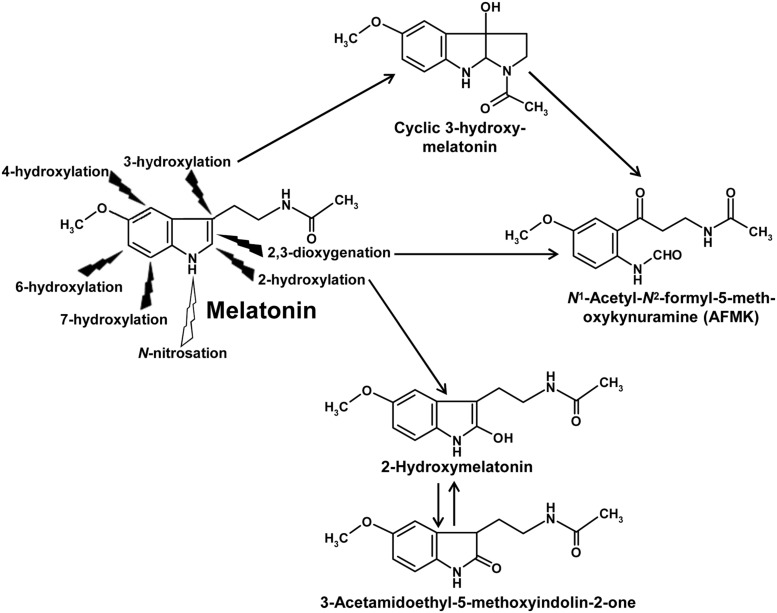
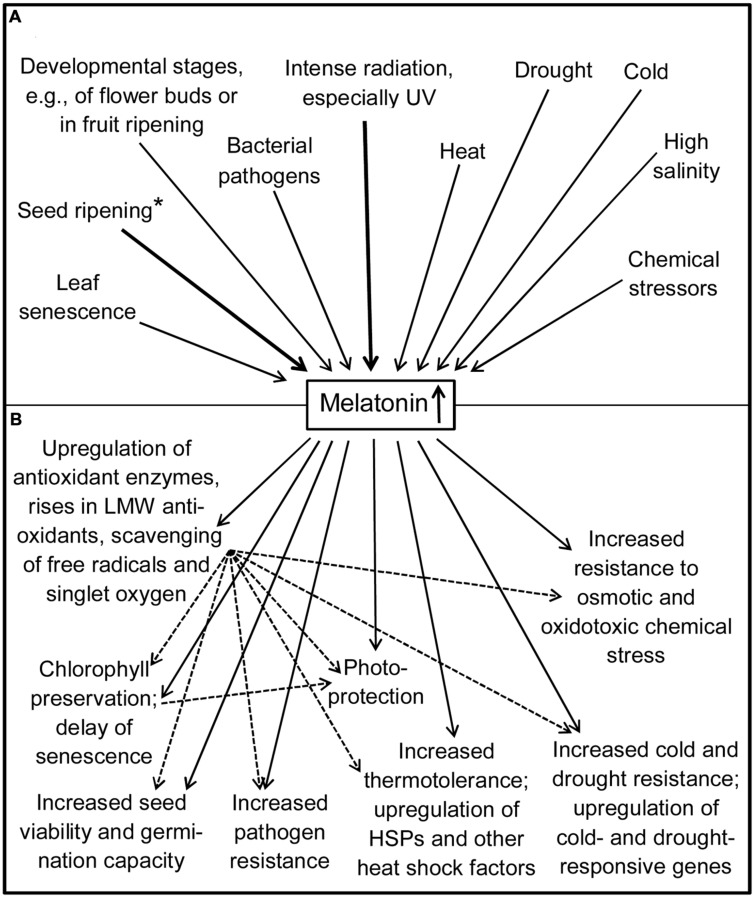
Melatonin has been detected in numerous plant species. A particularly surprising finding concerns the highly divergent levels of melatonin that vary between species, organs and environmental conditions, from a few pg/g to over 20 μg/g, reportedly up to 200 μg/g. Highest values have been determined in oily seeds and in plant organs exposed to high UV radiation. The divergency of melatonin concentrations is discussed under various functional aspects and focused on several open questions. This comprises differences in precursor availability, catabolism, the relative contribution of isoenzymes of the melatonin biosynthetic pathway, and differences in rate limitation by either serotonin N-acetyltransferase or N-acetylserotonin O-methyltransferase. Other differences are related to the remarkable pleiotropy of melatonin, which exhibits properties as a growth regulator and morphogenetic factor, actually debated in terms of auxin-like effects, and as a signaling molecule that modulates pathways of ethylene, abscisic, jasmonic and salicylic acids and is involved in stress tolerance, pathogen defense and delay of senescence. In the context of high light/UV intensities, elevated melatonin levels exceed those required for signaling via stress-related phytohormones and may comprise direct antioxidant and photoprotectant properties, perhaps with a contribution of its oxidatively formed metabolites, such as N (1)-acetyl-N (2)-formyl-5-methoxykynuramine and its secondary products. High melatonin levels in seeds may also serve antioxidative protection and have been shown to promote seed viability and germination capacity.
Keywords: antioxidant; auxin-like; circadian; photoprotection; seeds; senescence; stress.
Figures
References
-
- Antolín I., Obst B., Burkhardt S., Hardeland R. (1997). Antioxidative protection in a high-melatonin organism: the dinoflagellate Gonyaulax polyedra is rescued from lethal oxidative stress by strongly elevated, but physiologically possible concentrations of melatonin. J. Pineal Res. 23 182–190. 10.1111/j.1600-079X.1997.tb00353.x - DOI - PubMed
-
- Arnao M. B. (2014). Phytomelatonin: discovery, content, and role in plants. Adv. Bot. 2014:815769 10.1155/2014/815769 - DOI
Publication types
LinkOut - more resources
Full Text Sources
Other Literature Sources
