Review
. 2016 Feb 18:4:5.
doi: 10.3389/fped.2016.00005. eCollection 2016.

A Review of Pediatric Critical Care in Resource-Limited Settings: A Look at Past, Present, and Future Directions

Affiliations
Review

A Review of Pediatric Critical Care in Resource-Limited Settings: A Look at Past, Present, and Future Directions

Erin L Turner et al. Front Pediatr. .

Abstract

Fifteen years ago, United Nations world leaders defined millenium development goal 4 (MDG 4): to reduce under-5-year mortality rates by two-thirds by the year 2015. Unfortunately, only 27 of 138 developing countries are expected to achieve MDG 4. The majority of childhood deaths in these settings result from reversible causes, and developing effective pediatric emergency and critical care services could substantially reduce this mortality. The Ebola outbreak highlighted the fragility of health care systems in resource-limited settings and emphasized the urgent need for a paradigm shift in the global approach to healthcare delivery related to critical illness. This review provides an overview of pediatric critical care in resource-limited settings and outlines strategies to address challenges specific to these areas. Implementation of these tools has the potential to move us toward delivery of an adequate standard of critical care for all children globally, and ultimately decrease global child mortality in resource-limited settings.

Keywords: Ebola epidemic; millenium development goal 4; pediatric critical care; resource allocation; resource-limited setting.


Figures
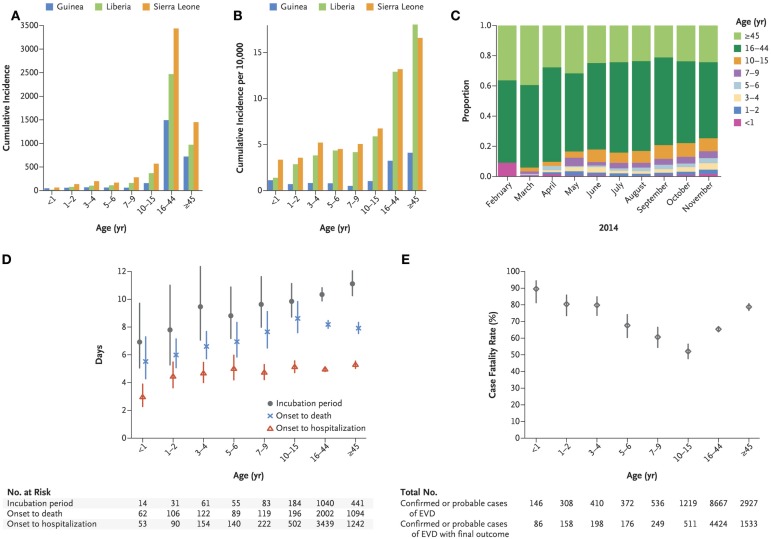
Figure 1
Figure 1
Age-group-specific incidence of Ebola virus disease in West Africa, incubation period, intervals from onset to death and onset to hospitalization, and case fatality rate. (A) shows the cumulative incidence of confirmed and probable cases of Ebola virus disease (EVD) according to age group and country. (B) shows the cumulative incidence of confirmed and probable cases per 10,000 population according to age group and country. (C) shows the overall age distribution for confirmed and probable cases according to month of symptom onset. (D) shows the estimated average incubation period, the interval between symptom onset and death, and the interval between symptom onset and hospitalization according to age among persons with confirmed or probable EVD [with vertical lines indicating 95% confidence intervals (CIs)]. The numbers represent the sample sizes in each age group. (E) shows the estimated case fatality rate according to age among persons with confirmed or probable EVD (with 95% CIs), with representation of the total number of confirmed or probable cases of EVD cases in each age group and the total number of confirmed or probable cases of EVD for which there was information on the final outcome in each age group. Copied with permission from: WHO Ebola Response Team, et al. (11)
Figure 2
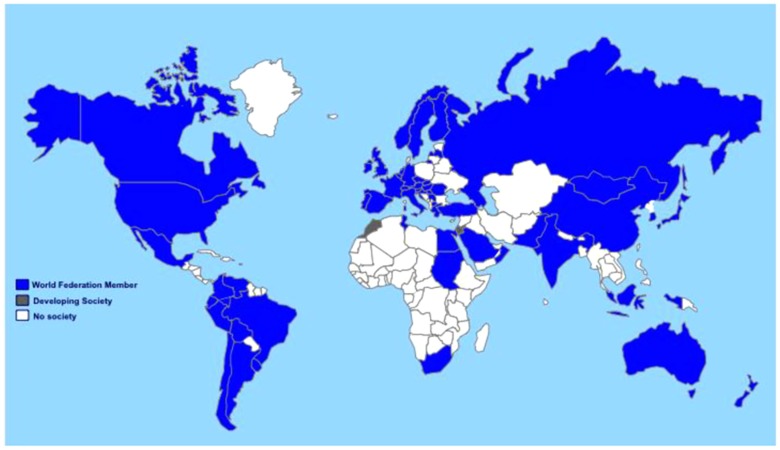
Figure 2
Accurate numbers of critical care centers and services worldwide are unknown. Membership in the World Federation of Societies in Intensive and Critical Care Medicine is used as an extrapolation of possible services worldwide, with countries illustrated where membership Societies are fully developed (blue), those where existing membership is developing a professional Society (gray), and countries without Federation members (white). Copied with permission from: Resource-Poor Settings: Infrastructure and Capacity Building Resource-Poor Setting: Infrastructure and Capacity Building: Care of the Critically Ill and Injured During Pandemics and Disasters: CHEST Consensus Statement (114).
Figure 3
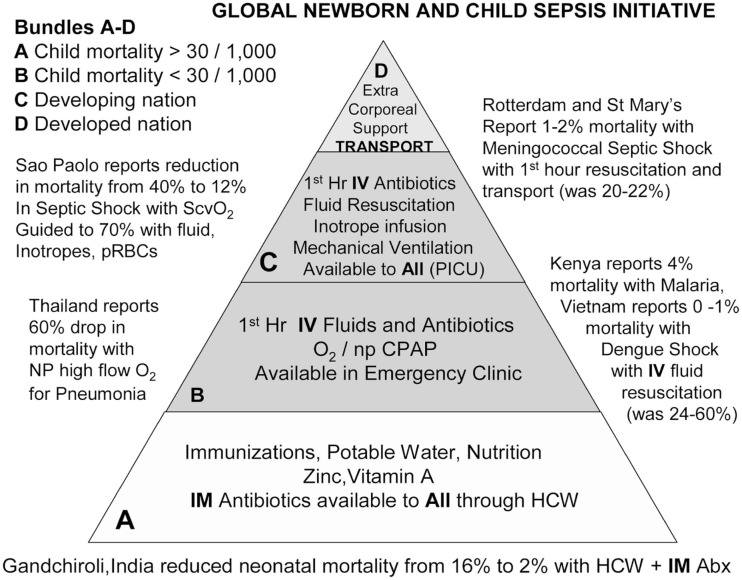
Figure 3
The sepsis initiative administrative bundles pyramid. This pyramid demonstrates the administrative recommendations according to levels of health resources from the health resource-scarce (level A) to health resource-abundant (level D). The foundation of care is level A. It is expected to be provided to populations with <5-year child mortality and >30 of 1,000 children. Level B is distinguished from level A by the ability to deliver oxygen and intravenous therapies. It is expected to be provided to populations with <5-year child mortality and <30 of 1,000 children. Category A indicates non-industrialized setting with child mortality rate >30 of 1,000 children; category B indicates non-industrialized setting with child mortality rate <30 of 1,000 children; category C indicates industrialized developing nation; and category D indicates industrialized developed nation. Level C is distinguished from level B by the ability to deliver machine-driven therapy to all. It is expected to be provided in the developing industrialized setting. Level D is distinguished from level C by the presence of an organized transport system and the ability to deliver extracorporeal therapies to all. It is expected to be provided in the developed industrialized setting. Categories A and B are in the non-industrialized setting. Categories C and D are in the industrialized setting. In category A, Bang et al. demonstrated an eightfold reduction in neonatal mortality when intramuscular (IM) gentamicin and oral cotrimoxazole were administered by rural healthcare workers. In category B, investigators in Thailand, Vietnam, and Kenya demonstrated that administering high-flow oxygen (O2) and isotonic intravenous fluid boluses reduced mortality from pneumonia, dengue shock, and severe malaria. In category C, de Oliveira et al. demonstrated a four-fold reduction from septic shock with American College of Critical Care Medicine/Pediatric Advanced Life Support goal-directed therapy. In Rotterdam and London, investigators demonstrated a 10-fold reduction in mortality from purpura and meningococcemia with a transport team and tertiary center care. IV, intravenous; PICU, pediatric intensive care unit; npCPAP, nasopharyngeal continuous positive airway pressure; HCW, healthcare worker; ScvO2, superior vena cava oxygen saturation; pRBC, packed red blood cells; NP, nasopharyngeal. Copied with permission from: Kissoon et al. (108).

References

    1. Wang H, Liddell CA, Coates MM, Mooney MD, Levitz CE, Schumacher AE, et al. Global, regional, and national levels of neonatal, infant, and under-5 mortality during 1990–2013: a systematic analysis for the global burden of disease study 2013. Lancet (2014) 384(9947):957–79.10.1016/S0140-6736(14)60497-9 - DOI - PMC - PubMed
    1. Bhutta ZA, Black RE. Global maternal, newborn, and child health – so near and yet so far. N Engl J Med (2013) 369(23):2226–35.10.1056/NEJMra1111853 - DOI - PubMed
    1. GBD 2013 Mortality and Causes of Death Collaborators. Global, regional, and national age-sex specific all-cause and cause-specific mortality for 240 causes of death, 1990–2013: a systematic analysis for the global burden of disease study 2013. Lancet (2015) 385(9963):117–71.10.1016/S0140-6736(14)61682-2 - DOI - PMC - PubMed
    1. Molyneux E, Ahmad S, Robertson A. Improved triage and emergency care for children reduces inpatient mortality in a resource-constrained setting. Bull World Health Organ (2006) 84(4):314–9.10.2471/BLT.04.019505 - DOI - PMC - PubMed
    1. Baker T. Pediatric emergency and critical care in low-income countries. Paediatr Anaesth (2009) 19(1):23–7.10.1111/j.1460-9592.2008.02868.x - DOI - PubMed

LinkOut - more resources