. 2015;1(11):512-522.
doi: 10.1021/acsinfecdis.5b00097.

Permeability Barrier of Gram-Negative Cell Envelopes and Approaches To Bypass It

Affiliations

Permeability Barrier of Gram-Negative Cell Envelopes and Approaches To Bypass It

Helen I Zgurskaya et al. ACS Infect Dis. 2015.

Abstract

Gram-negative bacteria are intrinsically resistant to many antibiotics. Species that have acquired multidrug resistance and cause infections that are effectively untreatable present a serious threat to public health. The problem is broadly recognized and tackled at both the fundamental and applied levels. This paper summarizes current advances in understanding the molecular bases of the low permeability barrier of Gram-negative pathogens, which is the major obstacle in discovery and development of antibiotics effective against such pathogens. Gaps in knowledge and specific strategies to break this barrier and to achieve potent activities against difficult Gram-negative bacteria are also discussed.

Keywords: Gram-negative resistance; multidrug efflux; outer membrane; permeability barrier.


Conflict of interest statement

Notes

The authors declare no competing financial interest.

Figures
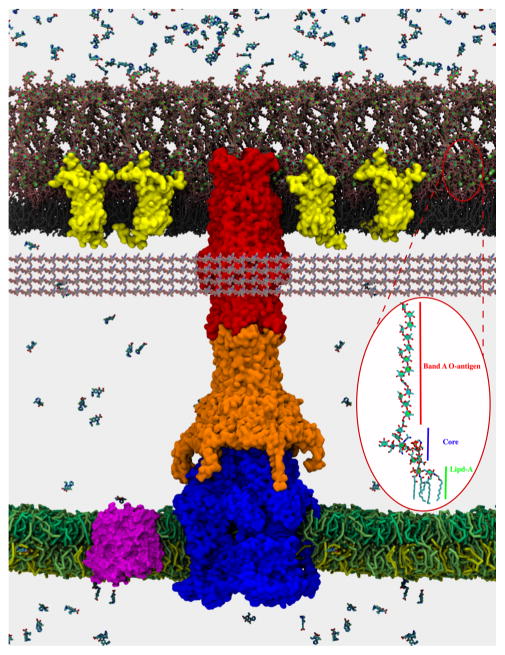
Figure 1
Figure 1
Cross-section view of a modeled P. aeruginosa cell envelope. The outer leaflet of the outer membrane is assembled of LPS (pink color) corresponding to the band A antigen, and the inner leaflet contains glycerophospholipids 1,2-dipalmitoyl-sn-glycero-3-phosphoe-thanolamine (DPPE). Green spheres are magnesium ions bound to O-chains and core polysaccharides of LPS. The inner membrane contains an equimolar mixture of cardiolipin, 1-palmitoyl-2-oleoyl-sn-glycero-3-phosphoethanolamine (POPE)b and 1-palmitoyl-2-oleoyl-sn-glycero-3-phosphoglycerol (POPG). Embedded in the outer membrane are the main porin OprF (PDB 4RLC) in a yellow surface density. In the inner bilayer is localized MdfA transporter, represented in a magenta surface (PDB 4ZOW). The modeled structure of the assembled MexAB-OprM multidrug efflux pump (MexB, blue; MexA, orange; OprM, red) spans both the inner and outer membranes. The structure of MexAB-OprM is from a long (1 μs) all-atom molecular dynamics simulations with the tripartite complex embedded in 1-palmitoyl-2-oleoyl-sn-glycero-3-phosphocholine (POPC) bilayers mimicking inner and outer membranes (see Figure 3). The MexA component lacks the N-terminal lipid modification. The outer and inner membranes are based on separate protein-free all-atom MD simulations with the above composition. Other structures were taken from the Protein Data Bank. Ciprofloxacin molecules were added to illustrate a difference of concentrations created by slow diffusion across the outer membrane through porins and LPS-containing bilayer and the active efflux across the outer (MexAB-OprM) and inner (MdfA) membranes. (Inset) Single representative LPS molecule from the simulations. The peptidoglycan is pictorially represented by fiber-like structures underneath the outer membrane. The image was composed and posteriorly rendered using the VMD Molecular Viewer.
Figure 2
Figure 2
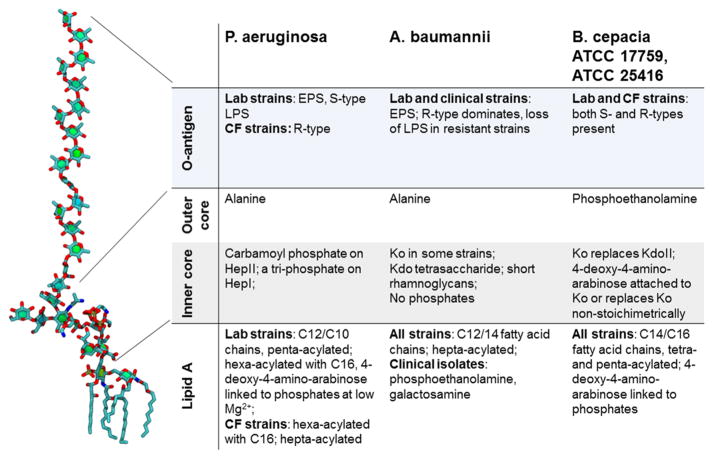
Diversity of chemical structures and modifications in LPS. The P. aeruginosa band A LPS molecule is shown for comparison. Abbreviations: Kdo, α-3-deoxy-D-manno-oct-2-ulosonic acid; Hep, heptulose; NGal, galactosamine; EPS, extracellular polysaccharide; S-type, “smooth” LPS containing O-chains; R-type, “rough” LPS lacking O-chains; Ko, D-glycero-D-talo-oct-2-ulosonic acid.
Figure 3
Figure 3
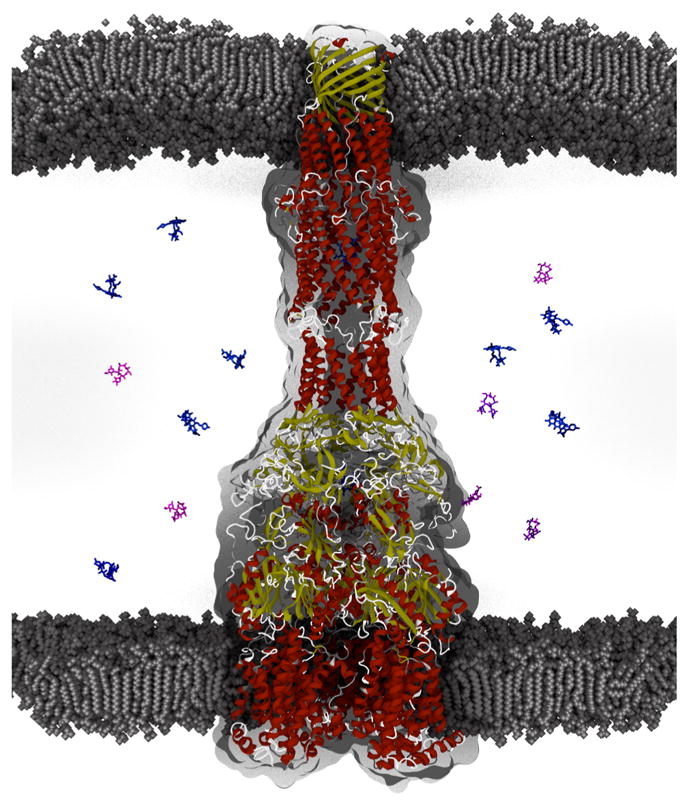
Model of the assembled MexB-MexA-OprM multidrug efflux pump from P. aeruginosa. MexA and other MFPs are proposed to translate the conformational changes in MexB transporter driven by a proton-motive force into opening of the outer membrane channel OprM that enables efflux across the outer membrane. The tripartite complex shown is a snapshot of a 1 μs MD simulation of the complex embedded in a bilayer composed of 1-palmitoyl-2-oleoyl-sn-glycero-3-phosphocholine (POPC). Proteins are colored according to secondary structure. For visual clarity water molecules are not shown. Accompanying drugs are shown for illustration purposes only (blue, rifampicin; pink, erythromycin). The gray shape corresponds to the AcrAB-TolC density obtained by the cryo-EM imaging. The equilibrated MexAB-OprM complex in the bacterial envelope maintains the expected distance of the P. aeruginosa periplasm. Image was initially exported from VMD Molecular Viewer in STL format and posteriorly rendered in Blender (https://www.blender.org). The gray shape corresponds to the AcrAB-TolC density obtained by the cryo-EM imaging.

References

    1. Levy SB, Marshall B. Antibacterial resistance worldwide: causes, challenges and responses. Nat Med. 2004;10:S122. - PubMed
    1. Sievert DMP, Ricks PP, Edwards JRMS, Schneider AMPH, Patel JP, Srinivasan AMD, Kallen AMD, Limbago BP, Fridkin SMD. For the National Healthcare Safety Network, T., and Participating, N. F. Antimicrobial-Resistant Pathogens Associated with Healthcare-Associated Infections: Summary of Data Reported to the National Healthcare Safety Network at the Centers for Disease Control and Prevention, 2009–2010. Infect Control Hospital Epidemiol. 2013;34:1–14. - PubMed
    1. Livermore DM. The need for new antibiotics. Clin Microbiol Infect. 2004;10(Suppl 4):1–9. - PubMed
    1. Munoz-Price LS, Poirel L, Bonomo RA, Schwaber MJ, Daikos GL, Cormican M, Cornaglia G, Garau J, Gniadkowski M, Hayden MK, Kumarasamy K, Livermore DM, Maya JJ, Nordmann P, Patel JB, Paterson DL, Pitout J, Villegas MV, Wang H, Woodford N, Quinn JP. Clinical epidemiology of the global expansion of Klebsiella pneumoniae carbapenemases. Lancet Infect Dis. 2013;13:785–796. - PMC - PubMed
    1. Rice LB. Mechanisms of Resistance and Clinical Relevance of Resistance to β-Lactams, Glycopeptides, and Fluoroquinolones. Mayo Clin Proc. 2012;87:198–208. - PMC - PubMed