


Improvements in insulin sensitivity after aerobic exercise and weight loss in older women with a history of gestational diabetes and type 2 diabetes mellitus
- PMID: 26925596
- PMCID: PMC4961462
- DOI: 10.3109/07435800.2015.1094087
Improvements in insulin sensitivity after aerobic exercise and weight loss in older women with a history of gestational diabetes and type 2 diabetes mellitus
Abstract
Purpose: To determine whether a hypocaloric diet alone (WL) or with exercise training (AEX + WL) is effective in improving body composition, fitness, glucose utilization and CVD risk factors in sedentary women with a history of gestational diabetes (GDM) and with type 2 diabetes (T2DM).
Materials and methods: Longitudinal clinical investigation of 25 overweight/obese (BMI: 32 ± 1 kg/m(2)) women (59 ± 1 yrs) with a GDM history (n = 20) or T2DM (n = 5). Women completed 6 months WL (n = 10) or AEX+WL (n = 15) with VO2max, body composition, and glucose tolerance testing. Insulin sensitivity was measured during the last 30 min of 2 h hyperinsulinemic-euglycemic clamps (40 mU·m(-2.)min(-1)) before and after interventions.
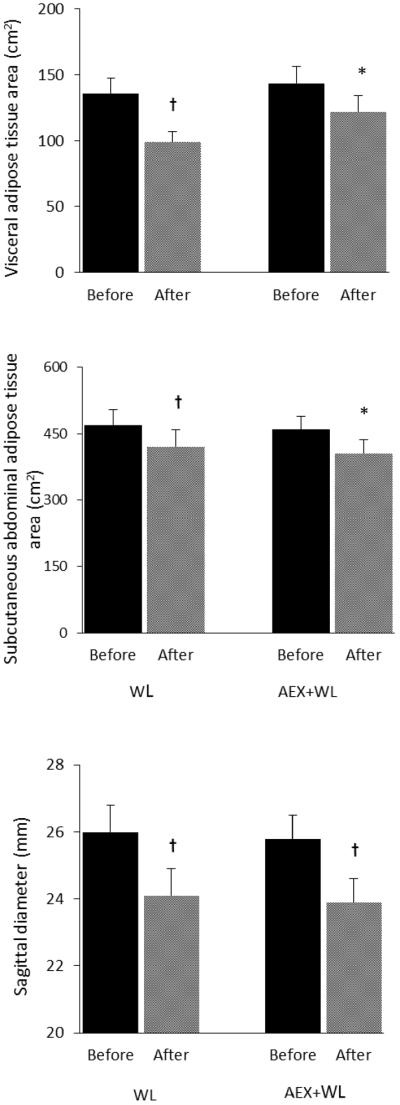
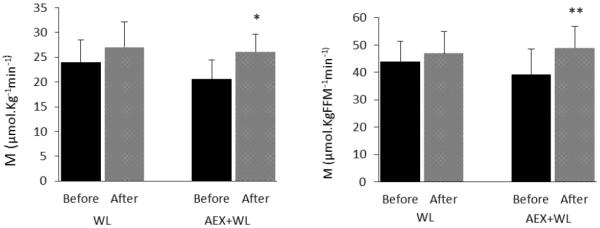
Results: Body weight decreased ~7% after WL and AEX+WL (p < 0.001), with an 11-12% decrease in fat mass (p < 0.0001). Visceral fat and subcutaneous abdominal fat decreased 27 and 10% after WL (p < 0.01) and 14 and 11% after AEX + WL (p < 0.05). VO2max increased 16% after AEX + WL (p < 0.001) and did not change after WL. Glucose AUC decreased 14 and 13% after WL (p < 0.05) and AEX + WL (p < 0.01) with a 42% decrease in insulin AUC after AEX + WL (p < 0.01). Glucose utilization increased 25% (p = 0.05) with AEX + WL and 7% with WL.
Conclusions: A six-month aerobic exercise program combined with moderate weight loss reduces body weight, visceral and subcutaneous abdominal fat, and improves insulin sensitivity in older women who had previously been diagnosed with GDM and those with T2DM. These findings should encourage women with a history of GDM to engage in an active lifestyle and reduce caloric intake to lower the risk for the development of T2DM.
Keywords: Aging; exercise; insulin sensitivity; nutrition; obesity.
Figures
References
-
- DeSisto CL, Kim SY, Sharma AJ. Prevalence estimates of gestational diabetes mellitus in the United States, Pregnancy Risk Assessment Monitoring System (PRAMS), 2007–2010. Preventing chronic disease. 2014;11:E104. doi: 10.5888/pcd11.130415. PubMed PMID: 24945238; PubMed Central PMCID: PMC4068111. - PMC - PubMed
-
- Verier-Mine O. Outcomes in women with a history of gestational diabetes. Screening and prevention of type 2 diabetes. Literature review. Diabetes Metab. 2010;36(6 Pt 2):595–616. doi: 10.1016/j.diabet.2010.11.011. PubMed PMID: 21163424. - PubMed
-
- Metzger BE, Cho NH, Roston SM, Radvany R. Prepregnancy weight and antepartum insulin secretion predict glucose tolerance five years after gestational diabetes mellitus. Diabetes Care. 1993;16(12):1598–605. Epub 1993/12/01. PubMed PMID: 8299456. - PubMed
-
- Kaufmann RC, Schleyhahn FT, Huffman DG, Amankwah KS. Gestational diabetes diagnostic criteria: long-term maternal follow-up. Am J Obstet Gynecol. 1995;172(2 Pt 1):621–5. Epub 1995/02/01. doi: 0002-9378(95)90582-0 [pii]. PubMed PMID: 7856695. - PubMed
-
- Kim C, Berger DK, Chamany S. Recurrence of gestational diabetes mellitus: a systematic review. Diabetes Care. 2007;30(5):1314–9. Epub 2007/02/10. doi: dc06-2517 [pii] 10.2337/dc06-2517. PubMed PMID: 17290037. - PubMed
MeSH terms
Substances
Grants and funding
LinkOut - more resources
Full Text Sources
Other Literature Sources
Medical
Research Materials
Miscellaneous
