


Maternal whole grain intake and outcomes of in vitro fertilization
- PMID: 26926253
- PMCID: PMC4894002
- DOI: 10.1016/j.fertnstert.2016.02.015
Maternal whole grain intake and outcomes of in vitro fertilization
Abstract
Objective: To evaluate the relationship between pretreatment intake of whole grains and outcomes of IVF.
Design: Prospective cohort study.
Setting: Academic medical center.
Patient(s): A total of 273 women who collectively underwent 438 IVF cycles.
Intervention(s): Whole grain intake was assessed with a validated food frequency questionnaire at enrollment.
Main outcome measure(s): Intermediate and clinical end points of IVF were abstracted from medical records.
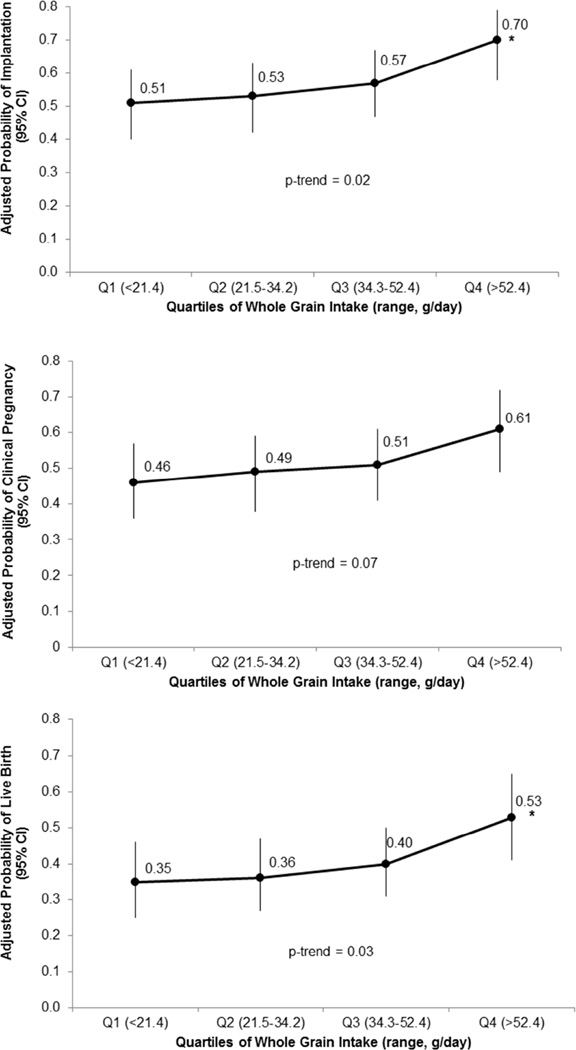
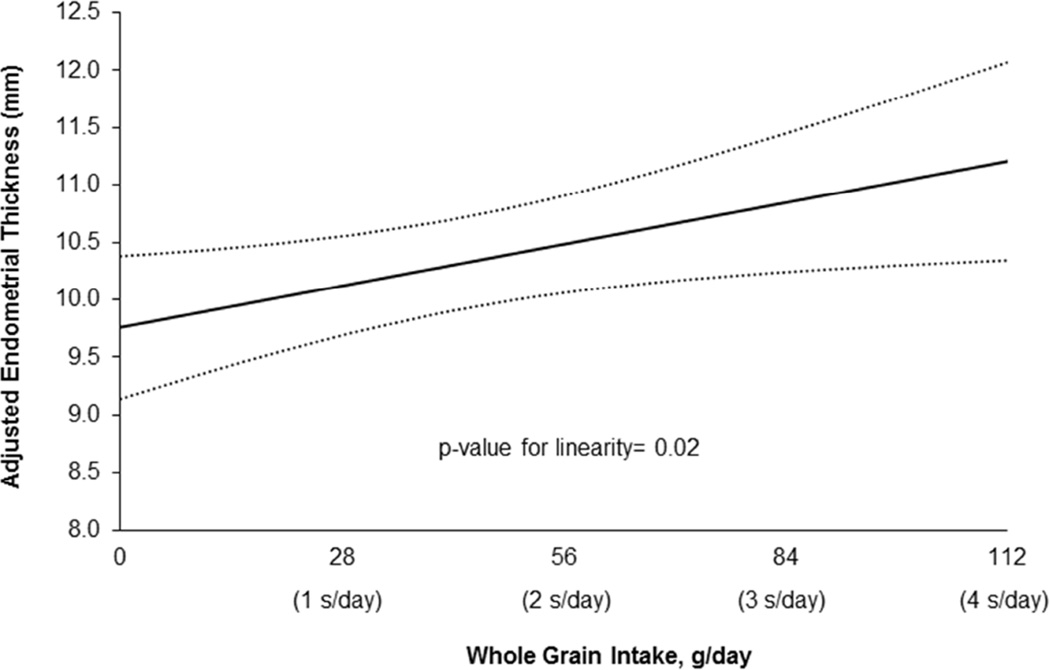
Result(s): Women had a median whole grain intake of 34.2 g per day (∼1.2 servings/day). Higher pretreatment whole grain intake was associated with higher probability of implantation and live birth. The adjusted percentage of cycles resulting in live birth for women in the highest quartile of whole grain intake (>52.4 g/day) was 53% (95% confidence interval [CI] 41%, 65%) compared with 35% (95% CI 25%, 46%) for women in the lowest quartile (<21.4 g/day). This association was largely driven by intake of bran as opposed to germ. When intermediate end points of IVF were examined, only endometrial thickness on the day of ET was associated with whole grain intake. A 28-g per day (∼1 serving/day) increase in whole grain intake was associated with a 0.4-mm (95% CI 0.1, 0.7 mm) increase in endometrial thickness.
Conclusion(s): Higher pretreatment whole grain intake was related to higher probability of live birth among women undergoing IVF. The higher probability of live birth may result from increased endometrial thickness on the day of ET and improved embryo receptivity manifested in a higher probability of implantation.
Keywords: Whole grains; assisted reproductive technology; female infertility; in vitro fertilization.
Copyright © 2016 American Society for Reproductive Medicine. Published by Elsevier Inc. All rights reserved.
Conflict of interest statement
Figures
References
-
- Tang G, Wang D, Long J, Yang F, Si L. Meta-analysis of the association between whole grain intake and coronary heart disease risk. Am J Cardiol. 2015;115:625–629. - PubMed
-
- Jacobs DR, Jr, Marquart L, Slavin J, Kushi LH. Whole-grain intake and cancer: an expanded review and meta-analysis. Nutr Cancer. 1998;30:85–96. - PubMed
-
- Aune D, Norat T, Romundstad P, Vatten LJ. Whole grain and refined grain consumption and the risk of type 2 diabetes: a systematic review and dose-response meta-analysis of cohort studies. Eur J Epidemiol. 2013;28:845–858. - PubMed
-
- Liu S, Willett WC, Manson JE, Hu FB, Rosner B, Colditz G. Relation between changes in intakes of dietary fiber and grain products and changes in weight and development of obesity among middle-aged women. Am J Clin Nutr. 2003;78:920–927. - PubMed
Publication types
MeSH terms
Substances
Grants and funding
LinkOut - more resources
Full Text Sources
Other Literature Sources
Medical
