


Nationwide Trends and Variations in Urological Surgical Interventions and Renal Outcome in Patients with Spina Bifida
- PMID: 26926542
- PMCID: PMC4826303
- DOI: 10.1016/j.juro.2015.11.033
Nationwide Trends and Variations in Urological Surgical Interventions and Renal Outcome in Patients with Spina Bifida
Abstract
Purpose: Bladder dysfunction in patients with spina bifida can lead to significant morbidity due to renal insufficiency. Indications for surgery vary among institutions and the impact is unclear. We examined trends and variations in urological interventions and chronic renal insufficiency in patients with spina bifida.
Materials and methods: We reviewed NIS (Nationwide Inpatient Sample) for all patients with spina bifida treated from 1998 to 2011. We used ICD-9-CM codes to identify urological surgery and chronic renal insufficiency. We calculated the Spearman correlation coefficients between rates of spina bifida related bladder surgeries and rates of chronic renal insufficiency outcomes by state. Linear regression models were fitted to investigate the associations between rates of spina bifida related surgery and chronic renal insufficiency across treatment years.
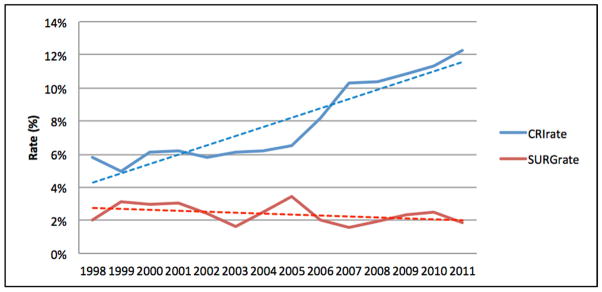
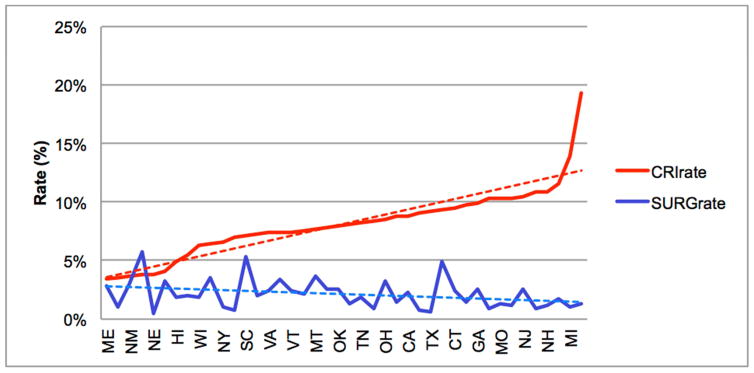
Results: We identified 427,616 spina bifida hospital admissions. Mean patient age was 26 years and 56% of patients were female. Of the admissions 35,249 (8%) were for chronic renal insufficiency and 11,078 (3%) were for surgery. During the study period chronic renal insufficiency rates doubled from 6% to 12% and surgery rates decreased from 2.0% to 1.8%. There was a moderately weak inverse association between surgery and chronic renal insufficiency rates with time (r = -0.3, p = 0.06) and by state (r = -0.3, p = 0.04). On multivariate analysis higher rates of surgery were associated with the state in which the patient was treated (p <0.001), and with younger age (p <0.001) and hospital teaching status (p <0.001). In contrast, chronic renal insufficiency was not associated with spina bifida related surgery (p = 0.67).
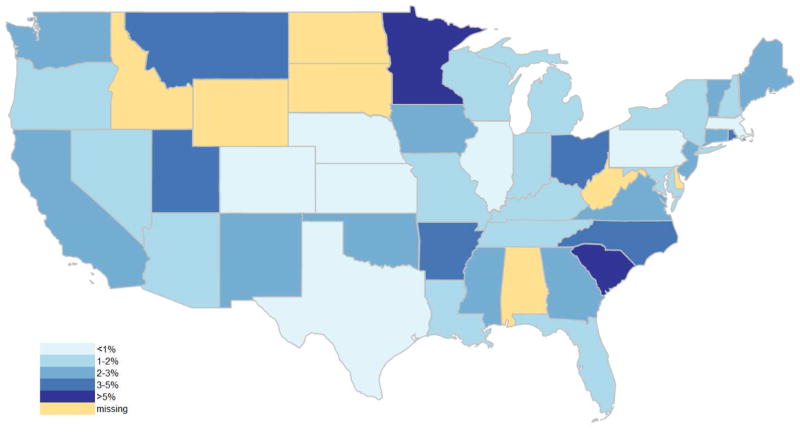
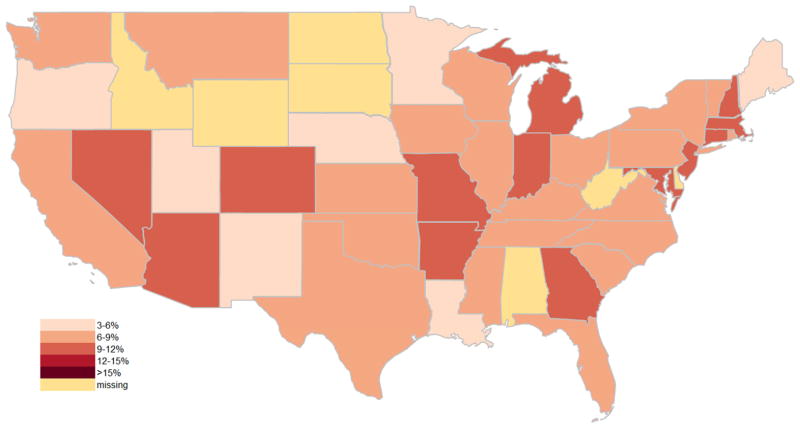
Conclusions: We observed a temporal and geographic trend toward decreasing urological surgery and increasing chronic renal insufficiency rates in spina bifida and a wide variation in urological surgical rates among states. Further study is needed to determine the factors behind these trends and variations in spina bifida management.
Keywords: chronic; kidney; neurogenic; renal insufficiency; spinal dysraphism; urinary bladder; urologic surgical procedures.
Copyright © 2016 American Urological Association Education and Research, Inc. Published by Elsevier Inc. All rights reserved.
Conflict of interest statement
Figures
Comment in
-
Editorial Comment.J Urol. 2016 Apr;195(4 Pt 2):1195. doi: 10.1016/j.juro.2015.11.076. Epub 2016 Feb 28. J Urol. 2016. PMID: 26926545 No abstract available.
References
-
- Honein MA, Paulozzi LJ, Mathews TJ, et al. Impact of folic acid fortification of the US food supply on the occurrence of neural tube defects. JAMA. 2001;285:2981. - PubMed
-
- Mathews TJ, Honein MA, Erickson JD. Spina bifida and anencephaly prevalence--United States, 1991–2001. MMWR Recomm Rep. 2002;51:9. - PubMed
-
- Lloyd JC, Wiener JS, Gargollo PC, et al. Contemporary epidemiological trends in complex congenital genitourinary anomalies. J Urol. 2013;190:1590. - PubMed
-
- Hopps CV, Kropp KA. Preservation of renal function in children with myelomeningocele managed with basic newborn evaluation and close followup. J Urol. 2003;169:305. - PubMed
Publication types
MeSH terms
Grants and funding
LinkOut - more resources
Full Text Sources
Other Literature Sources
Medical
