Randomized Controlled Trial
. 2016 Feb 25;8(3):116.
doi: 10.3390/nu8030116.

Co-Ingestion of Whey Protein with a Carbohydrate-Rich Breakfast Does Not Affect Glycemia, Insulinemia or Subjective Appetite Following a Subsequent Meal in Healthy Males

Affiliations
Randomized Controlled Trial

Co-Ingestion of Whey Protein with a Carbohydrate-Rich Breakfast Does Not Affect Glycemia, Insulinemia or Subjective Appetite Following a Subsequent Meal in Healthy Males

Dean M Allerton et al. Nutrients. .

Abstract

We aimed to assess postprandial metabolic and appetite responses to a mixed-macronutrient lunch following prior addition of whey protein to a carbohydrate-rich breakfast. Ten healthy males (age: 24 ± 1 years; body mass index (BMI): 24.5 ± 0.7 kg/m²) completed three trials in a non-isocaloric, crossover design. A carbohydrate-rich breakfast (93 g carbohydrate; 1799 kJ) was consumed with (CHO + WP) or without (CHO) 20 g whey protein isolate (373 kJ), or breakfast was omitted (NB). At 180 min, participants consumed a mixed-macronutrient lunch meal. Venous blood was sampled at 15 min intervals following each meal and every 30 min thereafter, while subjective appetite sensations were collected every 30 min throughout. Post-breakfast insulinemia was greater after CHO + WP (time-averaged area under the curve (AUC0--180 min): 193.1 ± 26.3 pmol/L), compared to CHO (154.7 ± 18.5 pmol/L) and NB (46.1 ± 8.0 pmol/L; p < 0.05), with no difference in post-breakfast (0-180 min) glycemia (CHO + WP, 3.8 ± 0.2 mmol/L; CHO, 4.2 ± 0.2 mmol/L; NB, 4.2 ± 0.1 mmol/L; p = 0.247). There were no post-lunch (0-180 min) effects of condition on glycemia (p = 0.492), insulinemia (p = 0.338) or subjective appetite (p > 0.05). Adding whey protein to a carbohydrate-rich breakfast enhanced the acute postprandial insulin response, without influencing metabolic or appetite responses following a subsequent mixed-macronutrient meal.

Keywords: appetite; breakfast; glycemia; insulinemia; whey protein.


Figures
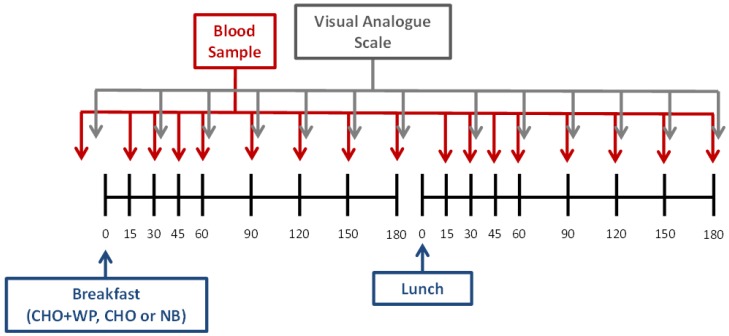
Figure 1
Figure 1
Schematic layout of experimental trials. CHO: high-carbohydrate breakfast trial; CHO + WP: high-carbohydrate breakfast with added whey protein trial; NB: no breakfast trial.
Figure 2
Figure 2
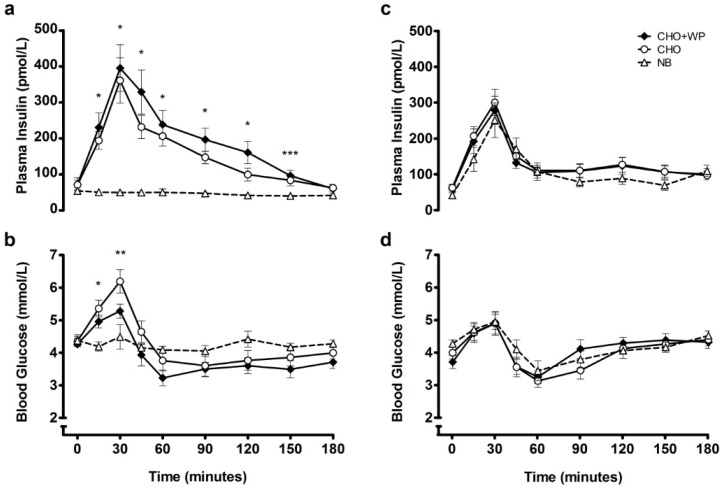
Mean ± SEM temporal changes in plasma insulin (a) and blood glucose (b) during the post-breakfast period, and plasma insulin (c) and blood glucose (d) during the post-lunch period. Significant differences (p < 0.05) between trials at individual time points are defined as follows: * NB vs. CHO + WP and CHO, ** NB vs. CHO, *** NB vs. CHO + WP. CHO: high-carbohydrate breakfast trial; CHO + WP: high-carbohydrate breakfast with added whey protein trial; NB: no breakfast trial.
Figure 3
Figure 3
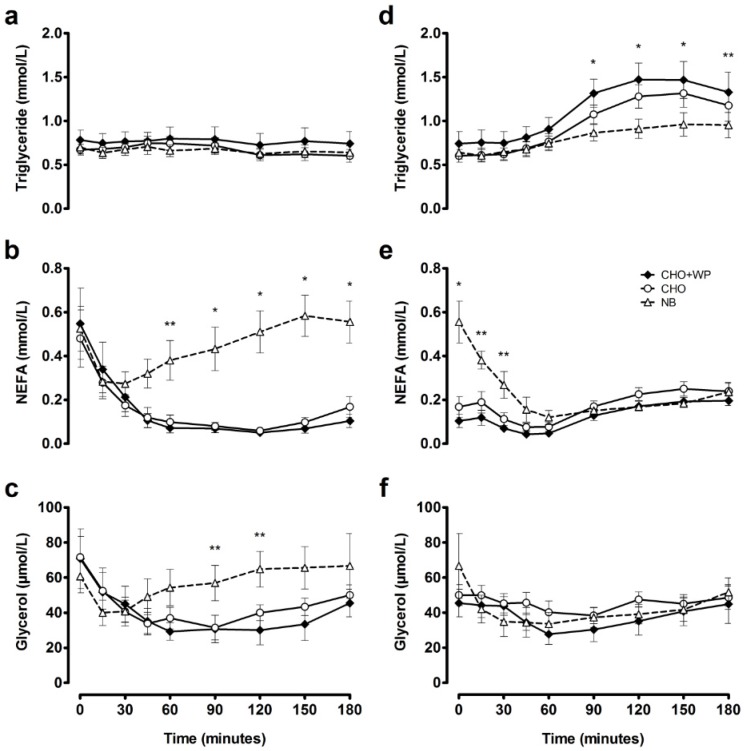
Mean ± SEM temporal changes in plasma triglyceride (a); NEFA (b) and glycerol (c) during the post-breakfast period, and plasma triglyceride (d); NEFA (e) and glycerol (f) during the post-lunch period. Significant differences (p < 0.05) between trials at individual time points are defined as follows: * NB vs. CHO + WP and CHO, ** NB vs. CHO + WP. CHO: high-carbohydrate breakfast trial; CHO + WP: high-carbohydrate breakfast with added whey protein trial; NB: no breakfast trial.
Figure 4
Figure 4
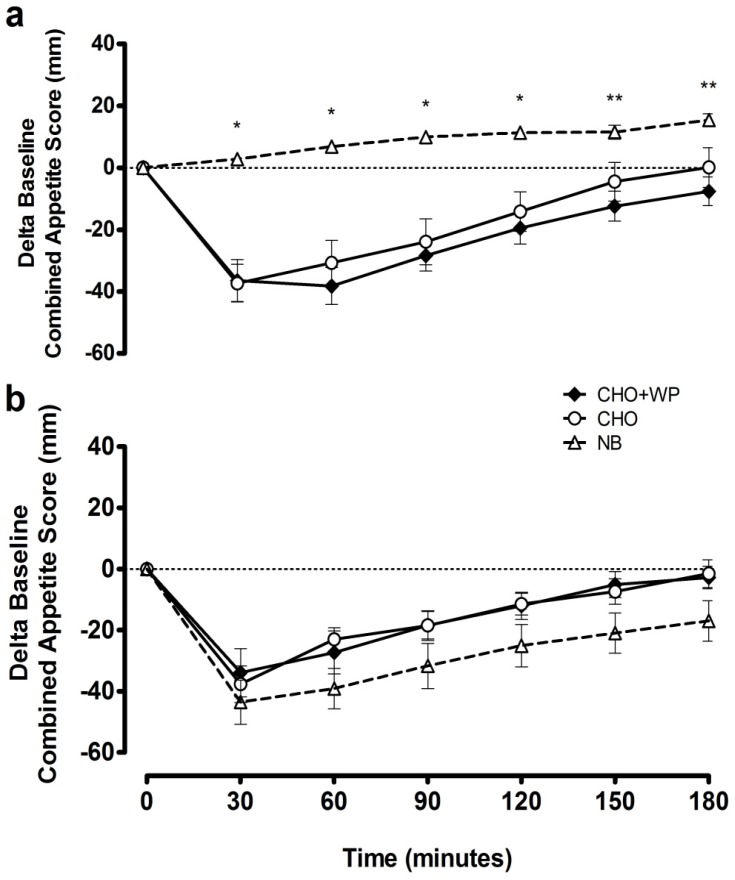
Mean ± SEM delta baseline changes in combined appetite score during the post-breakfast (a) and post-lunch (b) periods. Significant differences (p < 0.05) between trials at individual time points are defined as follows; * NB vs. CHO + WP and CHO, ** NB vs. CHO + WP. CHO: high-carbohydrate breakfast trial; CHO + WP: high-carbohydrate breakfast with added whey protein trial; NB: no breakfast trial.

References

    1. Westerterp-Plantenga M.S., Lemmens S.G., Westerterp K.R. Dietary protein—its role in satiety, energetics, weight loss and health. Br. J. Nutr. 2012;108(Suppl. 2):S105–S112. doi: 10.1017/S0007114512002589. - DOI - PubMed
    1. Pasin G., Comerford K.B. Dairy foods and dairy proteins in the management of type 2 diabetes: A systematic review of the clinical evidence. Adv. Nutr. 2015;6:245–259. doi: 10.3945/an.114.007690. - DOI - PMC - PubMed
    1. Bjørnshave A., Hermansen K. Effects of dairy protein and fat on the metabolic syndrome and type 2 diabetes. Rev. Diabet. Stud. 2014;11:153–166. doi: 10.1900/RDS.2014.11.153. - DOI - PMC - PubMed
    1. Akhavan T., Luhovyy B.L., Brown P.H., Cho C.E., Anderson G.H. Effect of premeal consumption of whey protein and its hydrolysate on food intake and postmeal glycemia and insulin responses in young adults. Am. J. Clin Nutr. 2010;91:966–975. doi: 10.3945/ajcn.2009.28406. - DOI - PubMed
    1. Frid A.H., Nilsson M., Holst J.J., Bjorck I.M. Effect of whey on blood glucose and insulin responses to composite breakfast and lunch meals in type 2 diabetic subjects. Am. J. Clin. Nutr. 2005;82:69–75. - PubMed

Publication types