Review
. 2016 Jun:54:135-48.
doi: 10.1016/j.semcdb.2016.02.024. Epub 2016 Feb 27.

A few of our favorite things: Pairing, the bouquet, crossover interference and evolution of meiosis

Affiliations
Review

A few of our favorite things: Pairing, the bouquet, crossover interference and evolution of meiosis

Denise Zickler et al. Semin Cell Dev Biol. 2016 Jun.

Abstract

Meiosis presents many important mysteries that await elucidation. Here we discuss two such aspects. First, we consider how the current meiotic program might have evolved. We emphasize the central feature of this program: how homologous chromosomes find one another ("pair") so as to create the connections required for their regular segregation at Meiosis I. Points of emphasis include the facts that: (i) the classical "bouquet stage" is not required for initial homolog contacts in the current evolved meiotic program; and (ii) diverse observations point to commonality between molecules that mediate meiotic inter-homolog interactions and molecules that are integral to centromeres and/or to microtubule organizing centers (a.k.a. spindle pole bodies or centrosomes). Second, we provide an overview of the classical phenomenon of crossover (CO) interference in an effort to bridge the gap between description on the one hand versus logic and mechanism on the other.

Keywords: Bouquet; Crossover interference; Meiosis; Pairing.


Figures

Figure 1
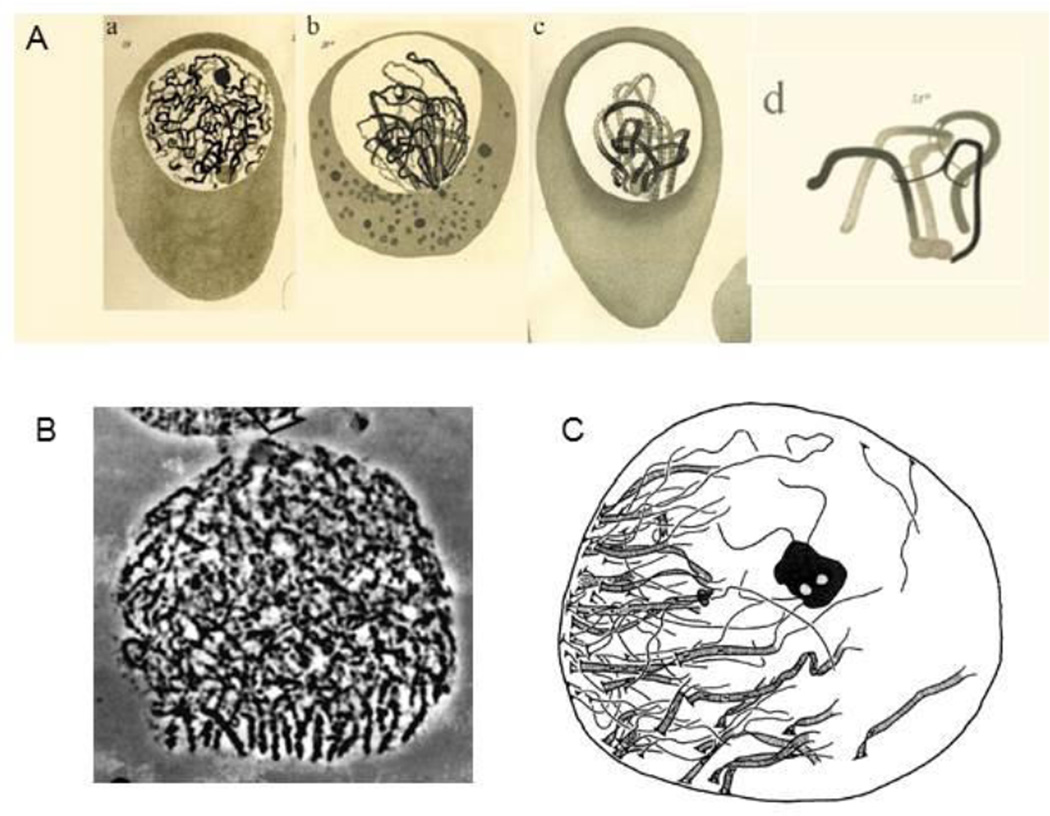
Figure 1. Bouquet Configurations
A. Gelei’s original discovery of the bouquet: a= leptotene, b=zygotene (thick threads= synapsis), c=pachytene all ends are still clustered; d = bivalent interlocking (50). B, C. Bouquets in salamander (from 51) and human spermatocyte (52). [B and C reprinted from (53).]
Figure 2
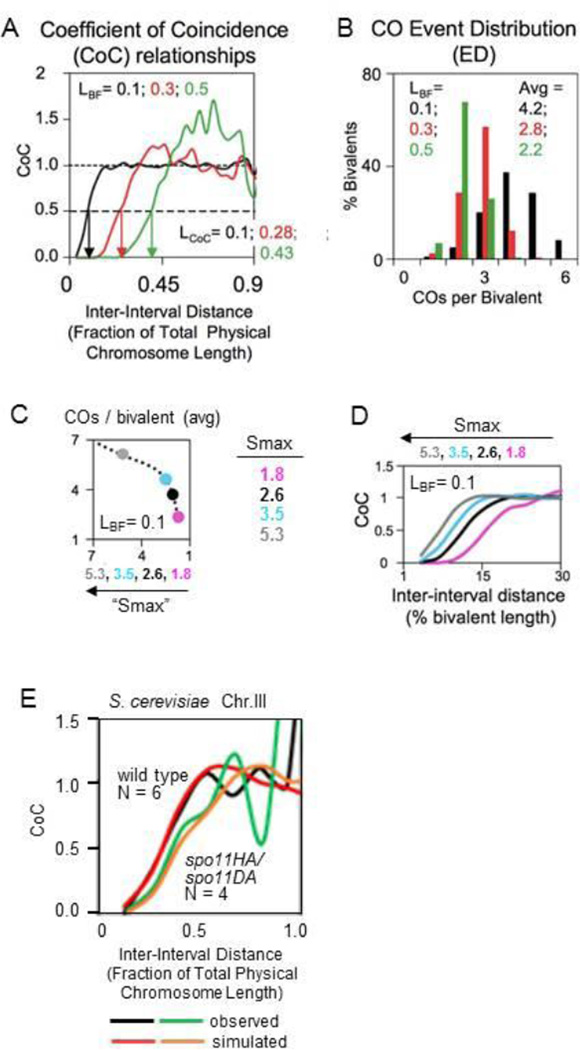
Figure 2. Coefficient of Coincidence (CoC) Analyses
A, B. CoC relationships (A) and the density distribution of different numbers of COs per bivalent (B) from data sets created by simulations using the beam-film model under different values of relevant parameters. Among these, (L) or (LBF) denotes the distance over which the interference signal spreads. (LCoC) denotes the inter-interval distance at which CoC = 0.5. [reprinted from 75] C, D Beam-film simulations illustrate the fact that when the strength of CO-designation increases, the number of COs per bivalent increases (C) and the CoC curves shift to the left, even though there is no change in the distance over which the interference signal spreads [adapted from 77.]. In such simulations, the strength of CO-designation is given by parameter Smax and interference distance is given by parameter L. Simulation parameter values are defined relativistically. Smax can range from zero (i.e. no CO-designation) to non-zero values that give appropriate outcomes. In simulations of several experimental datasets, the values of Smax range from ~1 to ~3.5 (75). Parameter L is defined as a fraction of bivalent length. In the simulation shown, Smax is varied from 1.8 to 5.3 while L remains constant at L=0.1 (10% of bivalent length). E. Reduction in the average number of DSBs per chromosome resulting from a spo11 mutant condition shifts the CoC curve to the right as observed for S. cerevisiae chromosome III (compare black and green). Beam-film simulations under best-fit conditions for this organism demonstrate that this shift is attributable solely to a decrease in the number of DSB-mediated precursor interactions (N) from N=6 in the wild-type to N=4 in the mutant with no change in the spreading interference signal or any other feature of CO formation/patterning (data and rationale in ; and 78). [Figure is by L. Zhang and N.K. unpublished].

References

    1. Niklas KJ, Cobb ED, Kutschera U. Did meiosis evolve before sex and the evolution of eukaryotic life cycles? Bioessays. 2014 Nov;36(11):1091–1101. - PubMed
    1. Wilkins AS, Holliday R. The evolution of meiosis from mitosis. Genetics. 2009 Jan;181(1):3–12. - PMC - PubMed
    1. Hurst LD, Nurse P. A note on the evolution of meiosis. J Theor Biol. 1991 Jun 21;150(4):561–563. - PubMed
    1. Cabral G, Marques A, Schubert V, Pedrosa-Harand A, Schlögelhofer P. Chiasmatic and achiasmatic inverted meiosis of plants with holocentric chromosomes. Nat Commun. 2014 Oct 8;5:5070. - PMC - PubMed
    1. Heckmann S, Jankowska M, Schubert V, Kumke K, Ma W, Houben A. Alternative meiotic chromatid segregation in the holocentric plant Luzula elegans. Nat Commun. 2014 Oct 8;5:4979. - PMC - PubMed

Publication types

MeSH terms

LinkOut - more resources