Meta-Analysis
. 2016 Apr;48(4):374-86.
doi: 10.1038/ng.3521. Epub 2016 Feb 29.

Breast cancer risk variants at 6q25 display different phenotype associations and regulate ESR1, RMND1 and CCDC170

Alison M Dunning  1 Kyriaki Michailidou  2 Karoline B Kuchenbaecker  2 Deborah Thompson  2 Juliet D French  3 Jonathan Beesley  3 Catherine S Healey  1 Siddhartha Kar  1 Karen A Pooley  2 Elena Lopez-Knowles  4   5 Ed Dicks  1 Daniel Barrowdale  2 Nicholas A Sinnott-Armstrong  6 Richard C Sallari  7 Kristine M Hillman  3 Susanne Kaufmann  3 Haran Sivakumaran  3 Mahdi Moradi Marjaneh  3 Jason S Lee  3 Margaret Hills  5 Monika Jarosz  4   5 Suzie Drury  4   5 Sander Canisius  8 Manjeet K Bolla  2 Joe Dennis  2 Qin Wang  2 John L Hopper  9 Melissa C Southey  10 Annegien Broeks  8 Marjanka K Schmidt  8 Artitaya Lophatananon  11 Kenneth Muir  11   12 Matthias W Beckmann  13 Peter A Fasching  13   14 Isabel Dos-Santos-Silva  15 Julian Peto  15 Elinor J Sawyer  16 Ian Tomlinson  17   18 Barbara Burwinkel  19   20 Frederik Marme  21   22 Pascal Guénel  23   24 Thérèse Truong  23   24 Stig E Bojesen  25   26   27 Henrik Flyger  28 Anna González-Neira  29 Jose I A Perez  30 Hoda Anton-Culver  31 Lee Eunjung  32 Volker Arndt  33 Hermann Brenner  33   34 Alfons Meindl  35 Rita K Schmutzler  36   37   38 Hiltrud Brauch  34   39   40 Ute Hamann  41 Kristiina Aittomäki  42 Carl Blomqvist  43 Hidemi Ito  44 Keitaro Matsuo  45 Natasha Bogdanova  46 Thilo Dörk  47 Annika Lindblom  48 Sara Margolin  49 Veli-Matti Kosma  50   51   52 Arto Mannermaa  50   51   52 Chiu-Chen Tseng  32 Anna H Wu  32 Diether Lambrechts  53   54 Hans Wildiers  55 Jenny Chang-Claude  56   57 Anja Rudolph  56 Paolo Peterlongo  58 Paolo Radice  59 Janet E Olson  60 Graham G Giles  9   61 Roger L Milne  9   61 Christopher A Haiman  32 Brian E Henderson  32 Mark S Goldberg  62   63 Soo H Teo  64   65 Cheng Har Yip  65 Silje Nord  66 Anne-Lise Borresen-Dale  66   67 Vessela Kristensen  66   67   68 Jirong Long  69 Wei Zheng  69 Katri Pylkäs  70   71 Robert Winqvist  70   71 Irene L Andrulis  72   73 Julia A Knight  74   75 Peter Devilee  76   77 Caroline Seynaeve  78 Jonine Figueroa  79 Mark E Sherman  79 Kamila Czene  80 Hatef Darabi  80 Antoinette Hollestelle  78 Ans M W van den Ouweland  81 Keith Humphreys  80 Yu-Tang Gao  82 Xiao-Ou Shu  69 Angela Cox  83 Simon S Cross  84 William Blot  69   85 Qiuyin Cai  69 Maya Ghoussaini  1 Barbara J Perkins  1 Mitul Shah  1 Ji-Yeob Choi  86   87 Daehee Kang  86   87   88 Soo Chin Lee  89   90 Mikael Hartman  91   92 Maria Kabisch  41 Diana Torres  41   93 Anna Jakubowska  94 Jan Lubinski  94 Paul Brennan  95 Suleeporn Sangrajrang  96 Christine B Ambrosone  97 Amanda E Toland  98 Chen-Yang Shen  99   100 Pei-Ei Wu  100 Nick Orr  101 Anthony Swerdlow  102   103 Lesley McGuffog  2 Sue Healey  3 Andrew Lee  2 Miroslav Kapuscinski  104 Esther M John  105 Mary Beth Terry  106 Mary B Daly  107 David E Goldgar  108 Saundra S Buys  109 Ramunas Janavicius  110 Laima Tihomirova  111 Nadine Tung  112 Cecilia M Dorfling  113 Elizabeth J van Rensburg  113 Susan L Neuhausen  114 Bent Ejlertsen  115 Thomas V O Hansen  116 Ana Osorio  117   118 Javier Benitez  117   118   119 Rachel Rando  120 Jeffrey N Weitzel  121 Bernardo Bonanni  122 Bernard Peissel  123 Siranoush Manoukian  123 Laura Papi  124 Laura Ottini  125 Irene Konstantopoulou  126 Paraskevi Apostolou  126 Judy Garber  127 Muhammad Usman Rashid  41   128 Debra Frost  2 EMBRACELouise Izatt  129 Steve Ellis  2 Andrew K Godwin  130 Norbert Arnold  131 Dieter Niederacher  132 Kerstin Rhiem  133 Nadja Bogdanova-Markov  134 Charlotte Sagne  135 Dominique Stoppa-Lyonnet  136   137 Francesca Damiola  135 GEMO Study CollaboratorsOlga M Sinilnikova  135   138 Sylvie Mazoyer  135 Claudine Isaacs  139 Kathleen B M Claes  140 Kim De Leeneer  140 Miguel de la Hoya  141 Trinidad Caldes  141 Heli Nevanlinna  142 Sofia Khan  142 Arjen R Mensenkamp  143 HEBONMaartje J Hooning  144 Matti A Rookus  145 Ava Kwong  146   147 Edith Olah  148 Orland Diez  149 Joan Brunet  150 Miquel Angel Pujana  151 Jacek Gronwald  94 Tomasz Huzarski  94 Rosa B Barkardottir  152 Rachel Laframboise  153 Penny Soucy  154 Marco Montagna  155 Simona Agata  155 Manuel R Teixeira  156   157 kConFab InvestigatorsSue Kyung Park  86   87   88 Noralane Lindor  60 Fergus J Couch  60   158 Marc Tischkowitz  159 Lenka Foretova  160 Joseph Vijai  161 Kenneth Offit  161 Christian F Singer  162 Christine Rappaport  162 Catherine M Phelan  163 Mark H Greene  164 Phuong L Mai  164 Gad Rennert  165   166 Evgeny N Imyanitov  167 Peter J Hulick  168 Kelly-Anne Phillips  169 Marion Piedmonte  170 Anna Marie Mulligan  171   172 Gord Glendon  72 Anders Bojesen  173 Mads Thomassen  174 Maria A Caligo  175 Sook-Yee Yoon  64   176 Eitan Friedman  177 Yael Laitman  177 Ake Borg  178 Anna von Wachenfeldt  49 Hans Ehrencrona  179   180 Johanna Rantala  181 Olufunmilayo I Olopade  182 Patricia A Ganz  183 Robert L Nussbaum  184 Simon A Gayther  32 Katherine L Nathanson  185 Susan M Domchek  185 Banu K Arun  186 Gillian Mitchell  187   188 Beth Y Karlan  189 Jenny Lester  189 Gertraud Maskarinec  190 Christy Woolcott  191 Christopher Scott  60 Jennifer Stone  192 Carmel Apicella  9 Rulla Tamimi  193   194   195 Robert Luben  196 Kay-Tee Khaw  196 Åslaug Helland  66 Vilde Haakensen  66 Mitch Dowsett  4   5 Paul D P Pharoah  1   2 Jacques Simard  154 Per Hall  80 Montserrat García-Closas  101   102 Celine Vachon  60 Georgia Chenevix-Trench  3 Antonis C Antoniou  2 Douglas F Easton  1   2 Stacey L Edwards  3
Affiliations
Meta-Analysis

Breast cancer risk variants at 6q25 display different phenotype associations and regulate ESR1, RMND1 and CCDC170

Alison M Dunning et al. Nat Genet. 2016 Apr.

Abstract

We analyzed 3,872 common genetic variants across the ESR1 locus (encoding estrogen receptor α) in 118,816 subjects from three international consortia. We found evidence for at least five independent causal variants, each associated with different phenotype sets, including estrogen receptor (ER(+) or ER(-)) and human ERBB2 (HER2(+) or HER2(-)) tumor subtypes, mammographic density and tumor grade. The best candidate causal variants for ER(-) tumors lie in four separate enhancer elements, and their risk alleles reduce expression of ESR1, RMND1 and CCDC170, whereas the risk alleles of the strongest candidates for the remaining independent causal variant disrupt a silencer element and putatively increase ESR1 and RMND1 expression.


Conflict of interest statement

COMPETING FINANCIAL INTERESTS

The authors declare no competing financial interests.

Figures
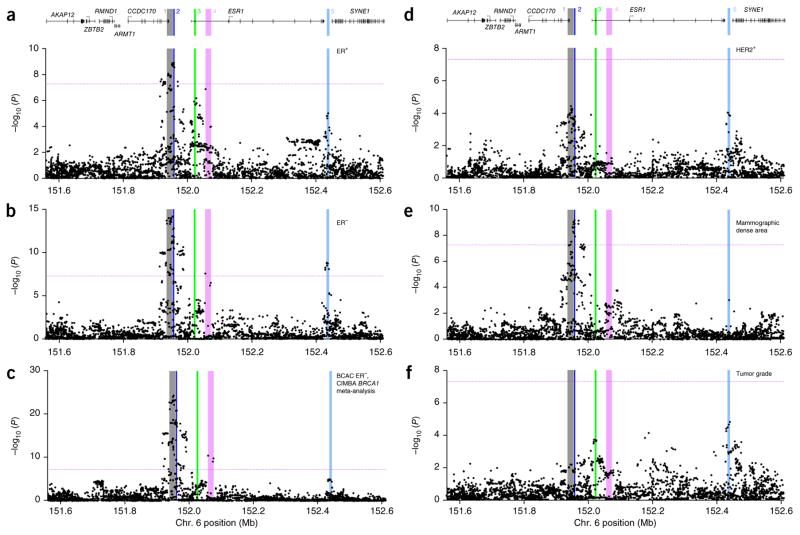
Figure 1
Figure 1
Association results for all SNPs with six phenotypes. (af) The phenotypes analyzed include risk of ER+ breast cancer in BCAC (a), risk of ER breast cancer in BCAC (b), risk of triple-negative breast cancer, derived from the CIMBA meta-analysis of BRCA1 mutation carriers with ER tumors (c), risk of HER2+ breast cancer in BCAC (d), mammographic dense area in MODE (e) and tumor grade after adjustment for ER status in BCAC (f). P values for each SNP (from unconditional logistic regression) are shown plotted as the negative log-transformed P value against relative position across the locus. A schematic of the gene structures is shown above a and d. The physical positions of signals 1–5 are shown as colored, numbered stripes. Dotted horizontal lines indicate the genome-wide significance level.
Figure 2
Figure 2
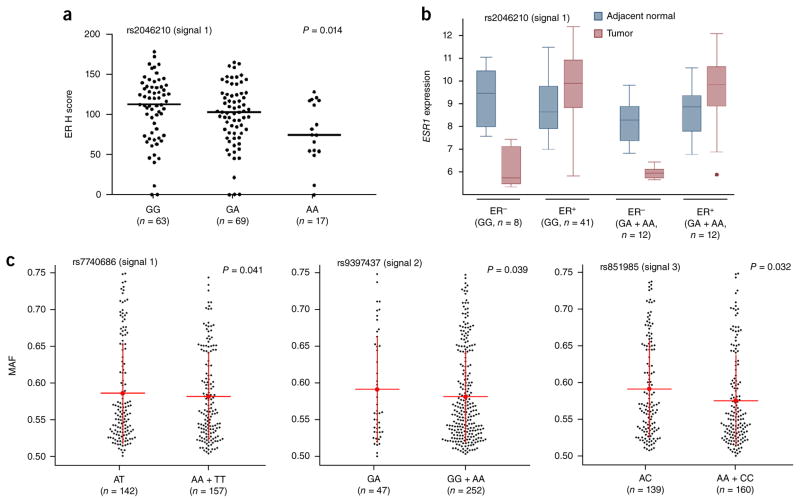
ER expression and allelic imbalance correlate with signal 1 SNPs. (a) Negative correlation between the signal 1 SNP rs2046210 and ER protein expression. Black dots represent ER expression from individual samples measured by immunohistochemistry (H score). Horizontal lines represent the mean H score for each genotype. The P value was calculated using a Spearman rank correlation test. (b) Box plots of ESR1 gene expression (log2 transformed) in breast tumor and adjacent normal samples. Boxes extend from the 25th to the 75th percentile, horizontal bars represent the median, whiskers indicate the full range of ESR1 expression and outliers are represented as circles. (c) Allelic imbalance in ESR1 expression by genotypic status at breast cancer risk variants. Data are classified according to the genotypes at risk SNPs (heterozygous versus homozygous). Black dots represent the average major allele fraction of the marker SNPs across ESR1 for an individual from TCGA with breast cancer. Red lines and whiskers correspond to means ± 1 s.d. For rs7740686 (signal 1) and rs9397437 (signal 2), Levene’s test (equality of variances) was used to calculate the P values; for rs851985 (signal 3), a two-tailed t test (equality of means) was used to calculate the P value.
Figure 3
Figure 3
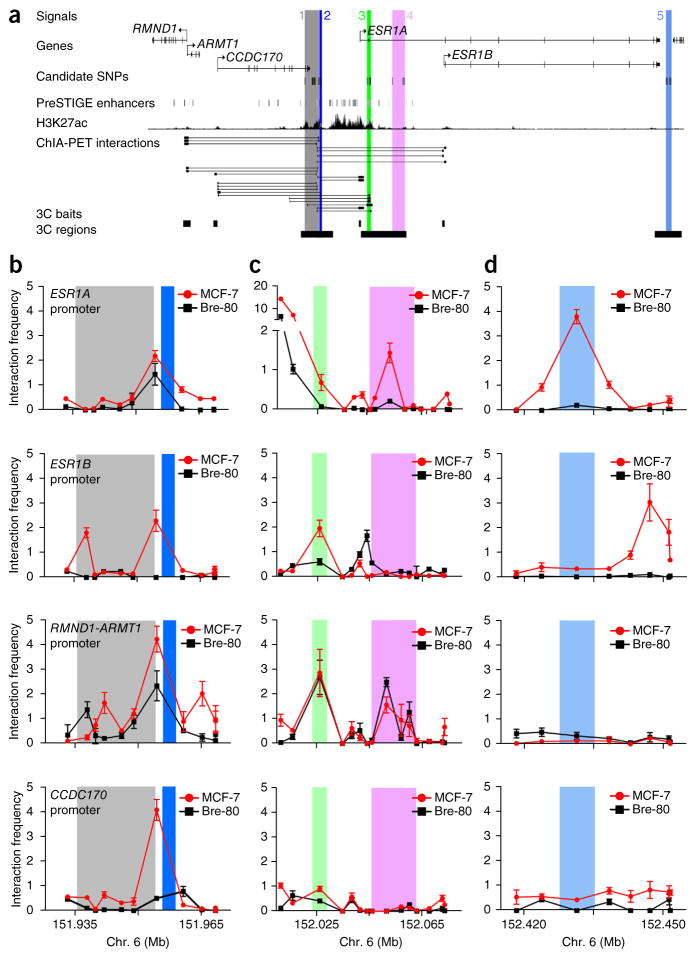
Chromatin interactions across the 6q25.1 risk region. (a) Signals 1–5 are numbered and shown as colored stripes. RMND1, ARMT1, CCDC170 and ESR1 gene structures are depicted with exons (vertical bars) joined by introns (lines). Gene-enhancer predictions from PreSTIGE, ChIP-seq binding profiles for H3K27ac and Encyclopedia of DNA Elements (ENCODE) RNA polymerase II ChIA-PET interactions in MCF-7 cells are shown. (bd) 3C anchor points (3C baits) and interrogated sequences (3C regions) are depicted as black boxes and gray shading, respectively. 3C interaction profiles in ER+ MCF-7 and ER Bre-80 breast cell lines are shown for signals 1 and 2 (b), signals 3 and 4 (c) and signal 5 (d). 3C libraries were generated with EcoRI, with the anchor point set at the ESR1, RMND1-ARMT1 or CCDC170 promoter region. Graphs present the results from three biological replicates; error bars, s.d.
Figure 4
Figure 4
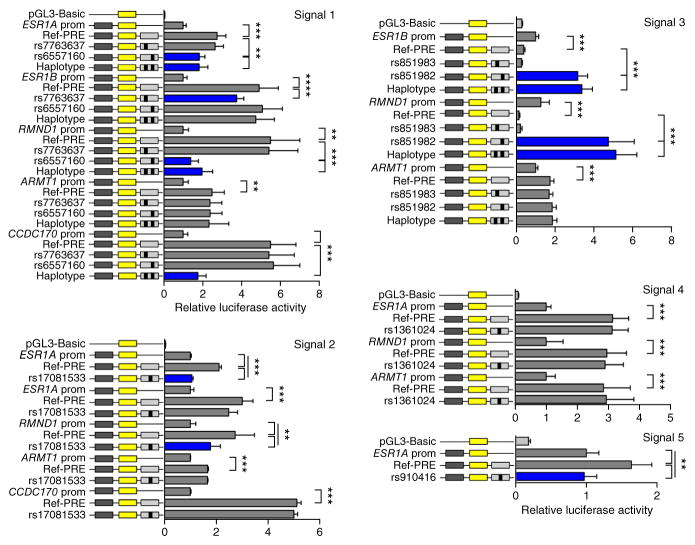
Risk alleles reduce ESR1 and RMND1 promoter activity. Luciferase reporter assays were performed following transient transfection of ER+ MCF-7 breast cancer cells. PREs containing the major SNP alleles were cloned downstream of target gene promoter-driven luciferase constructs (prom) for the creation of reference (Ref-PRE) constructs. Minor SNP alleles were engineered into the constructs and are designated by the rsID of the corresponding SNP. “Haplotype” denotes a construct that contains the minor alleles of both candidate SNPs within signal 1 or 3. Error bars, 95% confidence intervals from three independent experiments. P values were determined by two-way ANOVA followed by Dunnett’s multiple-comparisons test: **P < 0.01, ***P < 0.001.
Figure 5
Figure 5
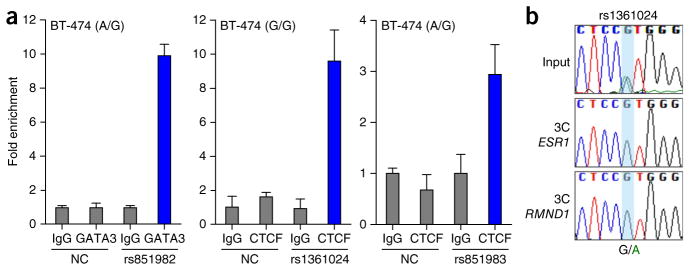
GATA3 and CTCF binding in vivo. (a) ChIP and quantitative PCR (qPCR) assays using antibody against GATA3 or CTCF in ER+ BT-474 breast cancer cells. A region within the second intron of ESR1 served as a negative control (NC). Normal rabbit IgG was used as a non-specific antibody control. Graphs present the results of two biological replicates; error bars, s.d. (b) 3C followed by sequencing for the signal 4 PRE containing rs1361024 in heterozygous ER+ MCF-7 breast cancer cells shows allele-specific chromatin looping. The chromatograms represent one of three independent 3C libraries generated and sequenced.

References

    1. Zheng W, et al. Genome-wide association study identifies a new breast cancer susceptibility locus at 6q25.1. Nat Genet. 2009;41:324–328. - PMC - PubMed
    1. Turnbull C, et al. Genome-wide association study identifies five new breast cancer susceptibility loci. Nat Genet. 2010;42:504–507. - PMC - PubMed
    1. Antoniou AC, et al. Common alleles at 6q25.1 and 1p11.2 are associated with breast cancer risk for BRCA1 and BRCA2 mutation carriers. Hum Mol Genet. 2011;20:3304–3321. - PMC - PubMed
    1. Lindström S, et al. Common variants in ZNF365 are associated with both mammographic density and breast cancer risk. Nat Genet. 2011;43:185–187. - PMC - PubMed
    1. Stacey SN, et al. Ancestry-shift refinement mapping of the C6orf97-ESR1 breast cancer susceptibility locus. PLoS Genet. 2010;6:e1001029. - PMC - PubMed

Publication types

MeSH terms

Grants and funding