Review
. 2016 Mar;74(3):149-65.
doi: 10.1093/nutrit/nuv105.

Adult height, nutrition, and population health

Affiliations
Review

Adult height, nutrition, and population health

Jessica M Perkins et al. Nutr Rev. 2016 Mar.

Abstract

In this review, the potential causes and consequences of adult height, a measure of cumulative net nutrition, in modern populations are summarized. The mechanisms linking adult height and health are examined, with a focus on the role of potential confounders. Evidence across studies indicates that short adult height (reflecting growth retardation) in low- and middle-income countries is driven by environmental conditions, especially net nutrition during early years. Some of the associations of height with health and social outcomes potentially reflect the association between these environmental factors and such outcomes. These conditions are manifested in the substantial differences in adult height that exist between and within countries and over time. This review suggests that adult height is a useful marker of variation in cumulative net nutrition, biological deprivation, and standard of living between and within populations and should be routinely measured. Linkages between adult height and health, within and across generations, suggest that adult height may be a potential tool for monitoring health conditions and that programs focused on offspring outcomes may consider maternal height as a potentially important influence.

Keywords: genetics; height; intergenerational; life course; morbidity; mortality; nutrition; population health; socioeconomic status; stature.


Figures

Figure 1
Figure 1
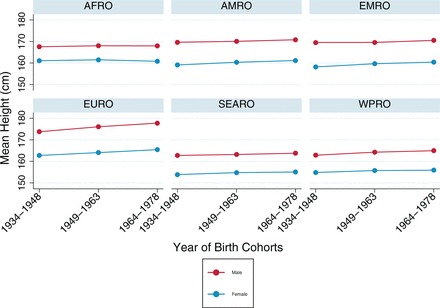
Average height (in cm) of adult men and women by year of birth category and World Health Organization (WHO) region. Data are from the 2003 World Health Surveys. The correlation of height with age group (represented by birth cohorts) for each WHO region is as follows: Africa (AFRO), 0.01; South-East Asia (SEARO), 0.10; the Americas (AMRO), 0.13; the Eastern Mediterranean (EMRO), 0.13; the Western Pacific (WPRO), 0.15; and Europe (EURO), 0.23.
Figure 2
Figure 2
Predicted association between height and year of birth by sex and World Bank income classification. Data are from the 2003 World Health Surveys and the World Bank. Models were adjusted for wealth quintile (derived from an asset index) and country fixed effects, and estimates were calculated using robust standard errors, taking into account clustering by primary sampling units.
Figure 3
Figure 3
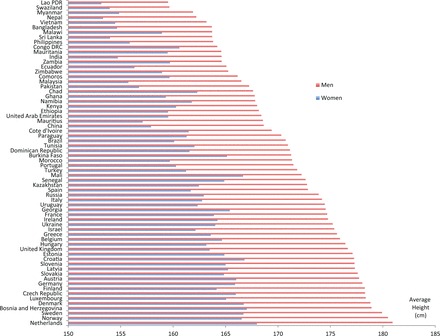
Mean height (in cm) of adult men and women across countries. The 2003 World Health Surveys measure self-reported heights for de facto populations, although surveys in India and China were not nationally representative. Mean heights for countries, calculated by the authors, are sample-weighted and age standardized by sex to the average World Health Surveys population.
Figure 4
Figure 4
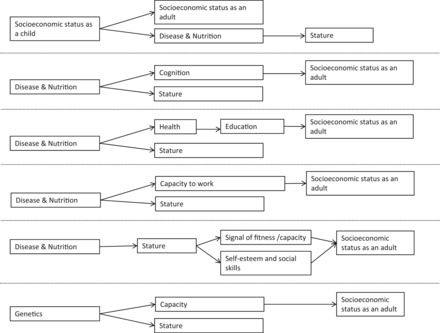
Disaggregation of some of the pathways through which environmental factors (socioeconomic status, disease, and nutrition) and genetics determine stature, and through which stature determines socioeconomic status and other outcomes.
Figure 5
Figure 5
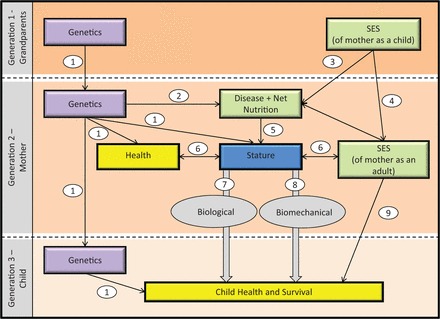
Conceptual model exploring the mechanisms that may link socioeconomic status (SES), height, and health across generations. Boxes are risk factors and outcomes, and ovals are mechanisms and interactions. The following points, which correspond to the numbers within the ovals, describe how determinants and consequences are related: (1) The additive endowment component affects maternal stature and health as well as child outcomes. (2) The multiplicative endowment component represents gene–environment interactions. (3) The socioeconomic conditions of the mother during childhood can mediate her exposure to disease and nutrition through a number of pathways, including food resources, access to medical care, and environmental sanitation. (4) Education and income can be transmitted intergenerationally through direct pathways (e.g., through inheritance for income or through transmission of skills for education). (5) The nutritional balance between intake and losses, including nutritional losses due to physical activity, psychological stress, and disease, directly affect growth. (6) There are potentially large interactions between stature, health, income, and education. (7) The biological pathways encapsulate factors that work through the viability of the uterine environment during pregnancy. (8) The biomechanical pathways indicate factors related to the relationship between stature and pelvic size. (9) Socioeconomic pathways through which the education of mothers (e.g. through health behaviors or autonomy of women to make health-related decisions for their children) and parental income affect childhood outcomes.

References

    1. Villermé LR. Mémoire sur la taille de l'homme en France. Annales d'Hygiène Publique et de Médicine Légale. 1829;1:351–396.
    1. Tanner JM. A History of the Study of Human Growth. Cambridge, UK: Cambridge University Press; 1981.
    1. Coelho PRP, McGuire RA. Diets versus diseases: the anthropometrics of slave children. J Econ Hist. 2000;60:232–246. - PubMed
    1. Steckel RH. Diets versus diseases in the anthropometrics of slave children: a reply. J Econ Hist. 2000;60:247–259. - PubMed
    1. Carson SA. Geography, insolation, and vitamin D in nineteenth century US African-American and white statures. Explor Econ Hist. 2009;46:149–159.

Publication types