


Assessment of Heart Transplant Waitlist Time and Pre- and Post-transplant Failure: A Mixed Methods Approach
- PMID: 26928705
- PMCID: PMC4892941
- DOI: 10.1097/EDE.0000000000000472
Assessment of Heart Transplant Waitlist Time and Pre- and Post-transplant Failure: A Mixed Methods Approach
Abstract
Background: Over the past two decades, there have been increasingly long waiting times for heart transplantation. We studied the relationship between heart transplant waiting time and transplant failure (removal from the waitlist, pretransplant death, or death or graft failure within 1 year) to determine the risk that conservative donor heart acceptance practices confer in terms of increasing the risk of failure among patients awaiting transplantation.
Methods: We studied a cohort of 28,283 adults registered on the United Network for Organ Sharing heart transplant waiting list between 2000 and 2010. We used Kaplan-Meier methods with inverse probability censoring weights to examine the risk of transplant failure accumulated over time spent on the waiting list (pretransplant). In addition, we used transplant candidate blood type as an instrumental variable to assess the risk of transplant failure associated with increased wait time.
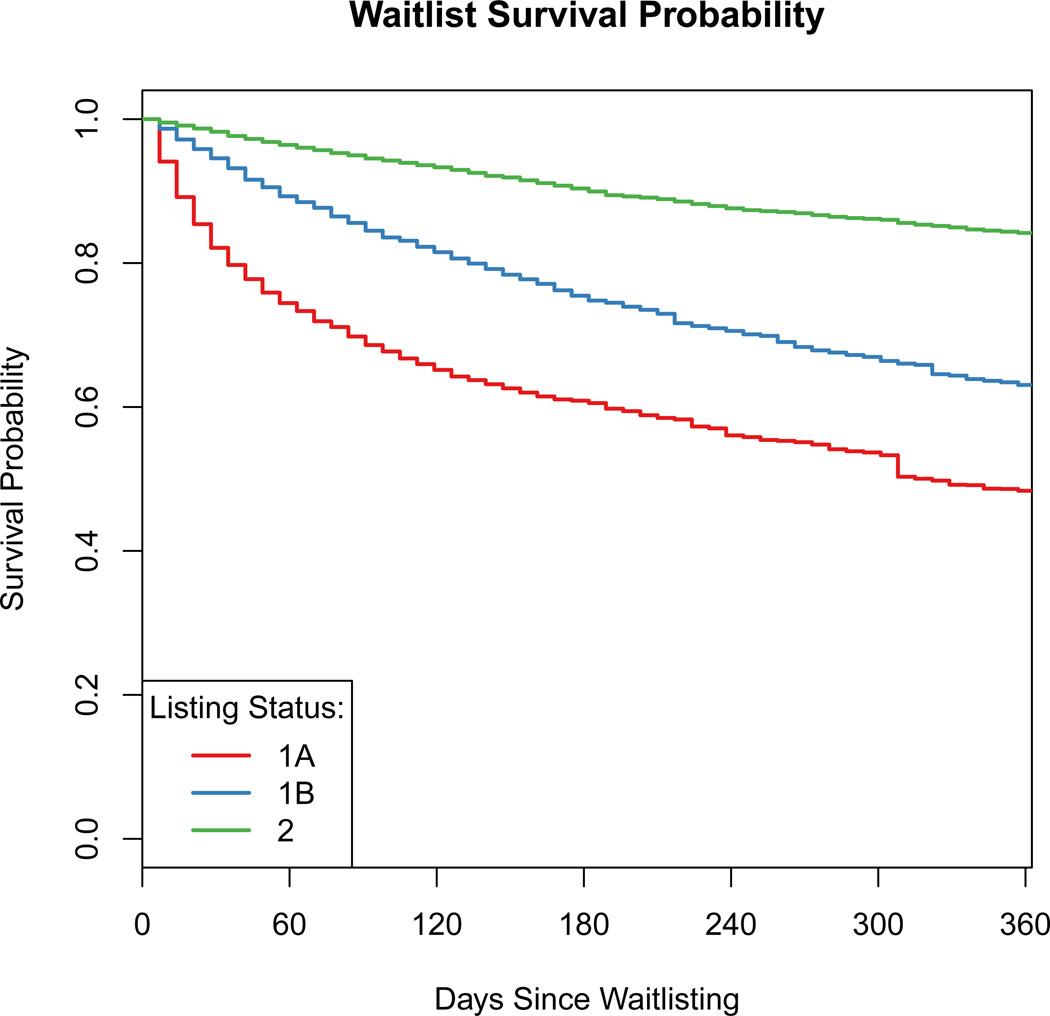
Results: Our results show that those who wait longer for a transplant have greater odds of transplant failure. While on the waitlist, the greatest risk of failure is during the first 60 days. Doubling the amount of time on the waiting list was associated with a 10% (1.01, 1.20) increase in the odds of failure within 1 year after transplantation.
Conclusions: Our findings suggest a relationship between time spent on the waiting list and transplant failure, thereby supporting research aimed at defining adequate donor heart quality and acceptance standards for heart transplantation.
Figures
Comment in
-
Commentary: Selection Bias in Clinical Epidemiology: Causal Thinking to Guide Patient-centered Research.Epidemiology. 2016 Jul;27(4):466-8. doi: 10.1097/EDE.0000000000000473. Epidemiology. 2016. PMID: 26928706 No abstract available.
References
-
- Mozaffarian D, et al. Heart disease and stroke statistics--2015 update: a report from the American Heart Association. Circulation. 2015;131:e29–e322. - PubMed
-
- Lund LH, et al. The registry of the International Society for Heart and Lung Transplantation: thirty-first official adult heart transplant report--2014; focus theme: retransplantation. J. Heart Lung Transplant. Off. Publ. Int. Soc. Heart Transplant. 2014;33:996–1008. - PubMed
-
- Kirklin JK, et al. Fifth INTERMACS annual report: risk factor analysis from more than 6,000 mechanical circulatory support patients. J. Heart Lung Transplant. Off. Publ. Int. Soc. Heart Transplant. 2013;32:141–156. - PubMed
-
- Stehlik J, et al. The Registry of the International Society for Heart and Lung Transplantation: 29th official adult heart transplant report-2012. J. Heart Lung Transplant. Off. Publ. Int. Soc. Heart Transplant. 2012;31:1052–1064. - PubMed
Publication types
MeSH terms
Substances
Grants and funding
LinkOut - more resources
Full Text Sources
Other Literature Sources
Medical
Miscellaneous
