. 2016 Mar 15;113(11):E1452-9.
doi: 10.1073/pnas.1518570113. Epub 2016 Feb 29.

Novel genomic island modifies DNA with 7-deazaguanine derivatives

Affiliations

Novel genomic island modifies DNA with 7-deazaguanine derivatives

Jennifer J Thiaville et al. Proc Natl Acad Sci U S A. .

Abstract

The discovery of ∼20-kb gene clusters containing a family of paralogs of tRNA guanosine transglycosylase genes, called tgtA5, alongside 7-cyano-7-deazaguanine (preQ0) synthesis and DNA metabolism genes, led to the hypothesis that 7-deazaguanine derivatives are inserted in DNA. This was established by detecting 2'-deoxy-preQ0 and 2'-deoxy-7-amido-7-deazaguanosine in enzymatic hydrolysates of DNA extracted from the pathogenic, Gram-negative bacteria Salmonella enterica serovar Montevideo. These modifications were absent in the closely related S. enterica serovar Typhimurium LT2 and from a mutant of S Montevideo, each lacking the gene cluster. This led us to rename the genes of the S. Montevideo cluster as dpdA-K for 7-deazapurine in DNA. Similar gene clusters were analyzed in ∼150 phylogenetically diverse bacteria, and the modifications were detected in DNA from other organisms containing these clusters, including Kineococcus radiotolerans, Comamonas testosteroni, and Sphingopyxis alaskensis Comparative genomic analysis shows that, in Enterobacteriaceae, the cluster is a genomic island integrated at the leuX locus, and the phylogenetic analysis of the TgtA5 family is consistent with widespread horizontal gene transfer. Comparison of transformation efficiencies of modified or unmodified plasmids into isogenic S. Montevideo strains containing or lacking the cluster strongly suggests a restriction-modification role for the cluster in Enterobacteriaceae. Another preQ0 derivative, 2'-deoxy-7-formamidino-7-deazaguanosine, was found in the Escherichia coli bacteriophage 9 g, as predicted from the presence of homologs of genes involved in the synthesis of the archaeosine tRNA modification. These results illustrate a deep and unexpected evolutionary connection between DNA and tRNA metabolism.

Keywords: 7-deazaguanine; DNA modification; comparative genomics; queuosine; restriction–modification.


Conflict of interest statement

The authors declare no conflict of interest.

Figures
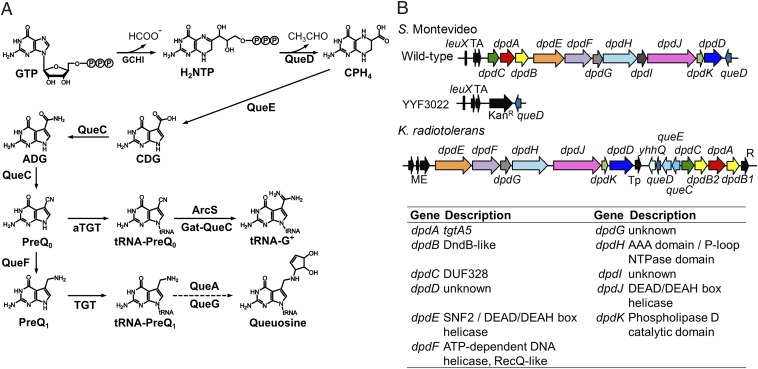
Fig. 1.
Fig. 1.
Biosynthesis of 7-deazaguanine derivatives. (A) The biosynthetic pathways to queuosine and archaeosine in tRNA. ADG, 7-amido-7-deazaguanine; aTGT, archaeal TGT; CDG, 5-carboxydeazaguanine; CPH4, 6-carboxytetrahydropterin; G+, archaeosine; GCHI, GTP cyclohydrolase I (FolE); H2NTP, Dihydroneopterin phosphate; TGT, tRNA-Guanine transglycosylase. (B) Gene clusters of S. Montevideo (GCA_000238535.2; TgtA5 UniProt ID E7V8J4) and K. radiotolerans (NC_009664; TgtA5 UniProt ID A6WGA1) tgtA5/dpdA and S. Montevideo mutant strain YYF3022 (∆dpdC-dpdD::kan). Similar colors represent homologs. Red arrows indicate dpdA; black arrows represent genes predicted to be involved in HGT; gray arrows represent hypothetical proteins (hyp). int, integrase; ME, mobile element protein; R, resolvase; TA, toxin–antitoxin gene pair (ccdA, ccdB); Tp, transposase.
Fig. 2.
Fig. 2.
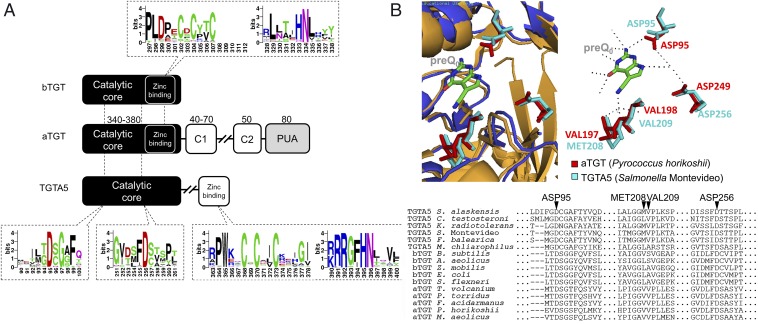
Comparison of TGT and TgtA5 proteins. (A) Schematic representation of the domain architecture and arrangement of TgtA5 proteins and bacterial and archaeal TGT proteins (bTGT and aTGT, respectively). The numbering of the upper and lower logos refers to the S. Montevideo TGT and TgtA5 sequences, respectively. Sequence logos in dashed boxes show the two conserved Asp residues of TgtA5 and the zinc binding sites of bTGT (Top) and TgtA5 (Bottom). C1 and C2 represent C-terminal domains unique to aTGT (17, 19). (B) Model and alignments of proposed substrate-binding pocket of TgtA5. The aligned cartoon representation (Top) of the pockets of S. Montevideo TgtA5 and P. horikoshii aTGT (PDB ID code 1IT8) was produced by PyMol (version 1.3). The catalytic residues of aTGT, ASP95, VAL197, VAL198, and ASP249 (red) (18) and their TgtA5 counterparts ASP95, MET208, VAL209, and ASP256 (cyan) are indicated in stick models. Dashed lines among stick models indicate the catalytic residues interacting with preQ0. Sequence alignment (Bottom) of select aTGT, bTGT, and TgtA5 proteins was performed using MUSCLE (53). Dots indicate regions intentionally deleted for this figure. Dashes indicate gaps in the sequence alignment. UniProt IDs for proteins included in multiple alignment are as follows: S. Montevideo TgtA5, E7V8J4; F. balearica TgtA5, E1SVY3; S. alaskensis TgtA5, Q1GPS0; Comamonas testosteroni TgtA5, H1RRG1; K. radiotolerans TgtA5, A6WGA1; E. coli bTGT, P0A847; Z. mobilis bTGT, Q8GM47; Shigella flexneri bTGT, Q54177; Bacillus subtilis bTGT, L8AMH3; Aquifex aeolicus bTGT, O67331; P. horikoshii aTGT, O58843; Methanococcus aeolicus aTGT, A6UVD8; Thermoplasma volcanium aTGT, Q977Z3; Picrophilus torridus aTGT, Q6L1W3; Ferroplasma acidarmanus aTGT, S0AQ23.
Fig. 3.
Fig. 3.
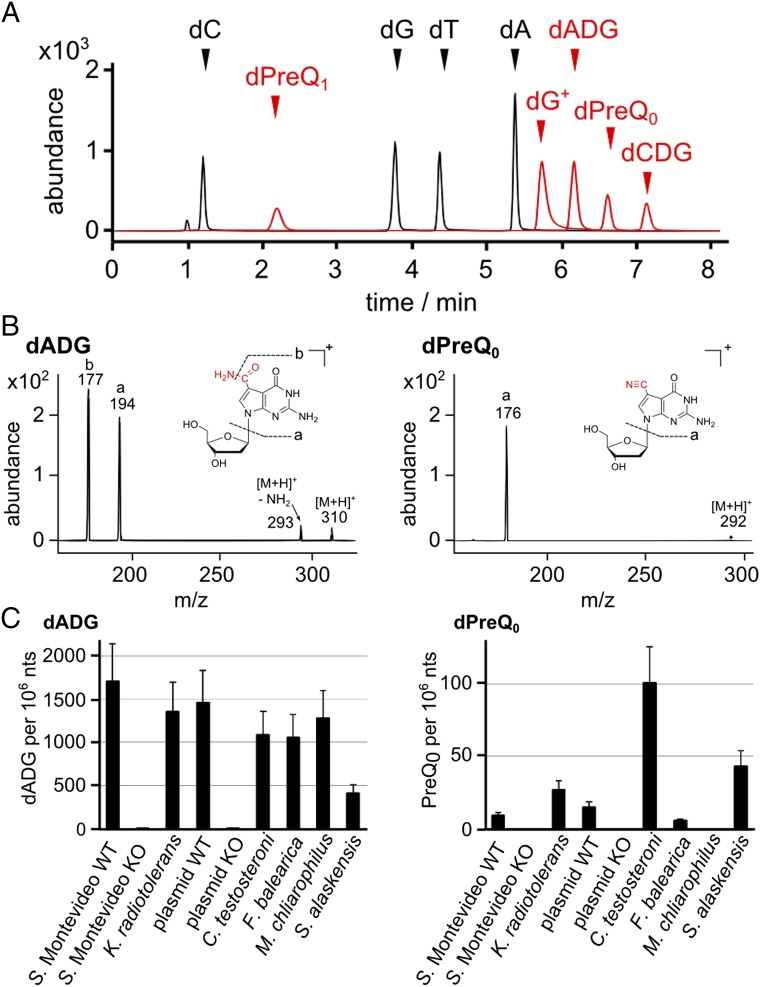
Detection and quantification of 2′-deoxy-7-deazaguanosine derivatives by LC–MS/MS. (A) The LC–MS/MS analytical method is illustrated with an extracted ion chromatogram showing the HPLC retention of the various 7-deazaG–modified (red) and canonical (black) 2’-deoxynucleosides. Abundance denotes arbitrary units of signal intensity. (B) MS/MS fragmentation patterns for synthetic dADG and dPreQ0. Abundance denotes arbitrary units of signal intensity. (C) Detected quantities in DNA samples of various bacterial species displayed as modification per 106 nucleotides.
Fig. 4.
Fig. 4.
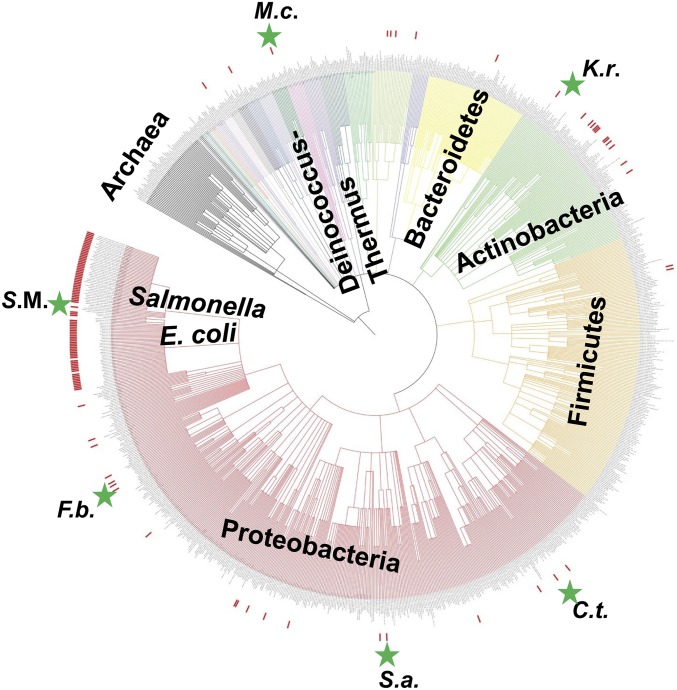
Taxonomic distribution of TgtA5. Taxonomic tree of ∼1,000 representative prokaryotes generated using iToL. Red bars indicate the presence of tgtA5 in species. Stars indicate organisms for which preQ0 and/or ADG were detected in DNA. C.t., C. testosteroni; F.b., F. balearica; K.r., K. radiotolerans; M.c., M. chliarophilus; S.a., S. alaskensis; S.M., S. Montevideo.
Fig. 5.
Fig. 5.
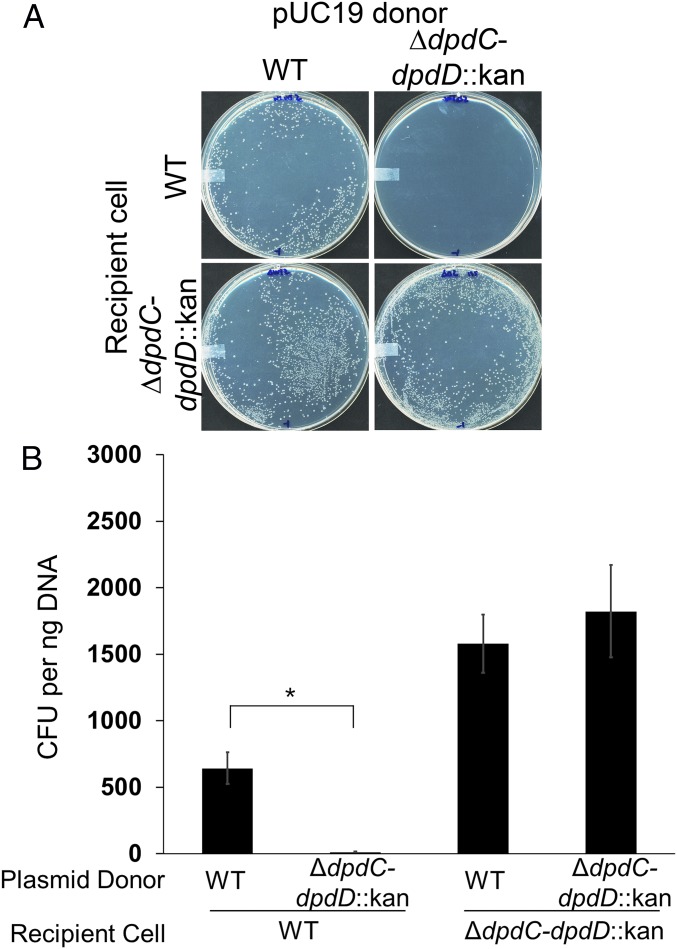
Transformation efficiency of modified and unmodified pUC19 DNA. (A) S. Montevideo WT and YYF3022 (ΔdpdC-dpdD::kan) transformed with 10 ng pUC19 extracted from either WT (modified) or ΔdpdC-dpdD::kan (unmodified) on LB agar plates containing ampicillin. (B) Transformation efficiencies of modified versus unmodified pUC19 in WT and ΔdpdC-dpdD::kan. Transformation efficiency per 1 ng DNA was calculated per 106 viable cfu. The average of three experiments is shown, with error bars representing SE (*P < 0.05, two-tailed Student’s t test).
Fig. 6.
Fig. 6.
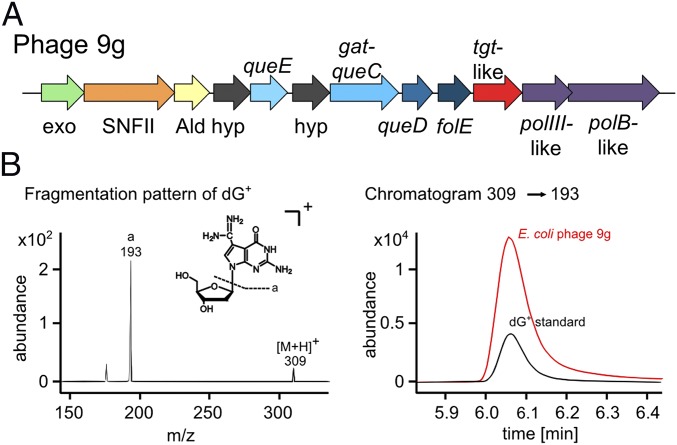
Phage 9g DNA is modified with dG+. (A) Gene cluster of phage 9g (NC_024146) tgt-like. Ald, aldolase; exo, Cas4-like exonuclease; hyp, hypothetical; polB-like, DNA polymerase B; polIII-like, DNA polymerase β-subunit; SNFII, superfamily II-like helicase. (B) MS/MS fragmentation pattern of synthetic dG+ (Left) used for subsequent detection of dG+ in E. coli phage 9g DNA (Right).

References

    1. Grosjean H. Nucleic acids are not boring long polymers of only four types of nucleotides. In: Grosjean H, editor. DNA and RNA Modification Enzymes: Structure, Mechanism, Function and Evolution. Landes Bioscience; Austin, TX: 2009. pp. 1–18.
    1. Warren RA. Modified bases in bacteriophage DNAs. Annu Rev Microbiol. 1980;34:137–158. - PubMed
    1. Ekanayake DK, et al. Epigenetic regulation of transcription and virulence in Trypanosoma cruzi by O-linked thymine glucosylation of DNA. Mol Cell Biol. 2011;31(8):1690–1700. - PMC - PubMed
    1. Wang L, et al. DNA phosphorothioation is widespread and quantized in bacterial genomes. Proc Natl Acad Sci USA. 2011;108(7):2963–2968. - PMC - PubMed
    1. Wang L, et al. Phosphorothioation of DNA in bacteria by dnd genes. Nat Chem Biol. 2007;3(11):709–710. - PubMed

Publication types

MeSH terms