


Drug-loaded erythrocytes: on the road toward marketing approval
- PMID: 26929599
- PMCID: PMC4755692
- DOI: 10.2147/DDDT.S96470
Drug-loaded erythrocytes: on the road toward marketing approval
Abstract
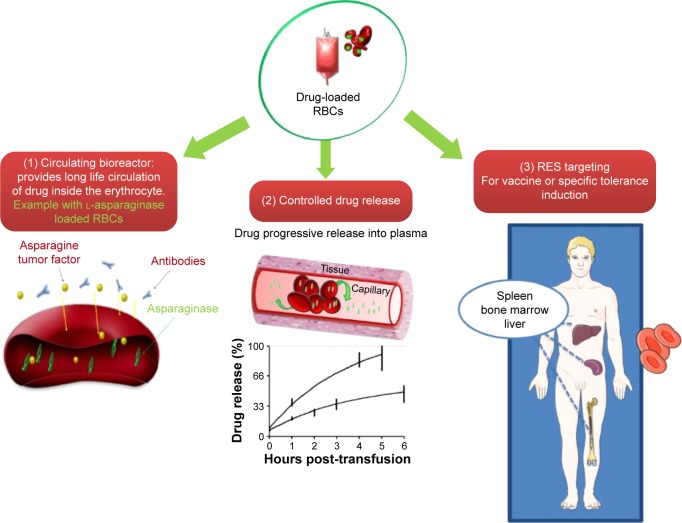
Erythrocyte drug encapsulation is one of the most promising therapeutic alternative approaches for the administration of toxic or rapidly cleared drugs. Drug-loaded erythrocytes can operate through one of the three main mechanisms of action: extension of circulation half-life (bioreactor), slow drug release, or specific organ targeting. Although the clinical development of erythrocyte carriers is confronted with regulatory and development process challenges, industrial development is expanding. The manufacture of this type of product can be either centralized or bedside based, and different procedures are employed for the encapsulation of therapeutic agents. The major challenges for successful industrialization include production scalability, process validation, and quality control of the released therapeutic agents. Advantages and drawbacks of the different manufacturing processes as well as success key points of clinical development are discussed. Several entrapment technologies based on osmotic methods have been industrialized. Companies have already achieved many of the critical clinical stages, thus providing the opportunity in the future to cover a wide range of diseases for which effective therapies are not currently available.
Keywords: clinical use; drug carrier; encapsulation method; industrial development; red blood cell.
Figures
References
-
- Pierige F, Serafini S, Rossi L, et al. Cell-based drug delivery. Adv Drug Deliv Rev. 2008;60(2):286–295. - PubMed
-
- Patel RP, Patel MJ, Patel NA. An overview of resealed erythrocyte drug delivery. J Pharm Res. 2009;2(6):1008–1012.
-
- Millan CG, Marinero ML, Castaneda AZ, et al. Drug, enzyme and peptide delivery using erythrocytes as carriers. J Control Release. 2004;95(1):27–49. - PubMed
-
- Gothoskar AV. Resealed erythrocytes: a review. Pharmaceutical Technology [serial on the internet]; 2004. [Accessed December 6, 2015]. pp. 140–158. Available from: http://www.pharmtech.com.
-
- Harisa GE, Ibrahim MF, Alanazi FK, et al. Application and safety of erythrocytes as a novel drug delivery system. Asian J Biochem. 2011;6:309–321.
Publication types
MeSH terms
Substances
Grants and funding
LinkOut - more resources
Full Text Sources
Other Literature Sources
Medical
