


Health Impacts of Active Transportation in Europe
- PMID: 26930213
- PMCID: PMC4773008
- DOI: 10.1371/journal.pone.0149990
Health Impacts of Active Transportation in Europe
Abstract
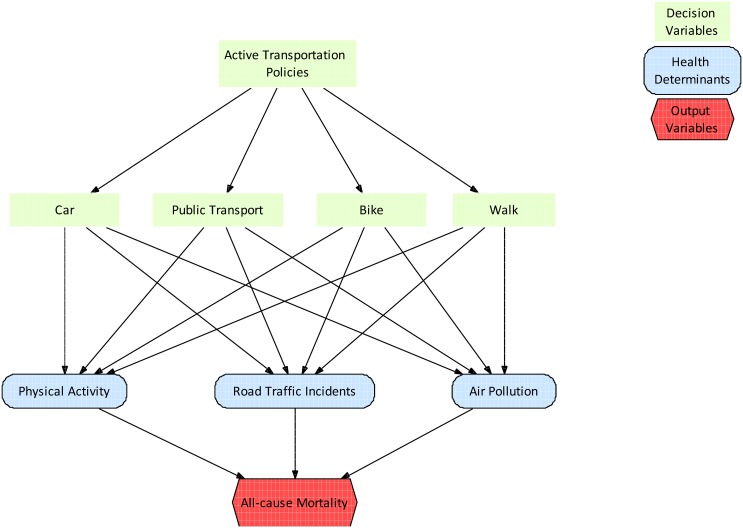
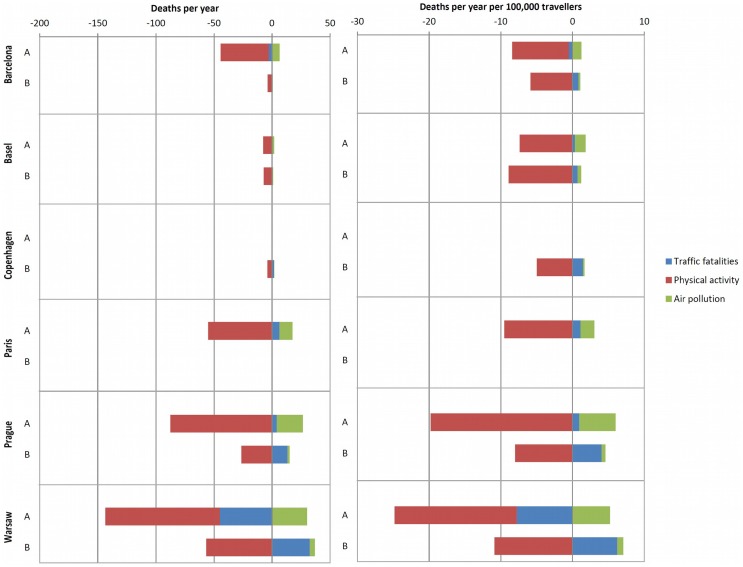
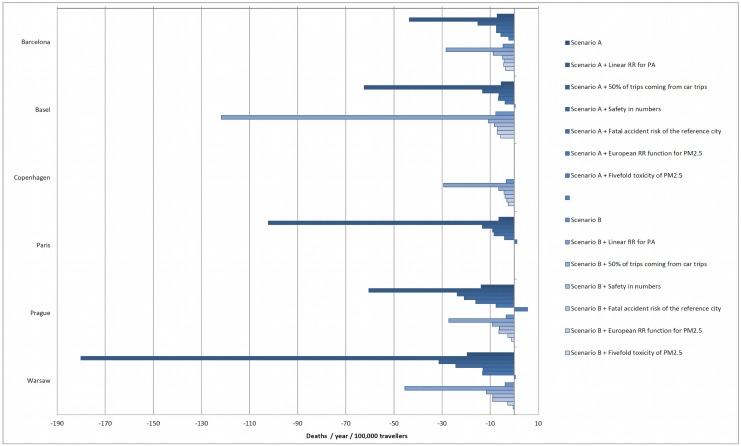
Policies that stimulate active transportation (walking and bicycling) have been related to heath benefits. This study aims to assess the potential health risks and benefits of promoting active transportation for commuting populations (age groups 16-64) in six European cities. We conducted a health impact assessment using two scenarios: increased cycling and increased walking. The primary outcome measure was all-cause mortality related to changes in physical activity level, exposure to fine particulate matter air pollution with a diameter <2.5 μm, as well as traffic fatalities in the cities of Barcelona, Basel, Copenhagen, Paris, Prague, and Warsaw. All scenarios produced health benefits in the six cities. An increase in bicycle trips to 35% of all trips (as in Copenhagen) produced the highest benefits among the different scenarios analysed in Warsaw 113 (76-163) annual deaths avoided, Prague 61 (29-104), Barcelona 37 (24-56), Paris 37 (18-64) and Basel 5 (3-9). An increase in walking trips to 50% of all trips (as in Paris) resulted in 19 (3-42) deaths avoided annually in Warsaw, 11(3-21) in Prague, 6 (4-9) in Basel, 3 (2-6) in Copenhagen and 3 (2-4) in Barcelona. The scenarios would also reduce carbon dioxide emissions in the six cities by 1,139 to 26,423 (metric tonnes per year). Policies to promote active transportation may produce health benefits, but these depend of the existing characteristics of the cities. Increased collaboration between health practitioners, transport specialists and urban planners will help to introduce the health perspective in transport policies and promote active transportation.
Conflict of interest statement
Figures
References
-
- European Environment Agency. The European Environment, State and Outlook 2010, Urban Environment. EEA, European Commission, editors. 2010. Copenhagen.
-
- UNEP. Share the Road: Investment in Walking and Cycling Road Infrastructure. United Nations Environment Programme, editor. 2010. Nairobi.
-
- EPA. Guide to Sustainable Transportation Performance Measures. 2011. US, Environmental Protection Agency.
-
- Lim SS, Vos T, Flaxman AD, Danaei G, Shibuya K, Adair-Rohani H et al. A comparative risk assessment of burden of disease and injury attributable to 67 risk factors and risk factor clusters in 21 regions, 1990–2010: a systematic analysis for the Global Burden of Disease Study 2010. Lancet 2013; 380(9859):2224–2260. - PMC - PubMed
-
- The World Bank, Institute for Health Metrics and Evaluation. Transport for Health: The Global Burden of Disease from Motorized Road Transport. 2014. Washington, DC, The World Bank. Global Road Safety Facility.
Publication types
MeSH terms
Grants and funding
LinkOut - more resources
Full Text Sources
Other Literature Sources
Medical
