


Depression-Burnout Overlap in Physicians
- PMID: 26930395
- PMCID: PMC4773131
- DOI: 10.1371/journal.pone.0149913
Depression-Burnout Overlap in Physicians
Abstract
Background: Whether burnout is a distinct phenomenon rather than a type of depression and whether it is a syndrome, limited to three "core" components (emotional exhaustion, depersonalization and low personal accomplishment) are subjects of current debate. We investigated the depression-burnout overlap, and the pertinence of these three components in a large, representative sample of physicians.
Methods: In a cross-sectional study, all Austrian physicians were invited to answer a questionnaire that included the Major Depression Inventory (MDI), the Hamburg Burnout Inventory (HBI), as well as demographic and job-related parameters. Of the 40093 physicians who received an invitation, a total of 6351 (15.8%) participated. The data of 5897 participants were suitable for analysis.
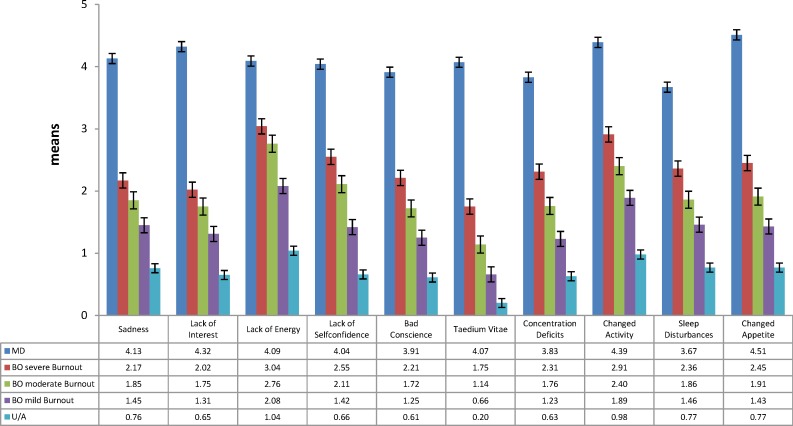
Results: Of the participants, 10.3% were affected by major depression. Our study results suggest that potentially 50.7% of the participants were affected by symptoms of burnout. Compared to physicians unaffected by burnout, the odds ratio of suffering from major depression was 2.99 (95% CI 2.21-4.06) for physicians with mild, 10.14 (95% CI 7.58-13.59) for physicians with moderate, 46.84 (95% CI 35.25-62.24) for physicians with severe burnout and 92.78 (95% CI 62.96-136.74) for the 3% of participants with the highest HBI_sum (sum score of all ten HBI components). The HBI components Emotional Exhaustion, Personal Accomplishment and Detachment (representing depersonalization) tend to correlate more highly with the main symptoms of major depression (sadness, lack of interest and lack of energy) than with each other. A combination of the HBI components Emotional Exhaustion, Helplessness, Inner Void and Tedium (adj.R2 = 0.92) explained more HBI_sum variance than the three "core" components (adj.R2 = 0.85) of burnout combined. Cronbach's alpha for Emotional Exhaustion, Helplessness, Inner Void and Tedium combined was 0.90 compared to α = 0.54 for the combination of the three "core" components.
Conclusions: This study demonstrates the overlap of burnout and major depression in terms of symptoms and the deficiency of the three-dimensional concept of burnout. In our opinion, it might be preferable to use multidimensional burnout inventories in combination with valid depression scales than to rely exclusively on MBI when clinically assessing burnout.
Conflict of interest statement
Figures
References
-
- Hsu K, Marshall V. Prevalence of depression and distress in a large sample of canadian residents, interns, and fellows. Am J Psychiatry. 1987;144(12):1561–1566. - PubMed
-
- Ahola K, Hakanen J. Job strain, burnout, and depressive symptoms: A prospective study among dentists. J Affect Disord. 2007;104(1–3):103–110. - PubMed
-
- Fahrenkopf AM, Sectish TC, Barger LK, Sharek PJ, Lewin D, Chiang VW, et al. Rates of medication errors among depressed and burnt out residents: Prospective cohort study. BMJ. 2008;336(7642):488–491. 10.1136/bmj.39469.763218.BE - DOI - PMC - PubMed
-
- Tomioka K, Morita N, Saeki K, Okamoto N, Kurumatani N. Working hours, occupational stress and depression among physicians. Occup Med (Lond). 2011;61(3):163–170. - PubMed
MeSH terms
LinkOut - more resources
Full Text Sources
Other Literature Sources
Medical
