


Changes in Discard Rate After the Introduction of the Kidney Donor Profile Index (KDPI)
- PMID: 26932575
- PMCID: PMC4925251
- DOI: 10.1111/ajt.13769
Changes in Discard Rate After the Introduction of the Kidney Donor Profile Index (KDPI)
Abstract
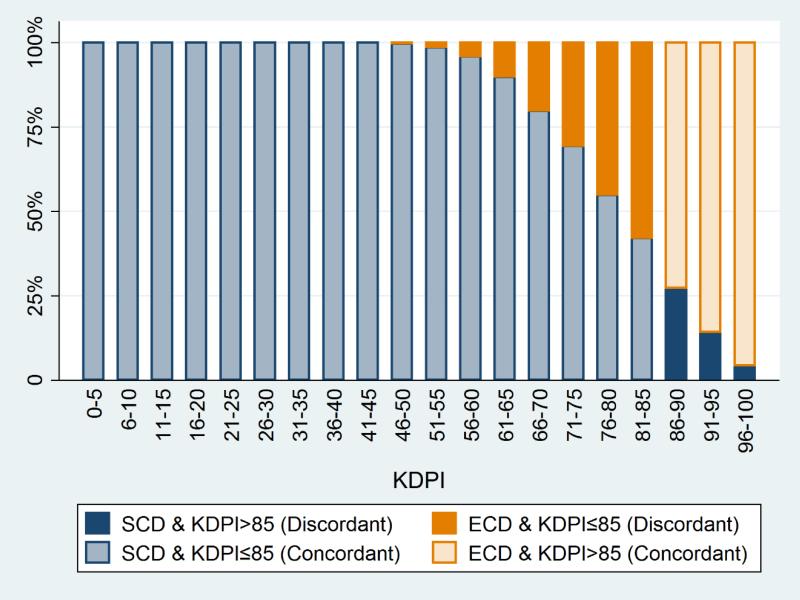
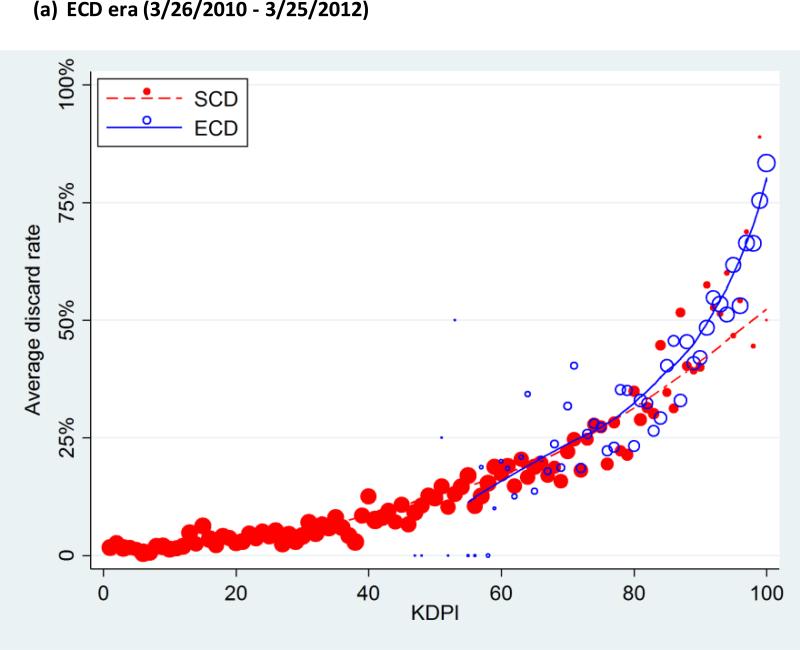
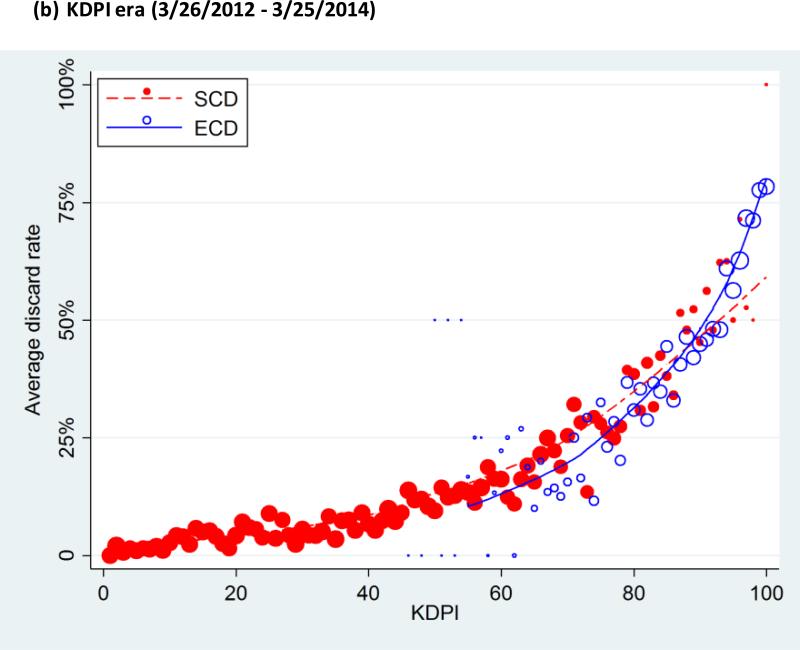
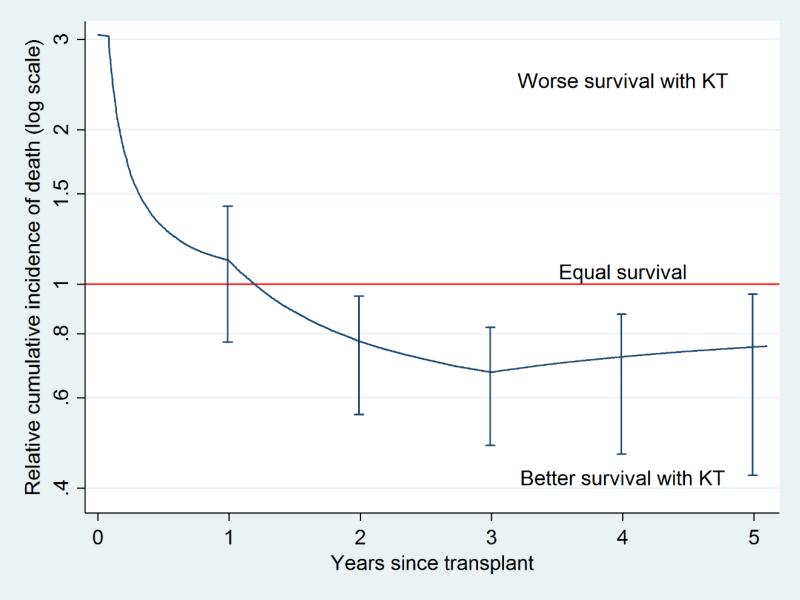
Since March 26, 2012, the Kidney Donor Profile Index (KDPI) has been provided with all deceased-donor kidney offers, with the goal of improving the expanded criteria donor (ECD) indicator. Although an improved risk index may facilitate identification and transplantation of marginal yet viable kidneys, a granular percentile system may reduce provider-patient communication flexibility, paradoxically leading to more discards ("labeling effect"). We studied the discard rates of the kidneys recovered for transplantation between March 26, 2010 and March 25, 2012 ("ECD era," N = 28 636) and March 26, 2012 and March 25, 2014 ("KDPI era," N = 29 021) using Scientific Registry of Transplant Recipients (SRTR) data. There was no significant change in discard rate from ECD era (18.1%) to KDPI era (18.3%) among the entire population (adjusted odds ratio [aOR] = 0.97 1.041.10 , p = 0.3), or in any KDPI stratum. However, among kidneys in which ECD and KDPI indicators were discordant, "high risk" standard criteria donor (SCD) kidneys (with KDPI > 85) were at increased risk of discard in the KDPI era (aOR = 1.07 1.421.89 , p = 0.02). Yet, recipients of these kidneys were at much lower risk of death (adjusted Risk Ratio [aRR] = 0.56 0.770.94 at 2 years posttransplant) compared to those remaining on dialysis waiting for low-KDPI kidneys. Our findings suggest that there might be an unexpected, harmful labeling effect of reporting a high KDPI for SCD kidneys, without the expected advantage of providing a more granular risk index.
Keywords: clinical decision-making; clinical research/practice; kidney transplantation/nephrology; organ acceptance; organ procurement and allocation; patient education.
© Copyright 2016 The American Society of Transplantation and the American Society of Transplant Surgeons.
Figures
References
-
- Rao PS, Schaubel DE, Guidinger MK, Andreoni KA, Wolfe RA, Merion RM, et al. A comprehensive risk quantification score for deceased donor kidneys: the Kidney Donor Risk Index. Transplantation. 2009;88(2):231–236. - PubMed
-
- The Organ Procurement and Transplantation Network [July 24, 2014];A guide to calculating and interpreting the Kidney Donor Profile Index (KDPI) http://optn.transplant.hrsa.gov/ContentDocuments/Guide_to_Calculating_In....
-
- Kauffman HM, Bennett LE, McBride MA, Ellison MD. The expanded donor. Transplant Rev. 1997;11(4):165–190.
-
- Gupta A, Chen G, Kaplan B. KDPI and donor selection. Am J Transplant. 2014;14(11):2444–2445. - PubMed
Publication types
MeSH terms
Grants and funding
LinkOut - more resources
Full Text Sources
Other Literature Sources
Medical
