


Estimation of country-specific and global prevalence of male circumcision
- PMID: 26933388
- PMCID: PMC4772313
- DOI: 10.1186/s12963-016-0073-5
Estimation of country-specific and global prevalence of male circumcision
Erratum in
-
Erratum to: Estimation of country-specific and global prevalence of male circumcision.Popul Health Metr. 2016 Apr 4;14:11. doi: 10.1186/s12963-016-0080-6. eCollection 2016. Popul Health Metr. 2016. PMID: 27051352 Free PMC article.
Abstract
Background: Male circumcision (MC) status and genital infection risk are interlinked and MC is now part of HIV prevention programs worldwide. Current MC prevalence is not known for all countries globally. Our aim was to provide estimates for country-specific and global MC prevalence.
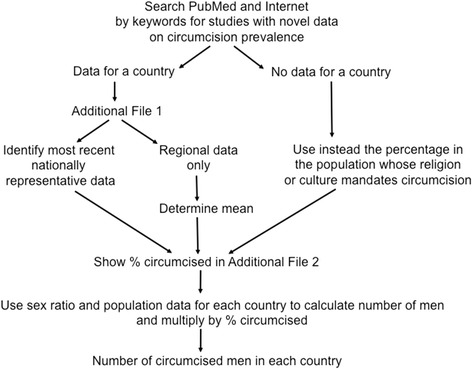
Methods: MC prevalence data were obtained by searches in PubMed, Demographic and Health Surveys, AIDS Indicator Surveys, and Behavioural Surveillance Surveys. Male age was ≥15 years in most surveys. Where no data were available, the population proportion whose religious faith or culture requires MC was used. The total number of circumcised males in each country and territory was calculated using figures for total males from (i) 2015 US Central Intelligence Agency (CIA) data for sex ratio and total population in all 237 countries and territories globally and (ii) 2015 United Nations (UN) figures for males aged 15-64 years.
Results: The estimated percentage of circumcised males in each country and territory varies considerably. Based on (i) and (ii) above, global MC prevalence was 38.7 % (95 % confidence interval [CI]: 33.4, 43.9) and 36.7 % (95 % CI: 31.4, 42.0). Approximately half of circumcisions were for religious and cultural reasons. For countries lacking data we assumed 99.9 % of Muslims and Jews were circumcised. If actual prevalence in religious groups was lower, then MC prevalence in those countries would be lower. On the other hand, we assumed a minimum prevalence of 0.1 % related to MC for medical reasons. This may be too low, thereby underestimating MC prevalence in some countries.
Conclusions: The present study provides the most accurate estimate to date of MC prevalence in each country and territory in the world. We estimate that 37-39 % of men globally are circumcised. Considering the health benefits of MC, these data may help guide efforts aimed at the use of voluntary, safe medical MC in disease prevention programs in various countries.
Keywords: Country-specific prevalence; Global prevalence; Male circumcision; Population health.
Figures
References
-
- Cox G, Morris BJ. Why circumcision: From pre-history to the twenty-first century. In: Bolnick DA, Koyle MA, Yosha A, editors. Surgical Guide to Circumcision. London: Springer; 2012. pp. 243–259.
-
- Morris BJ, Cox G. Current medical evidence supports male circumcision. In: Bolnick DA, Koyle MA, Yosha A, editors. Surgical Guide to Circumcision. London: Springer; 2012. pp. 201–213.
-
- Morris BJ, Castellsague X. The role of circumcision in preventing STIs. In: Gross GE, Tyring SK, editors. Sexually Transmitted Infections and Sexually Transmitted Diseases. Berlin and Heidelberg: Springer; 2011. pp. 715–739.
LinkOut - more resources
Full Text Sources
Other Literature Sources
Medical
