. 2016 Jun;233(11):2035-2043.
doi: 10.1007/s00213-016-4257-2. Epub 2016 Mar 2.

Forced swim stress increases ethanol consumption in C57BL/6J mice with a history of chronic intermittent ethanol exposure

Affiliations

Forced swim stress increases ethanol consumption in C57BL/6J mice with a history of chronic intermittent ethanol exposure

Rachel I Anderson et al. Psychopharmacology (Berl). 2016 Jun.

Abstract

Rationale: Stress exposure has been identified as one risk factor for alcohol abuse that may facilitate the transition from social or regulated alcohol use to the development of alcohol dependence. Additionally, stress is a common trigger for relapse and subsequent loss of control of drinking in alcohol-dependent individuals.

Objectives: The present study was designed to characterize effects of repeated forced swim stress (FSS) on ethanol consumption in three rodent drinking models that engender high levels of ethanol consumption.

Methods: Adult male C57BL/6J mice were exposed to 10-min FSS 4 h prior to each drinking session in three different models of high ethanol consumption: chronic intermittent ethanol (CIE) drinking (a model of dependence-like drinking), drinking-in-the-dark (DID; a model of binge-like drinking), and intermittent vs. continuous access (a model of escalated drinking).

Results: In the CIE drinking paradigm, daily FSS facilitated the escalation of ethanol intake that is typically seen in CIE-exposed mice without altering ethanol consumption in control mice exposed to FSS. FSS prior to drinking sessions did not alter ethanol consumption in the DID or intermittent access paradigms, whereas stressed mice in the continuous access procedure consumed less ethanol than their nonstressed counterparts.

Conclusions: The CIE drinking paradigm may provide a helpful preclinical model of stress-induced transition to ethanol dependence that can be used to (1) identify underlying neural mechanisms that facilitate this transition and (2) evaluate the therapeutic potential of various pharmacological agents hypothesized to alleviate stress-induced drinking.

Keywords: Binge drinking; Ethanol dependence; Forced swim stress; Mouse; Stress.


Conflict of interest statement

All authors declare that they have no conflicts of interest to disclose.

Figures
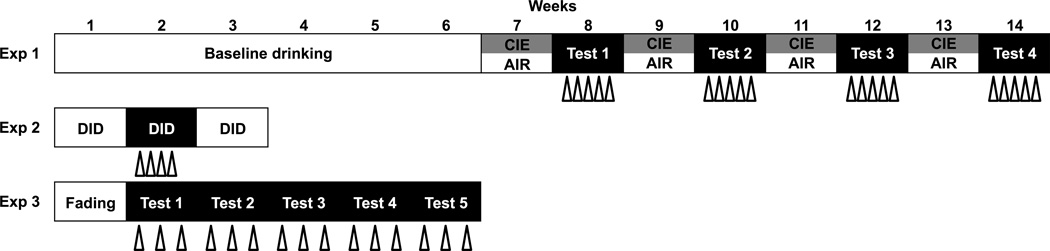
Fig. 1
Fig. 1. Procedure overview
Open triangles represent each 10-min exposure to forced swim stress (FSS) 4 hrs prior to ethanol access. In Experiment 1, once baseline drinking was established, alternating weeks of chronic intermittent ethanol (CIE) or air exposure and 5-day drinking tests occurred for a total of four cycles. FSS occurred prior to each daily drinking test session. In Experiment 2, the 4-day drinking-in-the-dark procedure was repeated for three cycles (baseline/stress/washout), with FSS prior to each drinking session during the second cycle only. In Experiment 3, ethanol concentration was gradually increased during a week of fading, followed by 6 weeks of either intermittent (24 hrs on Monday/Wednesday/Friday) or continuous access (24 hrs/7 days/week). FSS occurred prior to each Monday/Wednesday/Friday drinking session
Fig. 2
Fig. 2
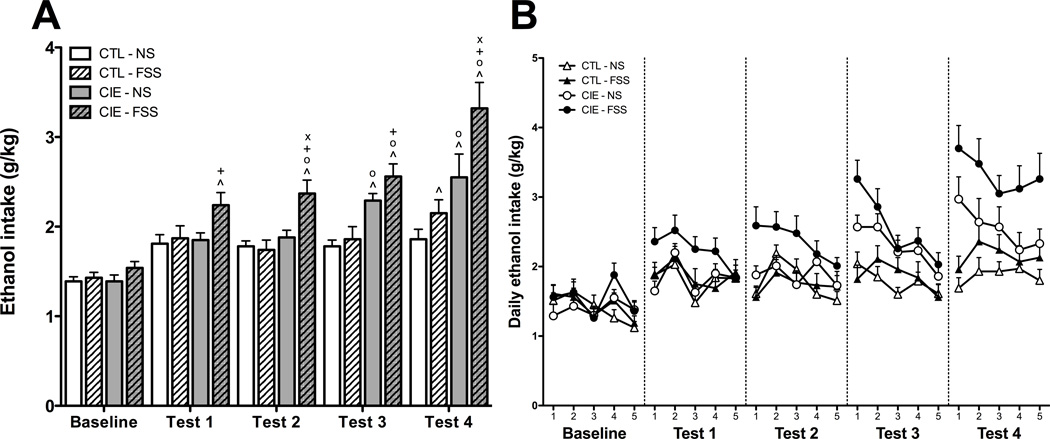
(A) Average weekly ethanol consumption. Increases relative to baseline ethanol consumption (indicated by ^) were observed during Test 4 for CTL-FSS mice (hatched white bars), Tests 3–4 for CIE-NS mice (gray bars), and Tests 1–4 for CIE-FSS mice (hatched gray bars). Elevated ethanol consumption relative to CTL-NS mice (white bars) was observed during Tests 3–4 for CIE-NS mice and Tests 2–4 for CIE-FSS mice (indicated by o). CIE-FSS also demonstrated greater ethanol intake than CTL-FSS mice during Tests 1–4 (indicated by +) and greater intake than CIE-NS mice during Tests 2 and 4 (indicated by x). Values shown are Means ± SEMs (B) Average daily ethanol consumption. During Test 2, CIE-FSS mice (black circles) drank more than all other groups. During Test 3, both CIE-NS (white circles) and CIE-FSS groups consumed more ethanol than CTL-NS (white triangles) and CTL-FSS (black triangles) mice. CIE-FSS mice consumed more ethanol than all other groups during Test 4. Additionally, CIE-NS mice consumed more ethanol than mice in the CTL-NS condition. No interactions of Group and Day were observed during any week of testing. Values shown are Means ± SEMs
Fig. 3
Fig. 3
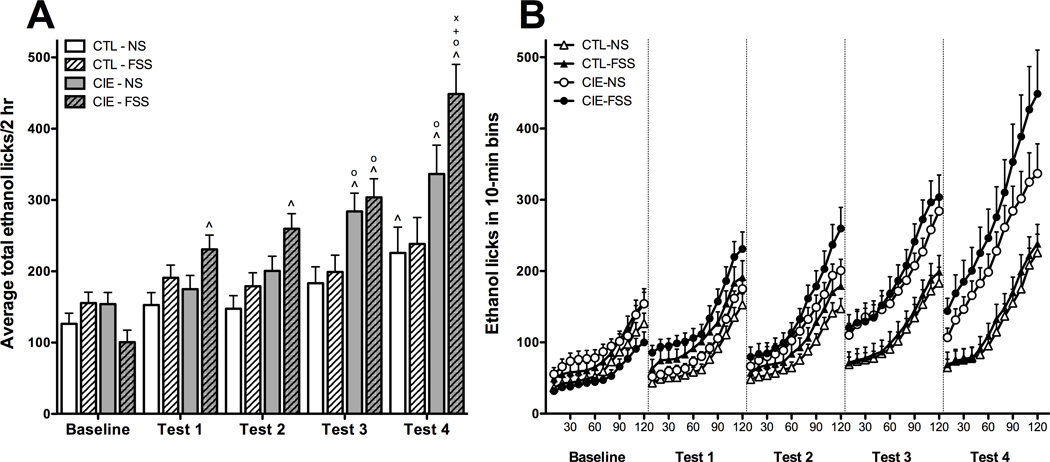
(A) Average total ethanol licks. Increases relative to baseline ethanol licks (indicated by ^) were observed during Test 4 for CTL-NS mice (white bars), Tests 3–4 for CIE-NS mice (gray bars), and Tests 1–4 for CIE-FSS mice (hatched gray bars). During Tests 3–4, both CIE-NS and CIE-FSS groups demonstrated greater ethanol lick responses than CTL-NS mice (indicated by o). The CIE-FSS group also had greater ethanol licks than both CTL-FSS mice (indicated by +) and CIE-NS mice (indicated by x) during Test 4. Values shown are Means ± SEMs (B) Average temporal distribution of ethanol licks in 10-min bins. Average weekly ethanol licks across the 2-hr drinking sessions are shown for CTL-NS (white triangles), CTL-FSS (black triangles), CIE-NS (white circles), and CIE-FSS (black circles) mice.
Fig. 4
Fig. 4
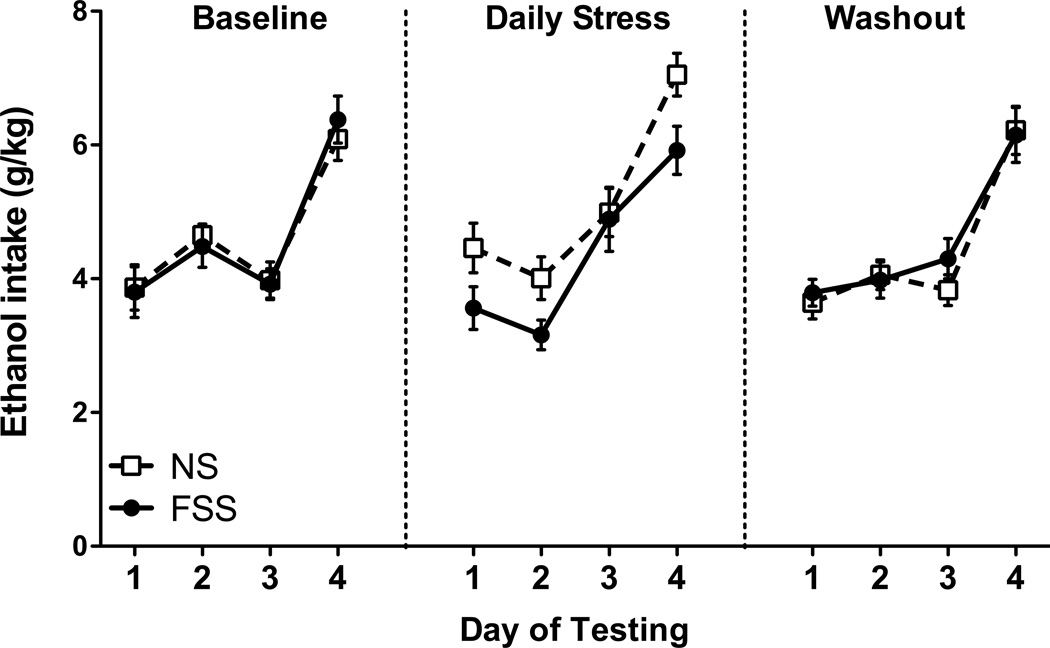
Average daily ethanol consumption. Forced swim stress (FSS; white squares) did not influence ethanol consumption relative to non-stressed mice (NS; black circles) during 2-hr (Days 1–3) or 4-hr (Day 4) drinking sessions in the drinking-in-the-dark paradigm. Values shown are Means ± SEMs
Fig. 5
Fig. 5
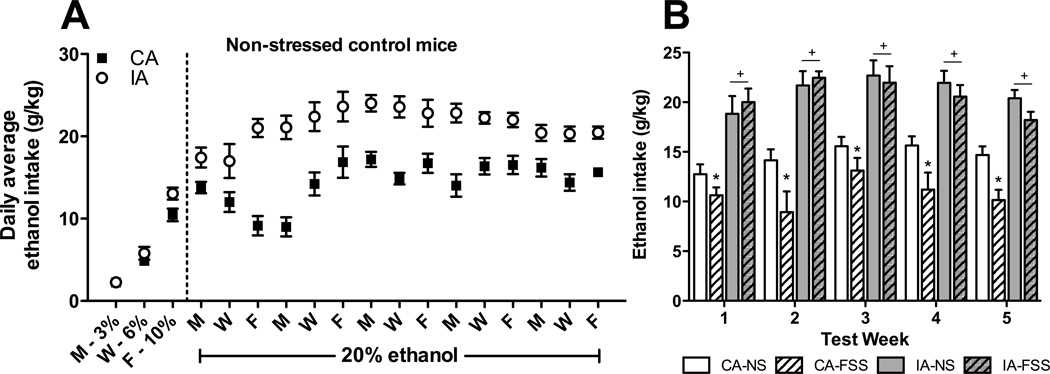
(A) Average daily ethanol consumption among non-stressed controls. Data are shown only for days during which both continuous (CA; black squares) and intermittent (IA; white circles) groups had access to ethanol. (B) Average weekly ethanol consumption during 24-hr intervals. Mice in the CA-FSS group (hatched white bars) had reduced ethanol consumption relative to CA-NS (white bars) during Tests 1–5 (indicated by *). IA-NS (gray bars) and IA-FSS (hatched gray bars) groups did not differ during any week of testing, although both groups consumed more ethanol than the CA groups during all 5 test weeks (indicated by +). Values shown are Means ± SEMs

References

    1. Bahi A. Increased anxiety, voluntary alcohol consumption and ethanol-induced place preference in mice following chronic psychosocial stress. Stress. 2013;16:441–451. - PubMed
    1. Becker HC. Effects of alcohol dependence and withdrawal on stress responsiveness and alcohol consumption. Alcohol Res. 2012;34:448–458. - PMC - PubMed
    1. Becker HC. Animal models of excessive alcohol consumption in rodents. Current topics in behavioral neurosciences. 2013;13:355–377. - PubMed
    1. Becker HC, Lopez MF, Doremus-Fitzwater TL. Effects of stress on alcohol drinking: a review of animal studies. Psychopharmacology (Berl) 2011;218:131–156. - PMC - PubMed
    1. Breese GR, Knapp DJ, Overstreet DH. Stress sensitization of ethanol withdrawal-induced reduction in social interaction: inhibition by CRF-1 and benzodiazepine receptor antagonists and a 5-HT1A-receptor agonist. Neuropsychopharmacology. 2004;29:470–482. - PMC - PubMed

Publication types

MeSH terms

LinkOut - more resources