Review
. 2016 Feb 19;11 Spec Iss(Spec Iss):21-30.
doi: 10.2147/COPD.S85978. eCollection 2016.

Exacerbations of COPD

Affiliations
Review

Exacerbations of COPD

Ian D Pavord et al. Int J Chron Obstruct Pulmon Dis. .

Abstract

Exacerbations of chronic obstructive pulmonary disease (COPD) are defined as sustained worsening of a patient's condition beyond normal day-to-day variations that is acute in onset, and that may also require a change in medication and/or hospitalization. Exacerbations have a significant and prolonged impact on health status and outcomes, and negative effects on pulmonary function. A significant proportion of exacerbations are unreported and therefore left untreated, leading to a poorer prognosis than those treated. COPD exacerbations are heterogeneous, and various phenotypes have been proposed which differ in biologic basis, prognosis, and response to therapy. Identification of biomarkers could enable phenotype-driven approaches for the management and prevention of exacerbations. For example, several biomarkers of inflammation can help to identify exacerbations most likely to respond to oral corticosteroids and antibiotics, and patients with a frequent exacerbator phenotype, for whom preventative treatment is appropriate. Reducing the frequency of exacerbations would have a beneficial impact on patient outcomes and prognosis. Preventative strategies include modification of risk factors, treatment of comorbid conditions, the use of bronchodilator therapy with long-acting β2-agonists or long-acting muscarinic antagonists, and inhaled corticosteroids. A better understanding of the mechanisms underlying COPD exacerbations will help to optimize use of the currently available and new interventions for preventing and treating exacerbations.

Keywords: COPD; biomarker; bronchodilator; exacerbation; phenotype.


Figures
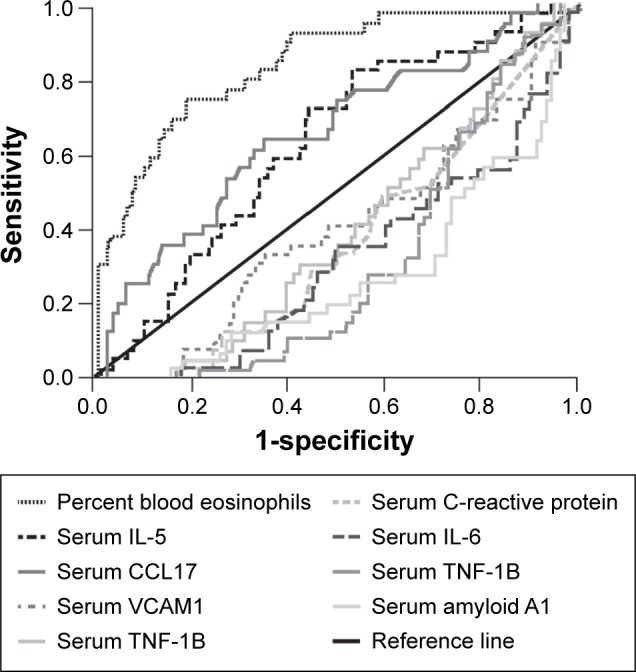
Figure 1
Figure 1
Receiver operating characteristic curve illustrating that blood eosinophils are a marker of sputum eosinophil-associated exacerbations. Note: Adapted with permission of the American Thoracic Society. Copyright © 2016 American Thoracic Society. Bafadhel M, McKenna S, Terry S, et al. 2011. Acute exacerbations of chronic obstructive pulmonary disease: identification of biologic clusters and their biomarkers. Am J Respir Crit Care Med. Volume 184(6), Pages 662–671. The American Journal of Respiratory and Critical Care Medicine is an official journal of the American Thoracic Society. Abbreviations: IL, interleukin; CCL, chemokine ligand; TNF, tumor necrosis factor; VCAM, vascular cell adhesion molecule.
Figure 2
Figure 2
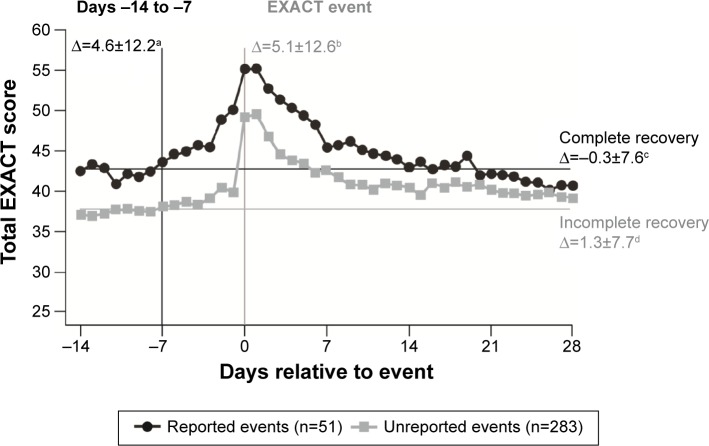
EXAcerbations of COPD Tool (EXACT) scores for reported (identified by health care resource utilization and by EXACT) and unreported (identified by EXACT only) exacerbations. Notes: aP=0.01; bP<0.01; cP=0.79; dP<0.01. Events presented are those with associated e-diary records for days −14 to −7. The ∆ values for days −14 to −7 and EXACT event represent EXACT + health care resource utilization vs EXACT only; the ∆ values for complete recovery for reported exacerbation and incomplete recovery for unreported exacerbations represent days 21 to 28 vs days −14 to −7.
Figure 3
Figure 3
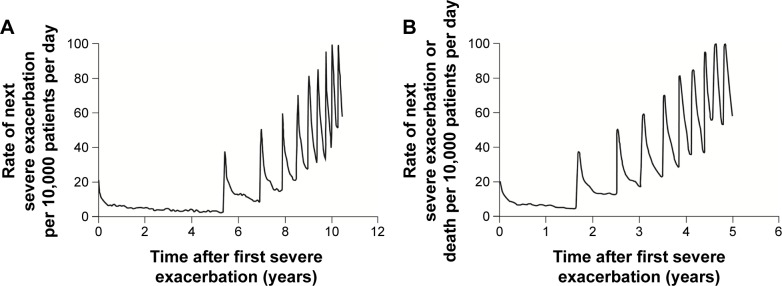
Natural history of COPD in a cohort of 73,106 patients after first hospitalization for a severe exacerbation, showing (A) rate of next severe exacerbation and (B) rate of next severe exacerbation or death per 10,000 patients per day. Notes: Time between successive events estimated using the median inter-exacerbation times conditional on survival with death as a competing risk (A), or the median inter-exacerbation times as time to next exacerbation or death, whichever occurred first. Reproduced from Thorax, Suissa S, Dell’Aniello S, Ernst P, Volume 67(11), pages 957–963, copyright 2012 with permission from BMJ Publishing Group Ltd.
Figure 4
Figure 4
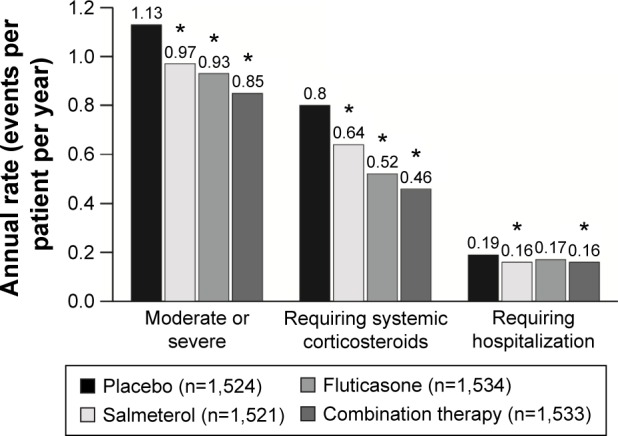
Annual rate of exacerbations, systemic corticosteroid prescriptions, and hospitalizations in a randomized, placebo-controlled trial of combination therapy with a long-acting β-agonist and inhaled corticosteroid in patients with COPD. Notes: *Significant difference vs placebo at the 0.05 significance level. From The New England Journal of Medicine, Calverley PM, Anderson JA, Celli B, et al, Salmeterol and fluticasone propionate and survival in chronic obstructive pulmonary disease, Volume 356(8), Pages 775–789. Copyright © 2007 Massachusetts Medical Society. Reprinted with permission from Massachusetts Medical Society.

References

    1. Jones PW, Lamarca R, Chuecos F, et al. Characterisation and impact of reported and unreported exacerbations: results from ATTAIN. Eur Respir J. 2014;44(5):1156–1165. - PubMed
    1. Spencer S, Jones PW. Time course of recovery of health status following an infective exacerbation of chronic bronchitis. Thorax. 2003;58(7):589–593. - PMC - PubMed
    1. Suissa S, Dell’Aniello S, Ernst P. Long-term natural history of chronic obstructive pulmonary disease: severe exacerbations and mortality. Thorax. 2012;67(11):957–963. - PMC - PubMed
    1. Celli BR, Thomas NE, Anderson JA, et al. Effect of pharmacotherapy on rate of decline of lung function in chronic obstructive pulmonary disease: results from the TORCH study. Am J Respir Crit Care Med. 2008;178(4):332–338. - PubMed
    1. Bafadhel M, McKenna S, Terry S, et al. Blood eosinophils to direct corticosteroid treatment of exacerbations of chronic obstructive pulmonary disease: a randomized placebo-controlled trial. Am J Respir Crit Care Med. 2012;186(1):48–55. - PMC - PubMed

MeSH terms