. 2016 Mar 1:13:10.
doi: 10.1186/s12983-016-0142-4. eCollection 2016.

Phylogenetic relationships of the New World titi monkeys (Callicebus): first appraisal of taxonomy based on molecular evidence

Affiliations

Phylogenetic relationships of the New World titi monkeys (Callicebus): first appraisal of taxonomy based on molecular evidence

Hazel Byrne et al. Front Zool. .

Abstract

Background: Titi monkeys, Callicebus, comprise the most species-rich primate genus-34 species are currently recognised, five of them described since 2005. The lack of molecular data for titi monkeys has meant that little is known of their phylogenetic relationships and divergence times. To clarify their evolutionary history, we assembled a large molecular dataset by sequencing 20 nuclear and two mitochondrial loci for 15 species, including representatives from all recognised species groups. Phylogenetic relationships were inferred using concatenated maximum likelihood and Bayesian analyses, allowing us to evaluate the current taxonomic hypothesis for the genus.

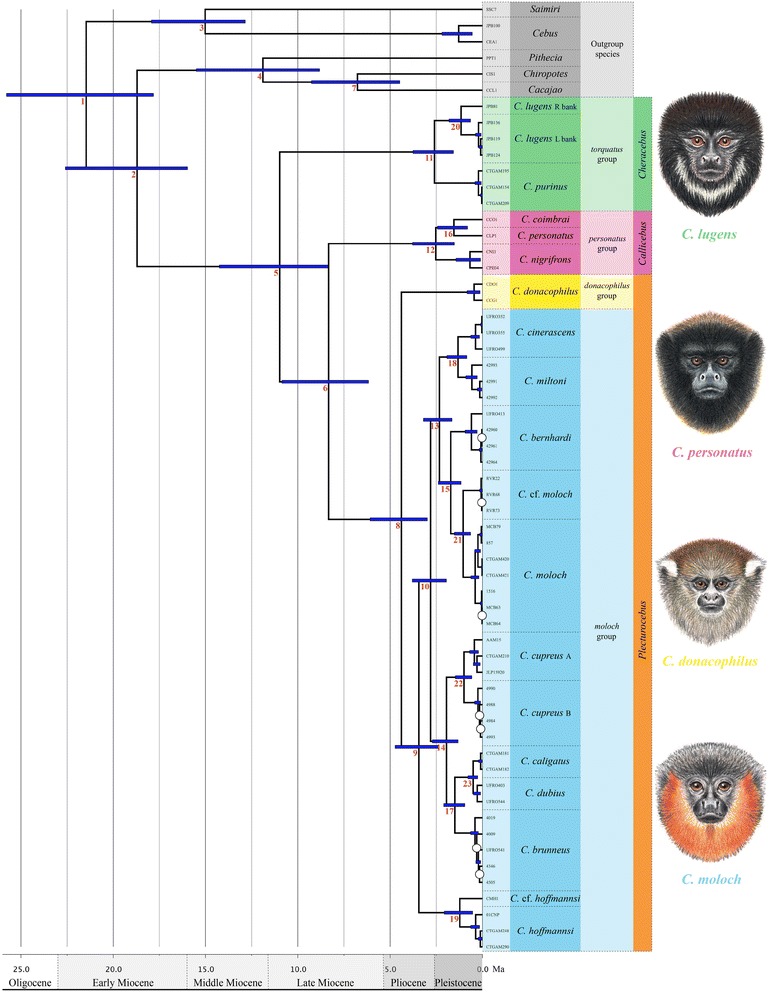
Results: Our results show four distinct Callicebus clades, for the most part concordant with the currently recognised morphological species-groups-the torquatus group, the personatus group, the donacophilus group, and the moloch group. The cupreus and moloch groups are not monophyletic, and all species of the formerly recognized cupreus group are reassigned to the moloch group. Two of the major divergence events are dated to the Miocene. The torquatus group, the oldest radiation, diverged c. 11 Ma; and the Atlantic forest personatus group split from the ancestor of all donacophilus and moloch species at 9-8 Ma. There is little molecular evidence for the separation of Callicebus caligatus and C. dubius, and we suggest that C. dubius should be considered a junior synonym of a polymorphic C. caligatus.

Conclusions: Considering molecular, morphological and biogeographic evidence, we propose a new genus level taxonomy for titi monkeys: Cheracebus n. gen. in the Orinoco, Negro and upper Amazon basins (torquatus group), Callicebus Thomas, 1903, in the Atlantic Forest (personatus group), and Plecturocebus n. gen. in the Amazon basin and Chaco region (donacophilus and moloch groups).

Keywords: Amazon; Atlantic forest; Callicebinae; Callicebus; Cheracebus; Genus-level taxonomy; Molecular phylogenetics; Platyrrhini; Plecturocebus; Titi monkey.


Figures
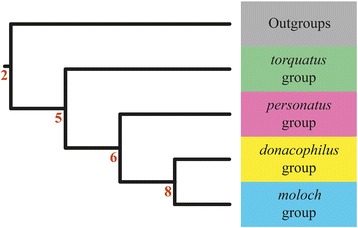
Fig. 1
Fig. 1
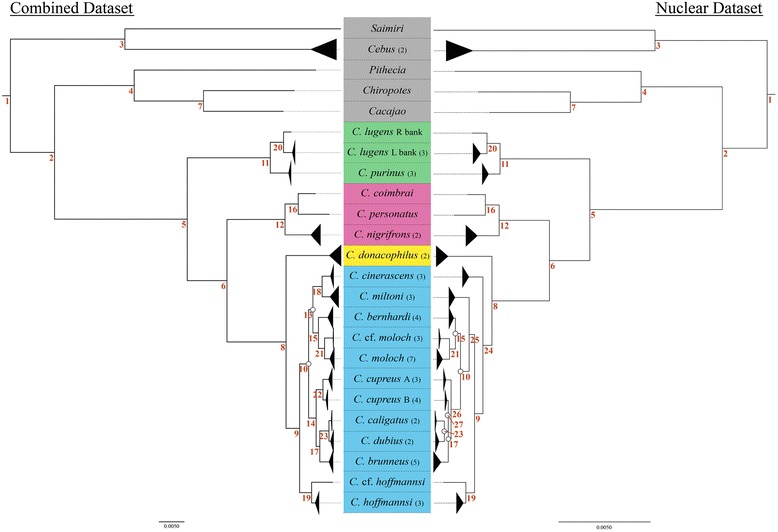
Phylogenetic reconstruction showing Callicebus species-group level topology found across all datasets. All nodes were significantly supported in all analyses (BP ≥ 70 % and PP ≥ 0.95). Node numbers correspond to those in Fig. 2, 3 and are listed with support values for all analyses in Additional file 1
Fig. 2
Fig. 2
Molecular phylogeny showing relationships among Callicebus taxa based on 53 Callicebus and 6 outgroup individuals. Shown are maximum likelihood trees inferred from the combined dataset (left) and the nuclear dataset (right), with branches collapsed to represent clades of interest. Numbers in parenthesis indicate the number of individuals represented in the collapsed clade. See Additional file 2 and 3 for the expanded ML (RAxML) and Bayesian (MrBayes, BEAST) trees with node support values. Unmarked nodes were significantly supported in all analyses (BP ≥ 70 % and PP ≥ 0.95), while nodes marked with white circles received low support (BP < 70 % and/or PP < 0.95). Red numbers represent nodes of interest listed with support values for all methods of analysis in Additional file 1. Background colours reflect species group; green for the torquatus group, pink for the personatus group, yellow for donacophilus group, blue for the moloch group; and grey indicates the outgroup species
Fig. 3
Fig. 3
A time-calibrated phylogeny showing estimated divergence ages among Callicebus individuals based on the combined dataset. Unmarked nodes were strongly supported (PP ≥ 0.99), while nodes marked with white circles received low support (PP < 0.95). Node bars indicate the 95 % highest posterior density. Red numbers represent nodes of interest listed with specific support values and estimated divergence times in Additional file 1. For trees with support values and estimated divergence times for all nodes see Additional file 2 (C) and 6, respectively. Nodes numbered 2 and 3 were used for calibration. A time scale in million years and the geological periods are given. Background colours reflect species-group; green for the torquatus group, pink for the personatus group, yellow for donacophilus group, blue for the moloch group; and grey indicates the outgroup species. Illustrations by Stephen D. Nash ©Conservation International
Fig. 4
Fig. 4
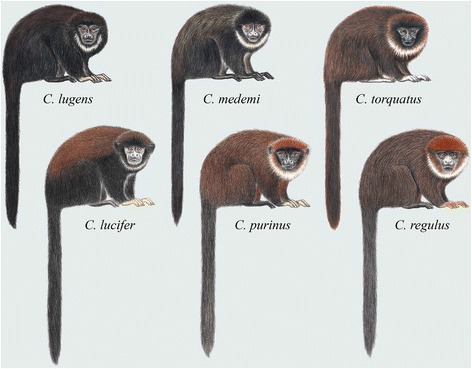
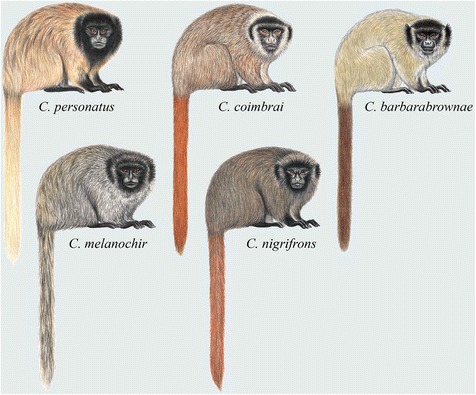
Titi monkeys, genus Cheracebus. Illustrations by Stephen D. Nash ©Conservation International
Fig. 5
Fig. 5
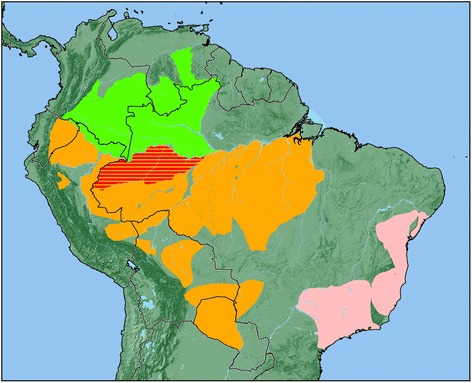
The geographic distribution of Cheracebus (green), Callicebus (pink) and Plecturocebus (orange). The area of sympatry between species of Cheracebus and Plecturocebus is shown in red
Fig. 6
Fig. 6
Titi monkeys, genus Callicebus. Illustrations by Stephen D. Nash ©Conservation International
Fig. 7
Fig. 7
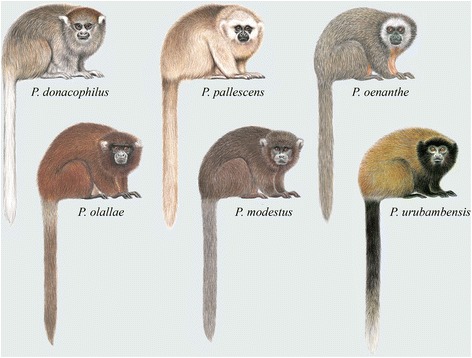
Titi monkeys, the donacophilus group of Plecturocebus. Illustrations by Stephen D. Nash ©Conservation International
Fig. 8
Fig. 8
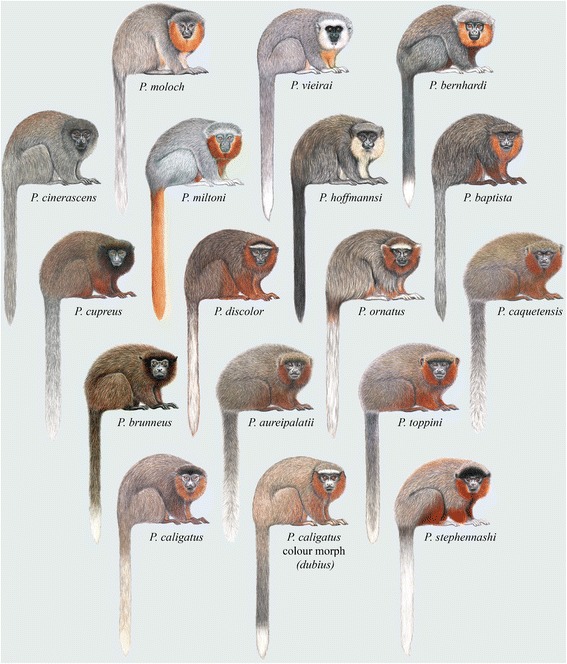
Titi monkeys, the moloch group of Plecturocebus. Illustrations by Stephen D. Nash ©Conservation International

References

    1. Perelman P, Johnson WE, Roos C, Seuánez HN, Horvath JE, Moreira MA, et al. A molecular phylogeny of living primates. PLoS Genet. 2011;7(3):e1001342. doi: 10.1371/journal.pgen.1001342. - DOI - PMC - PubMed
    1. Springer MS, Meredith RW, Gatesy J, Emerling CA, Park J, Rabosky DL, et al. Macroevolutionary dynamics and historical biogeography of primate diversification inferred from a species supermatrix. PLoS One. 2012;7(11):e49521. doi: 10.1371/journal.pone.0049521. - DOI - PMC - PubMed
    1. Schrago CG, Mello B, Soares AER. Combining fossil and molecular data to date the diversification of New World Primates. J Evol Biol. 2013;26(11):2438–2446. doi: 10.1111/jeb.12237. - DOI - PubMed
    1. Stallings JR, West L, Hahn W, Gamarra I. Primates and their relation to habitat in Paraguayan Chaco. In: Redford KH, Esienberg JF, editors. Advances in Neotropical mammalogy. Gainesville: The Sandhill Crane Press, Inc.; 1989. pp. 425–442.
    1. Titis HP. New World monkeys of the genus Callicebus (Cebidae, Platyrrhini): a preliminary taxonomic review. Fieldiana Zool New Ser. 1990;55:1–109.

LinkOut - more resources